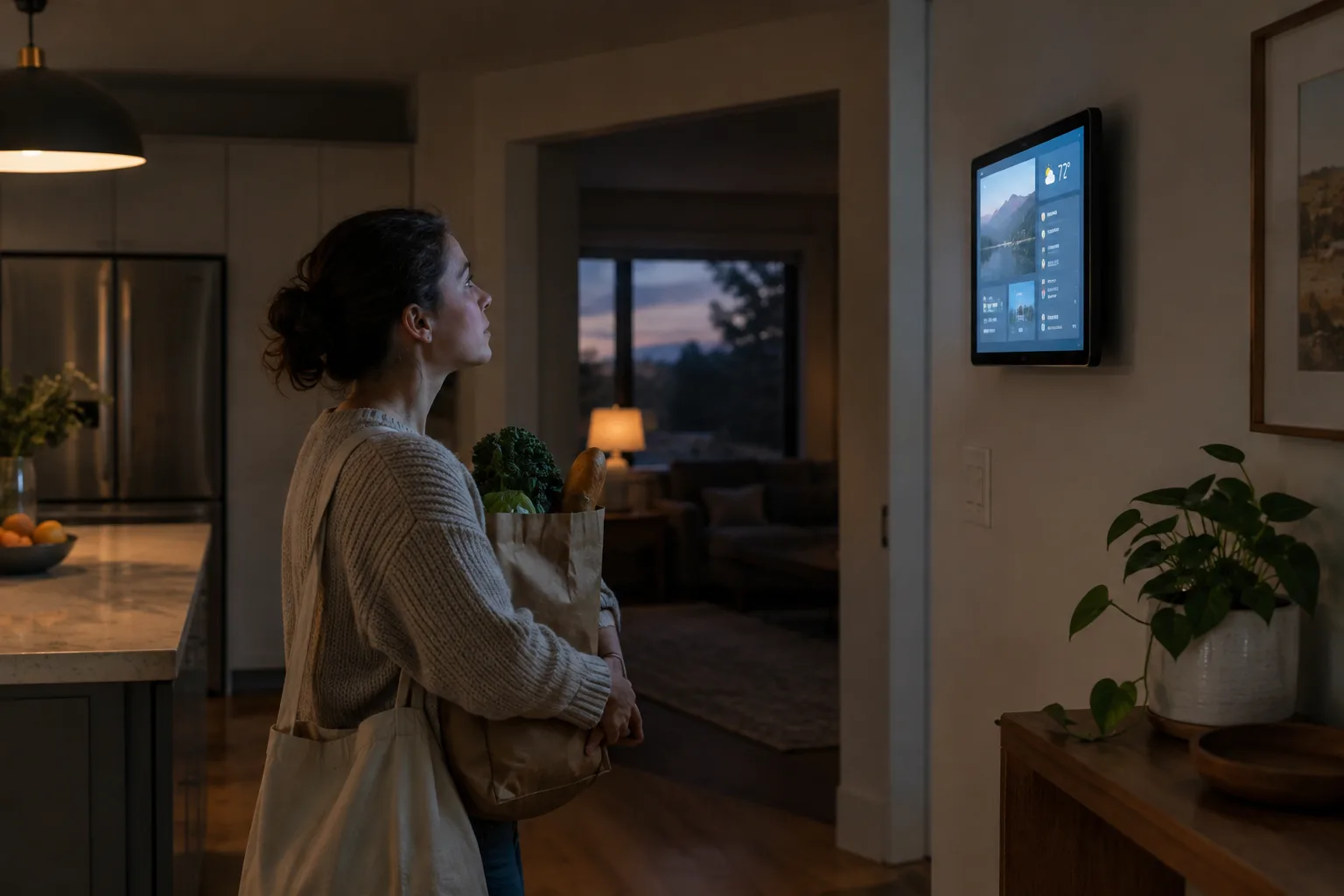

Apple is making its biggest visible smart-home push in years with HomeView, a 7-inch display-and-speaker it introduced on Oct. 13 as the center of a broader “Welcome Home” launch. Preorders opened the same day and availability begins Nov. 13 in eight markets including the U.S. and U.K.; the European Union is excluded at launch because Siri AI is not currently available in iOS there. The Verge reports a $299 U.S. price, putting HomeView squarely into the mainstream smart-display contest rather than the impulse-buy tier.
The real question is not whether Apple can make an attractive screen. It is whether Apple can turn that screen into a trustworthy household control plane — one that reliably handles cameras, locks, thermostats, and personal information in a shared room, without making the experience too dependent on an iPhone, a cloud service, and perfect Siri behavior.
What Apple is actually launching
HomeView is designed as a shared device first, not simply an iPad-like screen for the kitchen counter. It combines a 7-inch Liquid Retina display with a domed speaker base, comes in tabletop and wall-mounted forms, and supports four colors. Apple says adaptive brightness ranges from 500 nits down to 0.3 nits, which matters for a device meant to stay visible in living spaces all day and all night.
Its core pitch is that one screen can serve both the household and the individual. Apple says HomeView can recognize up to six users by face and show personal apps and widgets, FaceTime, Messages, Calendar, Reminders, Find My, photos, music, and household controls. It can also manage compatible lights, thermostats, locks, blinds, and cameras, including up to nine simultaneous camera feeds.
The accessory story is as important as the screen. Apple used the launch to refresh the HomePod mini and Apple TV 4K, and to introduce an Apple Home Collection of indoor, outdoor, and doorbell cameras, a lock, and thermostats developed with LG Electronics and Schneider Electric. Apple says those accessories support NFC setup and Matter or Works with Apple Home compatibility where specified. The new HomePod mini 2 is priced at $149, according to The Verge, and ships Oct. 30; the new Apple TV 4K is $299, includes four far-field microphones, and ships Nov. 13. Apple is clearly trying to sell a coordinated home stack, not a single gadget.
Apple’s bet: make the home another Apple Intelligence surface
The mechanism behind HomeView is straightforward. A fixed screen changes the role of the home app from something you open occasionally on a phone to something that is always present, always visible, and available to everyone in the house. That matters because the smart home’s biggest practical problem has never been a lack of accessories. It has been friction: too many apps, too many setup flows, too many moments when nobody nearby has the right phone in hand.
Apple’s answer is identity-aware sharing. The company says personal content appears only when an enrolled user is recognized and a paired iPhone or iPad is present and recently unlocked. Siri AI is the software differentiator layered on top. Apple says it can answer broad questions, understand onscreen context, and, when paired with an Apple Intelligence-enabled iPhone or iPad, use personal context from apps such as Calendar and Messages. Conversations can continue across HomeView, iPhone, iPad, Mac, Apple Watch, and Vision Pro through iCloud.
That combination helps explain why Apple is pushing this now. The home gives Apple Intelligence a more persistent role in daily life than a phone-only assistant can manage. A screen by the door, in the kitchen, or on a wall can become a place where reminders, package alerts, camera views, lock status, and messages all meet. If that works, HomeView is not just a new device category for Apple; it is a retention layer for iPhone, iCloud+, Apple Music, and whatever home services the company adds next.
Apple is also leaning hard on privacy architecture as a selling point. It says HomeView uses an A18 chip and Secure Exclaves that isolate camera and microphone processing, while Siri requests can run on device or through Private Cloud Compute. That is a meaningful design choice in a product meant to sit in one of the most sensitive places people own. But it is still a design claim until real-world use and independent testing show how the system behaves under stress.
The hard part is household trust, not industrial design
This is where the product’s promise meets the smart home’s least glamorous reality. Shared devices are messy. Families have guests, children, mixed phone platforms, changing permissions, bad lighting, lost phones, spotty Wi-Fi, and moments when nobody remembers who set up the automation in the first place.
Apple has not disclosed the failure rate of HomeView’s face recognition across lighting conditions, ages, or shared spaces. It has not published independent security testing of its Secure Exclaves, household authorization model, or camera and microphone behavior. It also has not clearly spelled out which HomeView functions work without an iPhone, which require an Apple Intelligence-enabled iPhone or iPad, which depend on iCloud+, or what daily usage limits apply to server-side Apple Intelligence features.
Those are not minor technicalities. They determine whether HomeView behaves like an appliance or like a dependent terminal. If the internet goes down, if Siri is unavailable, if the paired phone is not nearby, or if an iCloud+ subscription lapses, buyers will want to know exactly what still works. For a music screen or photo frame, ambiguity is tolerable. For front-door locks, doorbell cameras, and messages on a shared wall display, it is the product.
The EU launch gap sharpens that point. Apple says the exclusion is because Siri AI is not currently available in iOS there, but the commercial implication is broader: hardware availability is being shaped by AI feature readiness. That gives Amazon, Google, and local smart-home vendors more room in a major market and raises a practical question everywhere else. Is HomeView valuable because it is a good home controller on its own, or because it is a delivery vehicle for a Siri layer that remains region-, device-, and usage-dependent?
Why this matters beyond one screen
Apple has had the Home app since 2016 and HomePod since 2018, yet it never became the default smart-home platform. Amazon and Google built stronger positions through Echo, Ring, Nest, and sheer installed presence. HomeView is Apple’s clearest attempt to change that by making the home feel less like a bundle of accessories and more like a single operating surface.
If it works, the effects extend well beyond consumers. Accessory vendors get a stronger reason to prioritize Apple Home and Matter integrations. Installers get a simpler premium pitch built around a common setup flow, a common control surface, and Apple’s privacy brand. Investors get a new way to think about the home: not as a side market, but as another daily layer of ecosystem lock-in.
If it does not work, the reasons will probably be familiar. Mixed iOS and Android households may decide Apple’s permissions and personalization model is too uneven. Matter device makers may still need to support several ecosystems because feature parity is incomplete. Buyers may look at the full stack — HomeView, iCloud+, cameras, lock, thermostats, installation, and replacement — and conclude that cheaper or more interoperable hubs remain the safer choice.
That is why the first serious test for HomeView is not its demo polish. It is mundane resilience: what happens when the recognized face is wrong, the phone is upstairs, the Wi-Fi is down, the cloud tier expires, or a family member uses Android. If Apple can answer those questions better than its rivals, HomeView could become the missing hardware anchor for Apple Home. If not, it risks becoming an elegant new screen attached to the same old smart-home compromises.

 By
By
 By
By
 By
By
 By
By
 By
By

 By
By