
Science Corporation says the first patient with Stargardt disease received its PRIMA retinal implant in May at Sydney Eye Hospital in Australia, an important step in testing whether a retinal prosthesis built for one kind of blindness can travel into another. In an Oct. 13 video update from Science, the company said the patient saw a letter during the first rehabilitation session and read a word during the second.
That matters because PRIMA was previously known mainly for geographic atrophy caused by age-related macular degeneration. What happened this week is not a treatment approval and not proof that PRIMA works for Stargardt patients as a group. It is a first-in-disease clinical milestone that opens a more consequential question: can this become a repeatable platform for inherited retinal blindness, or is it only an encouraging one-patient feasibility signal?
What this first implant actually shows
The narrow claim is still meaningful. Science and its Sydney collaborators have now taken the same basic implant, surgery, and rehabilitation process into an inherited retinal-disease trial. Operationally, that means the hardware could be implanted in a Stargardt patient and produced an observed visual response during early rehab.
The study behind the update, PRIMAlia, is registered as NCT07266584 and is still recruiting. It is an exploratory trial at one Sydney site with an estimated enrollment of five adults, estimated primary completion in March 2029, and full study completion in March 2031. The target population includes inherited retinal degeneration such as Stargardt disease and retinitis pigmentosa.
That scale is enough to surface feasibility questions: whether surgery is workable in this population, whether the implant produces a usable signal, whether rehabilitation can translate that signal into a visual task, and whether any obvious safety issues emerge. It is nowhere near enough to answer the question patients and clinicians ultimately care about, which is whether the device delivers reliable, durable, useful benefit across a broader group.
Science has not disclosed the implanted patient’s age, genotype, baseline visual acuity, disease severity, visual field, rehabilitation schedule, or whether the reported letter and word observations map to a prespecified trial endpoint. It has not reported additional implanted patients, comparative outcomes, or peer-reviewed Stargardt data. So the headline result is best read as a proof of operational extension into a new disease, not as a clinical verdict.
Why Stargardt is a serious test of the platform idea
Stargardt disease is an inherited retinal disorder that progressively damages central vision, often earlier in life than age-related macular degeneration. Science says about 150,000 people worldwide have lost vision because of the disease. The business and clinical appeal is obvious: if one prosthetic approach can work across both age-related and inherited retinal degeneration, the addressable population expands and the case for specialized implant-and-rehab centers gets stronger.
The biological logic is plausible, but it is not automatic. Stargardt and geographic atrophy have different causes, timelines, and patient profiles. The bet behind PRIMAlia is that both conditions can leave enough inner retinal circuitry intact for electrical stimulation to be useful even after photoreceptors are damaged. The University of Sydney has described the trial as partial vision restoration through electrical stimulation of the retina.
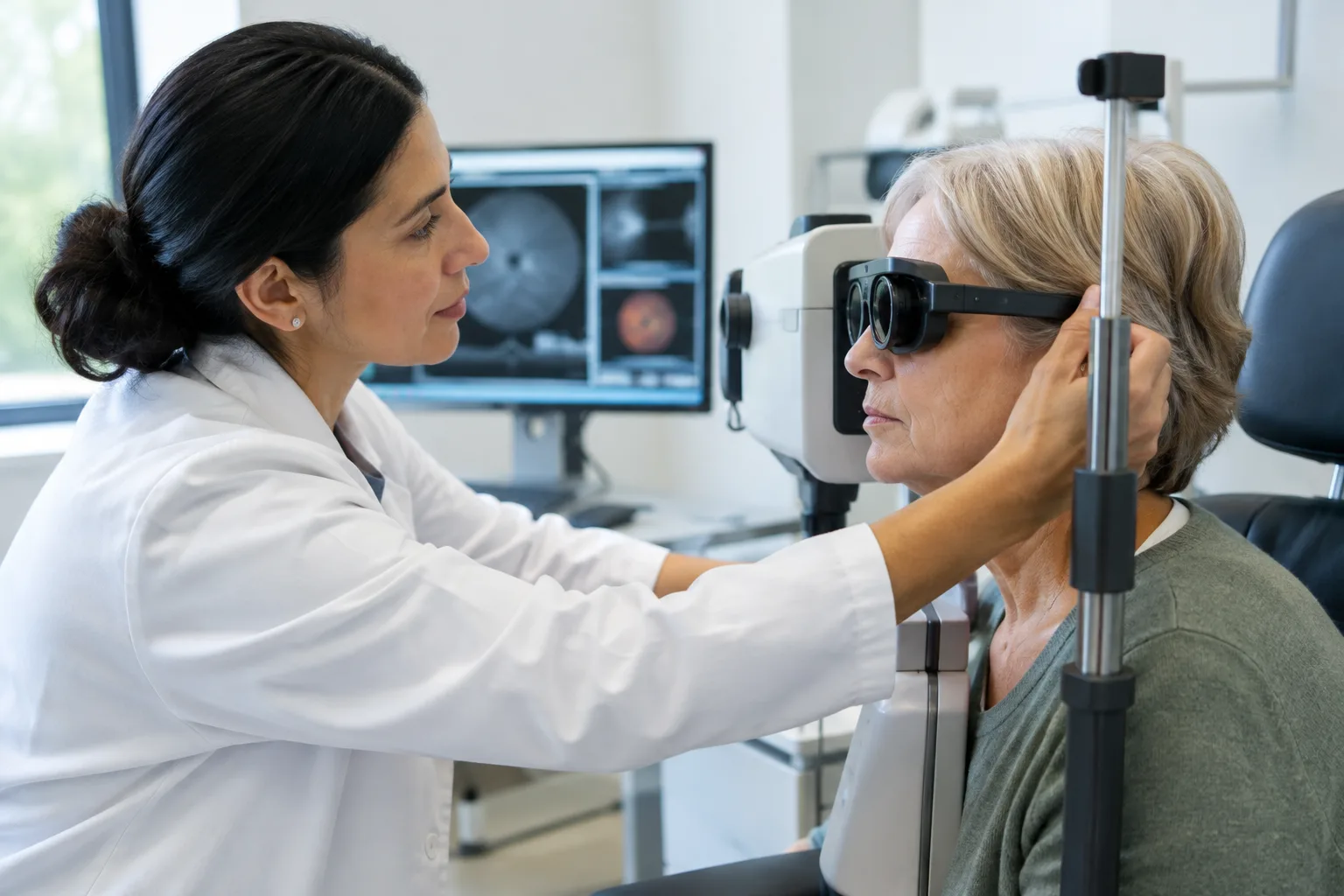
PRIMA’s mechanism is central to that bet. The system combines a small, battery-less, wireless subretinal implant with glasses that include a front-facing camera, a processor, and an eye-facing projector. The projector sends patterned near-infrared light carrying both visual information and power to the implant. The implant, which Science describes as having 378 light-powered pixels and measuring 2 millimeters by 2 millimeters by 30 micrometers, converts that light into electrical signals that stimulate surviving retinal cells, which then send signals through the optic nerve to the brain.
If that same architecture can support limited form vision in inherited disease, PRIMA starts to look less like a single-indication device and more like a platform. If it cannot, Stargardt may reveal the practical limits of disease selection, residual retinal anatomy, timing of implantation, or the amount of rehabilitation needed to turn signal into function.
The evidence ladder to watch now
Science does have prior evidence for PRIMA, but mostly in a different indication. The company says its pivotal PRIMAvera study implanted 38 patients across 17 European sites for geographic atrophy due to age-related macular degeneration. In an Oct. 5 company update, Science reported 36-month data from 27 patients evaluable for safety and 18 for efficacy: an average 29-letter improvement on the ETDRS chart among the efficacy group, 14 of 18 patients reaching at least a 15-letter improvement, and no new safety signal between months 12 and 36. Earlier PRIMA results were also published in the *New England Journal of Medicine*.
Those data support the platform’s existing clinical rationale. They do not answer the Stargardt question. Different disease biology, different ages of onset, different retinal anatomy, and a much smaller inherited-disease trial all matter. A strong result in geographic atrophy is useful context; it is not a proxy outcome for Stargardt.
Regulatory status also needs careful reading. Science says PRIMA is CE marked in the European Union and registered for supply in the United Kingdom for geographic atrophy due to age-related macular degeneration. It is not FDA approved or cleared, and it is not available for sale outside Europe and the U.K. In Australia, the device remains investigational for pre-market clinical investigation and is not registered for commercial use. Science also says the FDA granted Humanitarian Use Device designation for advanced geographic atrophy and Stargardt disease in spring 2026, but that is an expedited-pathway tool, not marketing authorization.
For clinicians, patients, investors, and payers, the next milestones are not subtle. They include additional implants in PRIMAlia, clearer reporting on safety and surgical complications, prespecified visual-acuity and reading outcomes, durability at 12, 24, and 36 months, and peer-reviewed results. The field also needs to know how performance varies by genotype and retinal condition, how much residual circuitry is enough, and whether patients can use the system in daily life rather than only in a controlled rehabilitation setting.
The commercial question sits just behind the clinical one. A platform that spans age-related and inherited retinal disease could justify larger manufacturing runs for microfabricated implants, specialized glasses and processors, surgeon training, and dedicated rehabilitation workflows. But rare-disease populations are geographically scattered, expert centers are limited, reimbursement is unresolved, and success may depend on careful patient selection rather than broad deployment.
So the cleanest reading of Science’s update is also the most useful one. PRIMA has now crossed into Stargardt disease in a human trial and produced an early, observed visual response. That is a real milestone. Whether it becomes a repeatable medical platform for inherited blindness is a question the company has only just begun to test.

 By
By
 By
By
 By
By
 By
By
 By
By

 By
By