
Bedrock Robotics has raised a $600 million Series C at a $4.1 billion post-money valuation, a large financing attached to a more important operational claim: its autonomous excavators have moved from pilots into paid work on live U.S. commercial construction sites.
The round, announced Oct. 26 by Bedrock, was co-led by CapitalG and Emergence Capital, with new investors including US Innovative Technology Fund, Bessemer Venture Partners, and Temasek. Bedrock says total funding is now nearly $1 billion and that the new capital will expand deployments, maintenance, and safety infrastructure across U.S. commercial sites.
That matters because construction has not lacked robotics demos; it has lacked repeatable field operations. Bedrock is trying to prove that “physical AI” can become a dependable input for contractors dealing with equipment-operator shortages and rising demand for sitework tied to factories, data centers, water systems, transportation, and housing. The real question is not whether an excavator can dig autonomously under controlled conditions. It is whether autonomy can keep working, safely and profitably, across messy, changing job sites.
From pilot footage to paid dirt moving
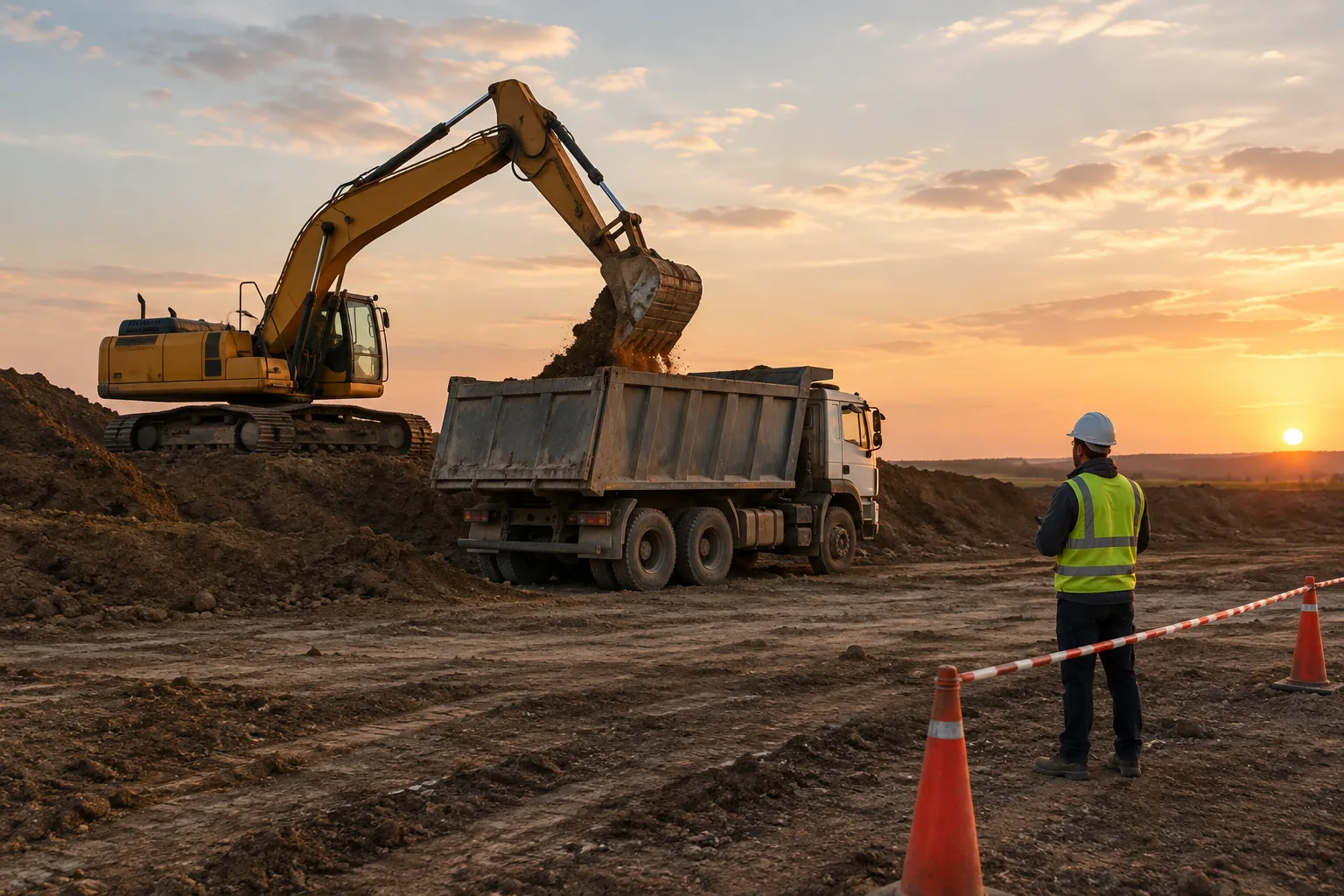
Bedrock says the turning point came in mid-August, when fully autonomous excavators began performing paid work on live commercial job sites. That is the key milestone in this announcement: somebody is paying for the work, not just evaluating the software.
According to TechCrunch, Bedrock machines are operating at a Nevada water-treatment facility, a Texas earthwork site run by Champion Site Prep, and a 1.2 million-cubic-yard civil sitework project with Zachry Construction. Bedrock also says customer volume has more than doubled since 2025 and names Haydon as its latest announced partner, with plans to use Bedrock-equipped machines on advanced manufacturing, transportation, water and wastewater, data-center, and healthcare projects.
Those are meaningful signs of commercial traction, but they are not yet the same thing as broad market proof. Three named site examples show that autonomous excavation can leave the lab. They do not show that the system performs equally well in dense urban work, winter weather, unfamiliar soil, trench-heavy jobs, or congested sites where multiple subcontractors and machines interact all day.
That distinction matters more in construction than in many software markets. Sites change daily. Terrain is irregular. Utilities, weather, incomplete plans, and moving crews all reshape risk. Excavators also do many different jobs—digging, trenching, grading, loading, and material handling—so strong performance in one earthmoving workflow does not automatically generalize to the rest.
Why the retrofit model is the strategic bet
Bedrock’s product is not a new fleet of purpose-built robot machines. It is a retrofit autonomy kit for existing heavy equipment. The company’s Operator model uses machine learning and sensors to let an excavator work without an operator in the cab, while human-driven trucks, field supervisors, safety systems, and support personnel remain part of the workflow.
That choice fits how construction actually buys equipment. Contractors run mixed fleets and may not want to wait for original equipment manufacturers to redesign machines around autonomy. A reversible retrofit, if it works as described, could let firms keep using existing assets while adding a new software-and-service layer.
Bessemer, which joined the round, says it observed two CAT 352 excavators moving earth without people in the cabs while loading a human-driven dump truck governed by a safety system. The firm also says the retrofit can be installed in a couple of hours, without permanent machine modifications, and reversed later. Even if that proves directionally right, it should be read as an investor description of what it saw, not as a universal benchmark across fleet ages, machine brands, attachments, or site conditions.
Still, the retrofit approach is central to why investors are interested. It lowers the burden of waiting for a fully autonomous machine lineup to emerge from equipment makers. It also creates a business that depends less on selling iron and more on installation, calibration, software updates, telemetry, remote support, and field service.
That is where the story shifts from machine intelligence to operating discipline. A retrofit autonomy company has to do more than make a model work. It has to show up on site, keep systems calibrated, maintain safety envelopes as conditions change, train crews, handle breakdowns, and decide who is responsible when a machine damages a utility or delays a job.
The harder test is economics, not the demo
The labor-shortage pitch behind Bedrock is plausible. TechCrunch cites an Associated Builders and Contractors estimate that more than 40% of construction workers will retire in the next five years. In that environment, an autonomous excavator does not need to eliminate jobs to create value. It may help cover repetitive mass excavation, reduce fatigue, let skilled operators supervise more equipment, or allow contractors to bid work they would otherwise decline.
But that still leaves the business case unproven in public.
Bedrock’s announcement does not disclose revenue, contract values, fleet size, autonomous machine-hours, intervention rates, injury or incident rates, insurance terms, pricing, or customer payback. Public reporting also does not establish whether customers buy the retrofit outright, pay per machine-hour, subscribe to the service, or share in productivity gains. Nor does it show cycle-time comparisons against strong human operators, changes in fuel or maintenance cost, or project-level margin improvement.
Those are not side questions. They are the scorecard that will decide whether autonomous excavation becomes infrastructure or stays an expensive specialty layer.
For contractors, the key measures are straightforward: how many autonomous hours a machine can deliver per shift, how often humans must intervene, whether uptime holds in bad conditions, whether the machine keeps cycle times competitive, how insurers treat the risk, and how quickly the retrofit pays back. For Bedrock, the test is whether it can turn a highly managed field deployment into a repeatable service business without drowning in support costs.
That is why this financing is significant but not self-validating. A $4.1 billion valuation says investors believe there is a large market if Bedrock can scale field operations. It does not prove durable demand, attractive unit economics, or superior safety outcomes. The $600 million round is best read as fuel for the expensive middle stage of physical AI: integration, onboarding, maintenance, safety cases, and commercial support.
If Bedrock succeeds, the company may help redefine what autonomy means in construction—not unattended robots replacing crews, but software that turns existing machines into more productive, more schedulable equipment inside a human-managed job site. If it fails, the likely reason will not be that excavators could never dig autonomously. It will be that reliable service, safety governance, and payback across real sites proved harder to scale than the autonomy demo itself.

 By

 By

 By

 By


 By

 By