
Agility Robotics began trading on Nasdaq on November 5 under the ticker AGLT, a milestone the company says makes it the first U.S.-listed pure-play humanoid robotics company. The listing matters less as a symbolic win for robotics than as a change in what the market can demand next: not better demos, but clearer evidence that warehouse pilots can become a durable operating business.
That is the real question now facing Agility, industrial buyers and public investors. A public listing can make a category more investable by forcing disclosure and discipline. It can also expose how far a promising technology still is from repeatable revenue, manageable cash burn and positive unit economics.
Agility enters the market with fresh capital and a large headline order figure. The company says its business combination with Churchill Capital Corp. XI and related financings brought in about $465 million in gross capital before transaction expenses, including roughly $164.1 million from Churchill’s trust account, $201 million from a PIPE led by Foxconn and $100 million of equity financing received before closing. But the structure of that financing also shows why the debut should be read carefully. In a Form 8-K, Churchill disclosed that 25,451,804 Class A shares, about 61.5% of shares outstanding at the redemption deadline, were redeemed, taking roughly $261.8 million out of the SPAC trust account.
That leaves Agility with meaningful new capital, but not with proof that the market has settled the commercial case for humanoids. It has simply funded the next stage of the argument.
The listing changes the burden of proof
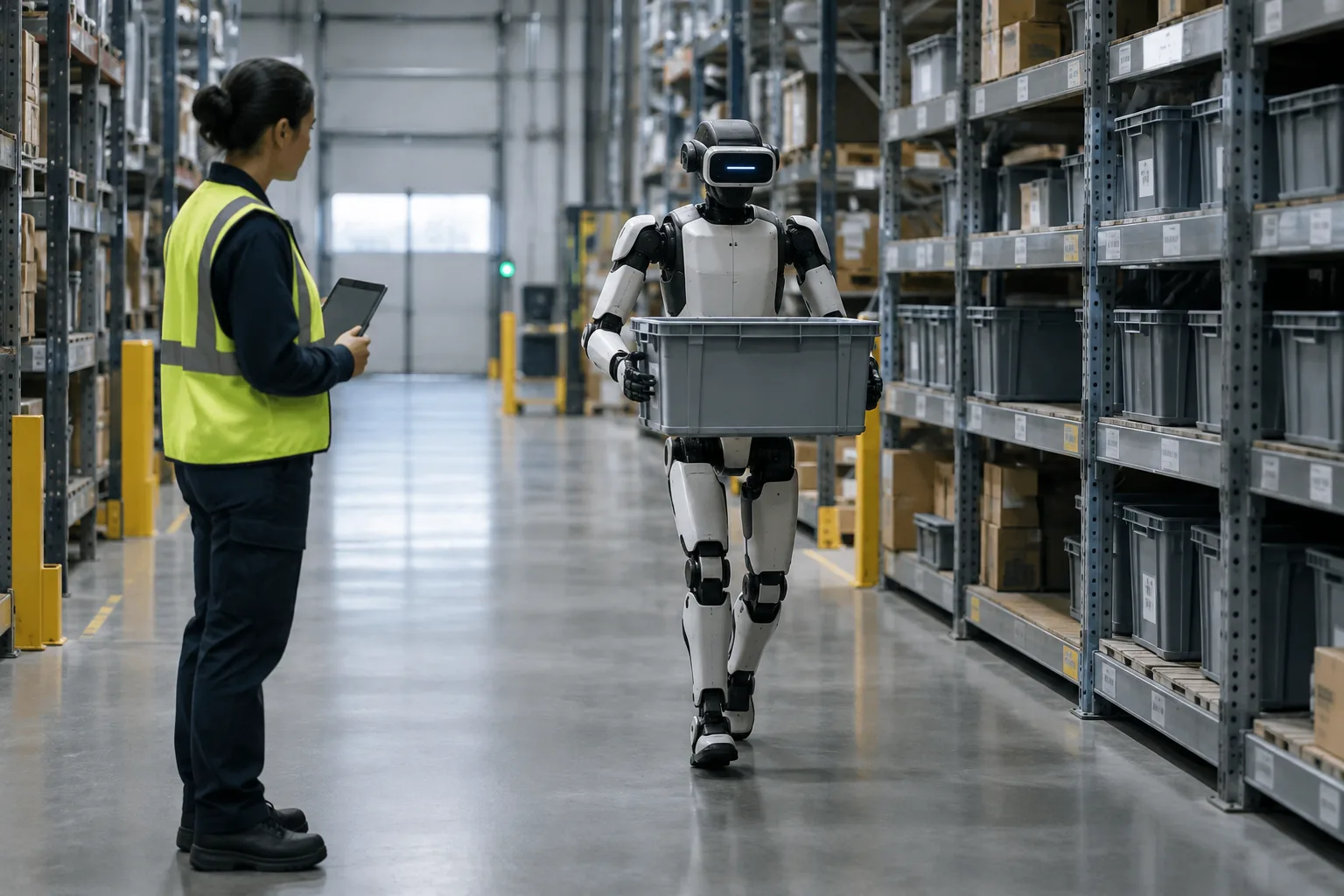
Agility’s pitch is more grounded than the broad consumer-robot fantasies that often surround humanoids. Its Digit platform is aimed at industrial and logistics work such as tote movement, lifting, parts handling and inspection. That focus matters because the value proposition is easier to test in warehouses and factories than in homes: employers know what a hard-to-staff shift costs, how much throughput they need and how much downtime they can tolerate.
The appeal is straightforward. A humanoid that can work safely around people, use existing spaces and avoid a costly facility redesign could be valuable in places where fixed automation is too rigid or labor is too hard to recruit. But once a company is public, the useful questions get more specific. How many productive hours does each robot deliver? How often does a human intervene? What does charging, maintenance and recovery from failure cost? Are customers paying for robot availability, for completed work or for a pilot that may never scale?
Those questions matter more than the broad claim that humanoid robotics is a big market. Public investors now have a listed operating company to measure, and industrial customers have a more transparent benchmark for deciding whether pilots are maturing into tools they can budget around.
The order book is a signal, not the answer
Agility’s own headline number is that it has more than $300 million in committed multi-year orders for its next-generation Digit 5 robot. That is substantial interest, but the company also says those commitments depend on contractual milestones, product features and specifications. Early customer access is expected in the first half of 2027, with general availability by the end of 2027.
That makes the order figure important, but not decisive. Public materials do not identify the customers behind those commitments, the number of robots involved, delivery schedules, pricing, cancellation rights, expected margins or how much of that total becomes revenue only after milestones are met. In other words, the figure describes demand potential, not delivered economics.
Independent reporting adds useful contrast. TechCrunch reported that Agility had about $174,000 in revenue in the first six months of 2026 and lost $362 million in the same period. Those numbers sit far from the company’s future order narrative, but that is exactly why the listing matters: the gap between interest and income is now central to the story.
The same report offers reasons not to dismiss Agility as merely conceptual. Digit robots have reportedly been deployed with nine industrial customers, and the machines have moved more than 100,000 totes at a GXO logistics facility. Agility has also said customers include GXO, Schaeffler, Toyota Motor Manufacturing Canada and Mercado Libre. That is more tangible than a lab demo. It suggests real work is happening in real facilities.
Still, the cost and complexity of getting from proof of concept to fleet deployment look high. TechCrunch reported that a prospective customer proof of concept can cost $500,000. If that is the price of proving a use case, then sales, engineering and support become part of the commercialization challenge, not just manufacturing. A robot may be technically impressive and still be too expensive to validate, deploy and maintain at scale.
What the public market should watch next
For now, Agility’s Nasdaq debut makes humanoid robotics more scrutinizable than investable in the conventional sense. Investors can finally track a scorecard that private peers do not have to reveal: orders converted into delivered units, revenue per deployed robot, customer renewals, expansion beyond pilot sites and how quickly the company turns operating data into lower service costs.
The most revealing numbers may not be glamorous ones. Agility says RoboFab is designed for annual production capacity of up to 10,000 robots, but designed capacity is not the same as actual output, and factory capacity alone will not decide the business. The harder bottlenecks may be uptime, field service, charging routines, safety validation and how much human supervision a deployment still needs.
Some of the early operating signals are encouraging but narrow. TechCrunch reported a 98% pick-and-place accuracy rate and 65,000 hours of operational data collected from customer facilities. Those data points suggest learning in live environments. They do not yet answer whether Digit can sustain acceptable throughput across sites, shifts and tasks with low intervention.
That is why the listing should be read as a public operating test, not as confirmation that humanoids have arrived. If Agility can show that pilot customers convert into repeat buyers, that robots stay productive through a full industrial schedule and that service economics improve as deployments grow, then AGLT could become the first clean public benchmark for the category. If it cannot, public disclosure will do something equally valuable: show where the commercial limits still are.
Either way, the Nasdaq debut changes the conversation. Humanoid robotics no longer has to be judged mainly by private capital rounds and staged demonstrations. At least in Agility’s case, it can now be judged by whether a warehouse robot becomes a business.
 By

 By


 By



 By