
WindBorne Systems has landed a sole-source U.S. Air Force contract with a ceiling of $48.727 million to supply atmospheric data from its autonomous weather balloons, giving the Redwood City startup one of the clearest endorsements yet for the idea that weather observations can be sold as infrastructure. The practical significance is less flashy: the Air Force has initially obligated about $1.7 million, not $48.7 million, so the real business test starts after the headline.
The question readers should ask is simple. Does this award put WindBorne on a path to repeatable, utility-like data revenue, or does it mostly show that the Pentagon likes having the option to order from a specialized supplier? For investors, weather businesses and industries that depend on forecasts, that distinction matters more than the ceiling value.
What the Air Force actually bought
According to the official contract announcement, the award was made on Sept. 29 as a firm-fixed-price, indefinite-delivery/indefinite-quantity contract running through Sept. 30, 2033. The Air Force can order continuous, global and targeted atmospheric vertical profiles from the surface to the stratosphere to support forecasting and mission planning.
That means the military did not buy WindBorne’s balloons. It bought the right to order data when and where it needs it. IDIQ contracts are built for flexibility, and that flexibility is exactly why the topline number can mislead. The $48.727 million figure is a maximum ceiling, not committed revenue or a funded backlog.
The first task order makes the gap concrete. The contract notice says $1,702,778 in fiscal 2025 and 2026 research, development, test and evaluation funds was obligated, satisfying the required minimum purchase. TechCrunch reported that the Air Force had ordered about $1.7 million so far and can request specific regions at specific times. That is meaningful validation for a startup’s product and procurement path. It is also only about 3.5% of the contract ceiling.
The sole-source structure cuts both ways. It suggests the Air Force saw something distinctive enough to avoid a broader competition for this requirement. But it does not, by itself, prove that WindBorne has an unassailable moat or that no other provider could emerge in a future procurement. In defense buying, a narrow operational need and a durable market advantage are not the same thing.
The flywheel WindBorne is trying to build
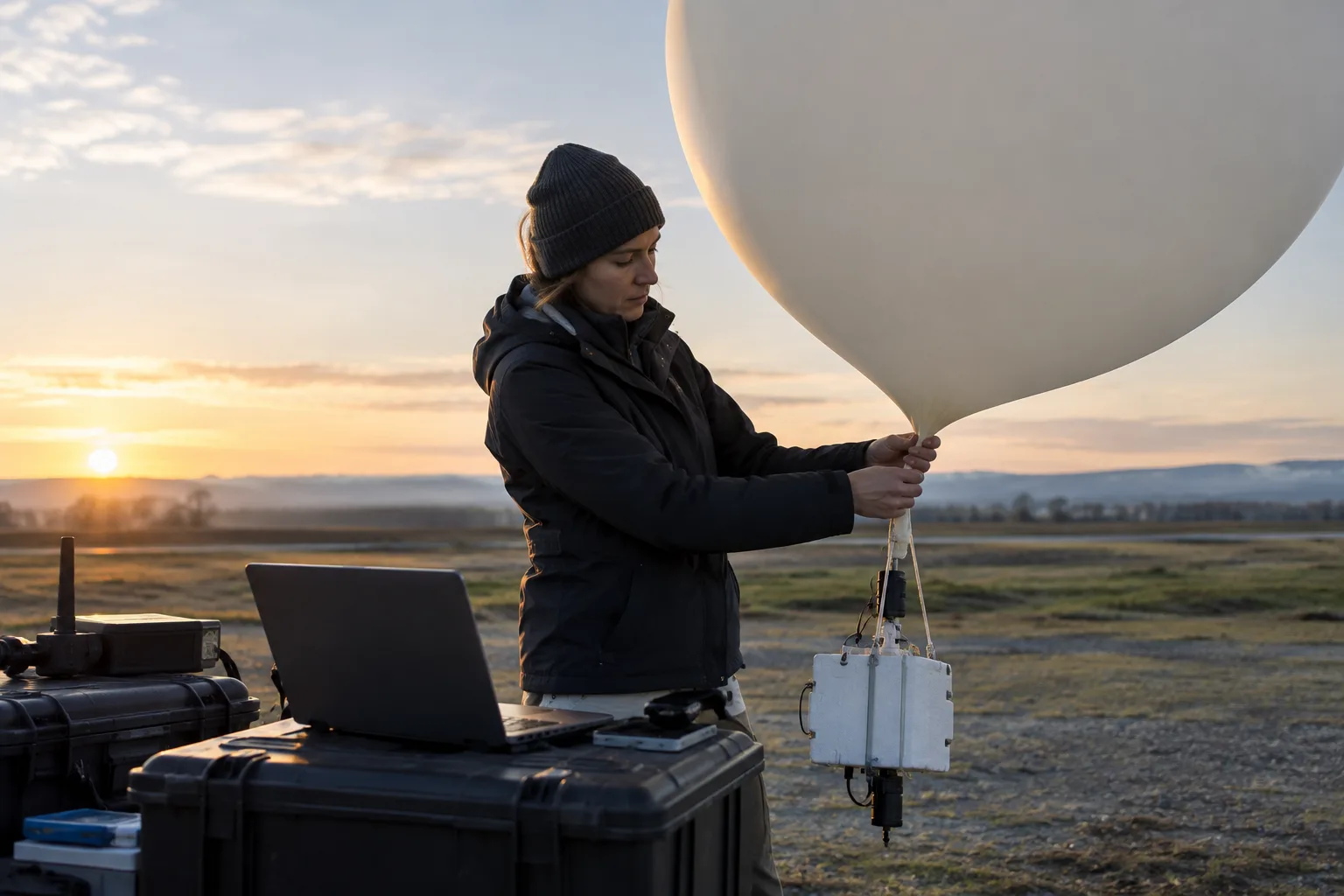
WindBorne’s pitch is attractive because it turns sensing into a service rather than a hardware sale. TechCrunch said the company operates about 700 balloons globally. Those balloons can change altitude by adjusting gas, releasing air or dropping ballast, which lets them move into different wind layers and collect repeated vertical profiles over long flights.
Those observations do two jobs at once. They are the product the company sells, and they are also input for WindBorne’s WeatherMesh forecasting model. In theory, that creates a flywheel: more balloons create more data; more data can improve the model; the model and live data can help decide where the balloons should sample next; better coverage makes the data stream more valuable to government and commercial customers.
If that loop works, a government customer can do more than add revenue. It can help finance a denser constellation, support more frequent forecast updates and create a reference account that matters to other buyers in energy, logistics, insurance and disaster response. WindBorne’s $37 million Series B this year, as reported by TechCrunch, fits that scaling narrative.
The appeal is especially clear in places where conventional observations are thin or poorly timed. Commercial balloons that can be repositioned vertically offer a way to add atmospheric measurements in specific regions or severe-weather windows without the government building and operating every sensor itself. That is the deeper story inside this contract: a shift toward buying weather capability as a data stream.
WindBorne has been building that case publicly. TechCrunch reported that the company released WeatherMesh 6 in the summer and says it outperforms the European Centre for Medium-Range Weather Forecasts model on selected benchmarks. In August, TechCrunch also reported that WindBorne became the first organization to use an unpowered flight system to collect data in the eye of a typhoon. Those milestones matter as signals of ambition and operational reach. They do not yet answer the harder questions about cost, margins or independent performance against established systems.
Why the ceiling matters less than the task orders
The contract’s most important unknowns are also the ones investors and operators will care about most. The public record does not say how much additional data the Air Force expects to buy, how task orders will be paced, what accuracy or latency thresholds apply, or what it costs WindBorne to manufacture, launch and maintain a larger fleet. It also does not show how much of WindBorne’s revenue comes from government versus commercial customers.
That missing detail is why the next few orders matter more than the announcement itself. A steady cadence of task orders would suggest WindBorne’s data is becoming operational infrastructure inside Air Force forecasting. Sparse or opportunistic orders would imply a useful niche product, but not necessarily a scalable one. The difference will show up in ordering patterns, not the contract ceiling.
There is also supplier-concentration risk on both sides. For the Air Force, a sole-source arrangement can speed access to a specialized capability, but it also creates dependence on one operator for part of the data layer. For WindBorne, government demand can help fund expansion while also concentrating revenue in a small number of public-sector programs with long sales cycles and uncertain renewal paths.
The bigger strategic implication is that weather and climate startups may be able to sell governments targeted observations the way cloud companies sell compute: on demand, integrated into larger workflows, and priced as a recurring service rather than a one-time equipment purchase. If that model catches on, incumbents and new entrants alike will need to compete on coverage, reliability, integration and the ability to prove that the data improves decisions.
For now, WindBorne has won something important but narrower than the biggest number suggests: a visible, seven-year opening to prove that autonomous atmospheric sensing can become repeatable infrastructure revenue. Whether this turns into a durable business will depend on the task orders that follow, the performance the company can demonstrate against independent baselines, and the cost of turning a 700-balloon fleet into something large and reliable enough to matter every day.

 By
By
 By
By
 By
By

 By
By
 By
By

 By
By