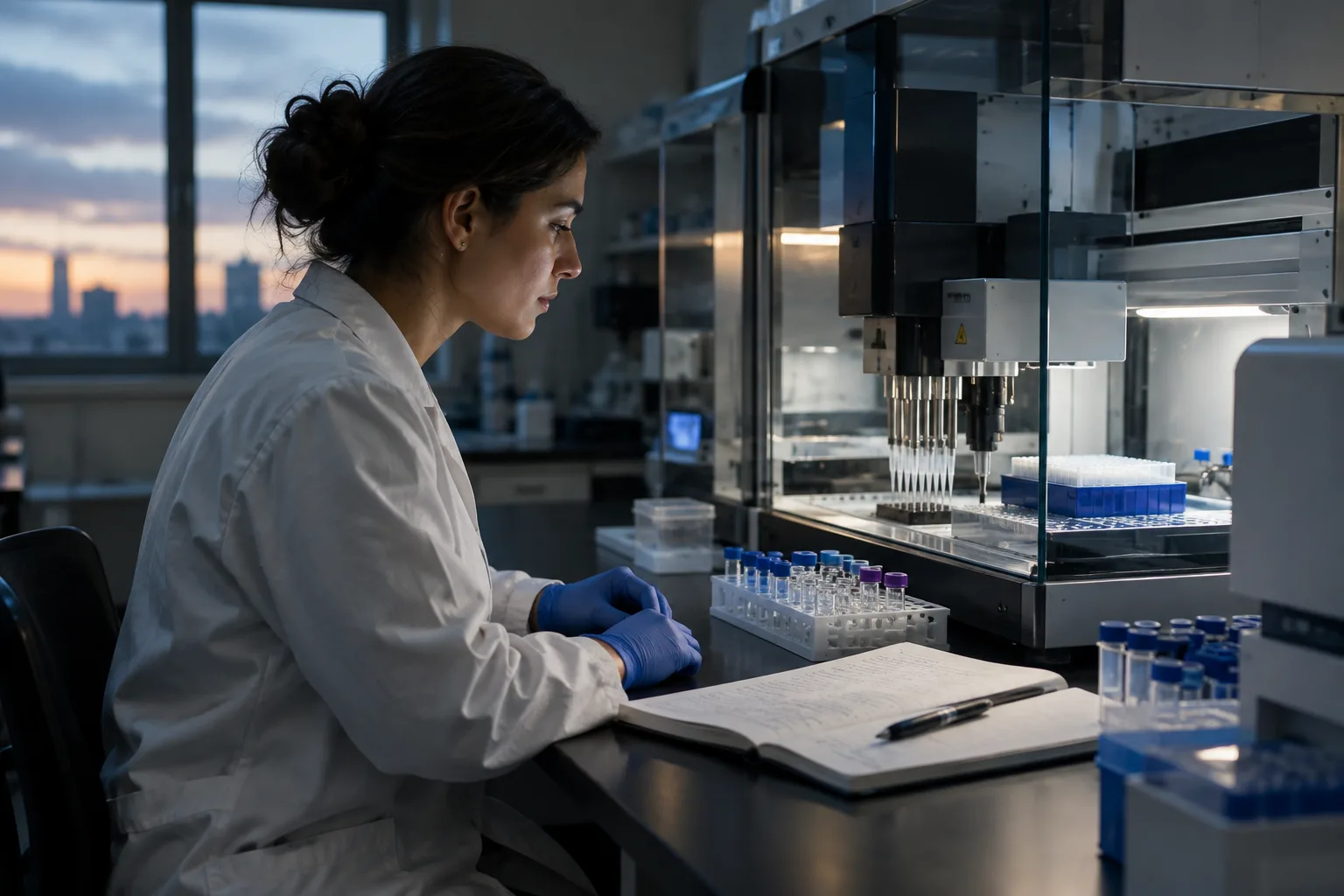

Enveda has raised $311 million in a Series E financing, giving the Boulder company one of the larger new war chests in AI-driven biotech and pushing it into a more demanding category. According to Enveda’s announcement, the round was led by Catalio Capital Management and will fund later development for three clinical programs, additional inflammatory and metabolic candidates, and expansion of PRISM, the company’s AI-native discovery platform and automated lab. TechCrunch reported the financing values Enveda at $2 billion, about double its level a year earlier.
That is the headline. The more useful question is what, exactly, this money proves. The answer is: not yet very much about drug approval, but quite a lot about what Enveda now has to become. This is no longer mainly a platform story about whether AI can help suggest molecules. It is a drug-development story about whether a company built around AI and automation can repeatedly carry medicines from interesting chemistry and early human signals into the far more expensive world of Phase 2 efficacy, manufacturing, regulatory alignment, and later-stage survival.
From platform pitch to drug-developer math
Enveda, founded in 2019 by Viswa Colluru, is built on a clear thesis: plants, microbes, and other living systems contain biologically active chemistry that conventional drug discovery has only partly explored. PRISM is meant to search that space in a closed loop. Computational models prioritize signals and candidate molecules; automated experiments test them; the resulting data feeds the next design choices.
That approach is attractive for a reason. Natural chemistry could widen the search space beyond the usual synthetic starting points. But the same strategy also brings practical headaches that software narratives tend to underplay: isolating or reproducing compounds, understanding mechanism, formulating an oral drug, securing a stable supply, protecting intellectual property, and showing that the result is reproducible enough for regulators and commercial manufacturing.
The new financing suggests investors believe Enveda has progressed beyond a speculative tools company. The syndicate spans biotech specialists and technology-oriented investors, and Enveda says total capital raised since inception now exceeds $845 million. That mix matters because the business model is shifting. A discovery platform can be judged on speed, output, and partnerships. A drug company is judged on trial execution, safety, efficacy, manufacturing readiness, and cash discipline. Those are harder milestones, and they consume capital fast.
Three programs, three different tests
The company’s near-term case rests on three clinical assets that together make a better test of the platform than any single financing announcement does.
ENV-294, an oral small molecule for inflammatory skin disease, is the attention-grabber. Fierce Biotech reported early Phase 1b results showing a mean 68% reduction in eczema area and severity by Day 28 and 85% by Day 42. Those are striking numbers, but they are still early-stage figures without the full public context readers would need to judge them against standard care or even against the normal noise of small studies. The missing pieces include trial design, enrollment, control structure, dose-response, discontinuation rates, and durability. Enveda’s follow-on plan includes Phase 2a studies in atopic dermatitis and asthma. That is where a promising signal starts to become a real product case—or fades.
ENV-308 asks a different question. It is not being positioned as a weight-loss drug. Enveda is studying it for helping people maintain weight loss after stopping GLP-1 medicines, a large and commercially tempting market if the biology holds up. But that indication also demands careful proof. Any candidate tied to the post-GLP-1 landscape will face intense scrutiny on mechanism, safety, effect size, and whether the benefit is meaningful against lifestyle drift and the alternatives patients and physicians already know.
Then there is ENV-6946, a Phase 1 inflammatory bowel disease program. It lacks the headline power of the other two, but strategically it may be just as important. If Enveda wants to show PRISM is a durable engine rather than a one-off hit generator, the company needs multiple programs in different therapeutic settings to move forward credibly. One intriguing asset can happen in any discovery shop. A repeatable pipeline is the harder claim.
A proof checklist after the financing
For investors, pharma business-development teams, and clinical researchers, the useful scorecard is straightforward:
- Trial quality: Do Phase 2 studies show controlled, statistically credible efficacy and acceptable tolerability, not just encouraging early readouts?
- Platform contribution: Can Enveda explain how much of each candidate’s novelty came from PRISM and automated discovery versus later medicinal chemistry and standard laboratory iteration?
- Mechanism and reproducibility: Is there a believable biological explanation for the effect, and does it replicate across programs?
- Manufacturing path: Can the company reliably make the compounds at pharmaceutical quality and scale, with stable supply and defensible IP?
- Capital efficiency: How much of the new round goes to internal pipeline development versus platform expansion, and what does that imply about burn, runway, and the cost of each program?
- Portfolio depth: Do multiple candidates advance, or does the story narrow to one standout asset carrying the valuation?
That last point is especially important because the $2 billion valuation is a financing mark, not clinical proof. It reflects expected future value under a set of investor assumptions. It does not answer the central operational question: whether Enveda can improve the probability-adjusted cost, time, and quality of getting a medicine to patients.
The broader AI-biotech sector should pay attention for the same reason. As TechCrunch noted, no AI-discovered drug has yet received FDA approval. If Enveda succeeds, it will still not mean AI has turned drug development into software. More likely, it will show that better search and tighter lab loops can produce better starting points—while the economics remain dominated by trials, manufacturing, regulatory work, and the cost of failure.
So the Series E is best read as a high-priced extension of the experiment, not its resolution. Enveda now has the capital to run a serious test of its model in humans. The next evidence that matters will not be the size of the round or the prestige of the cap table, but whether ENV-294, ENV-308, and ENV-6946 can clear the checkpoints that separate an impressive financing from a medicine.

 By
By
 By
By
 By
By
 By
By
 By
By
 By
By