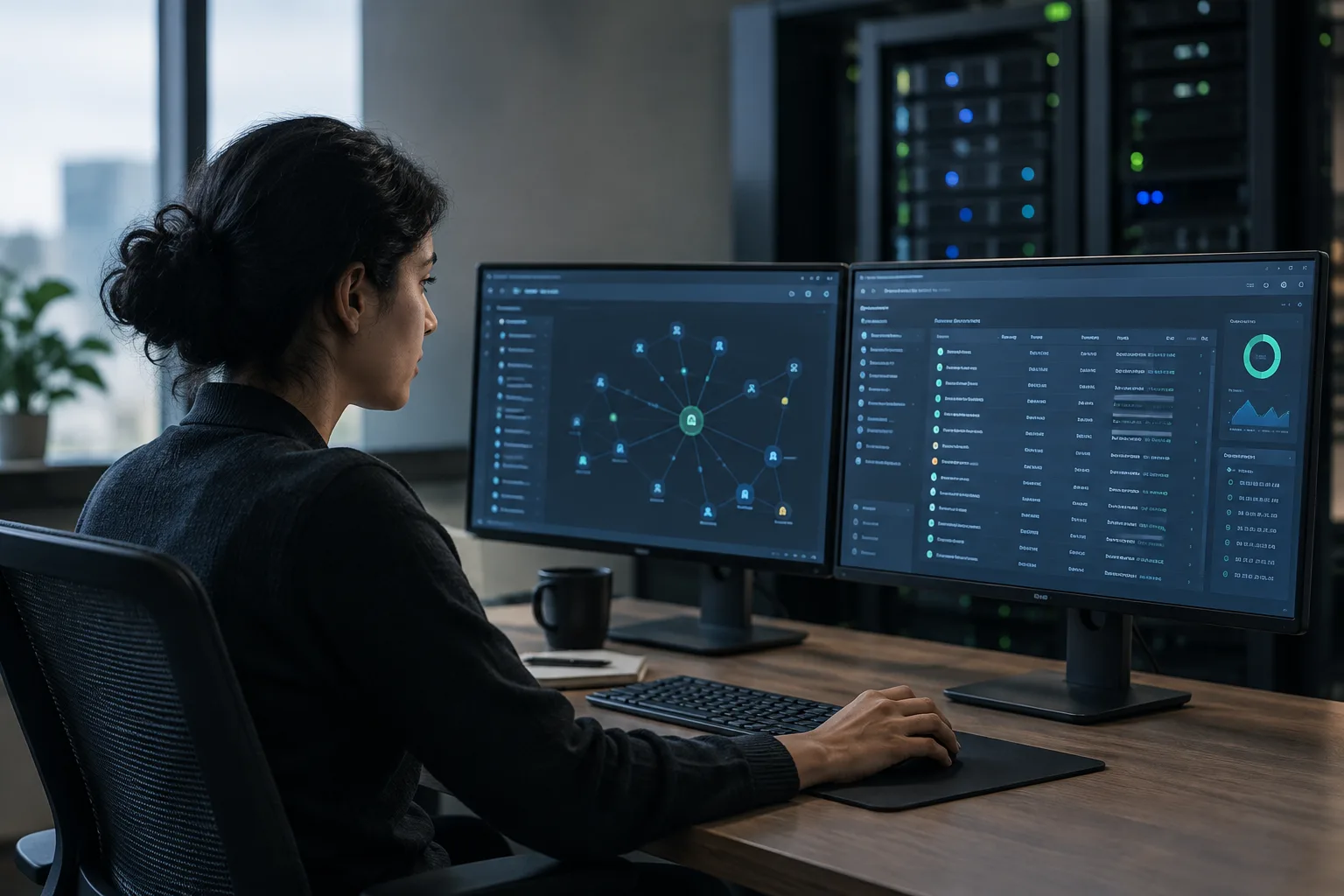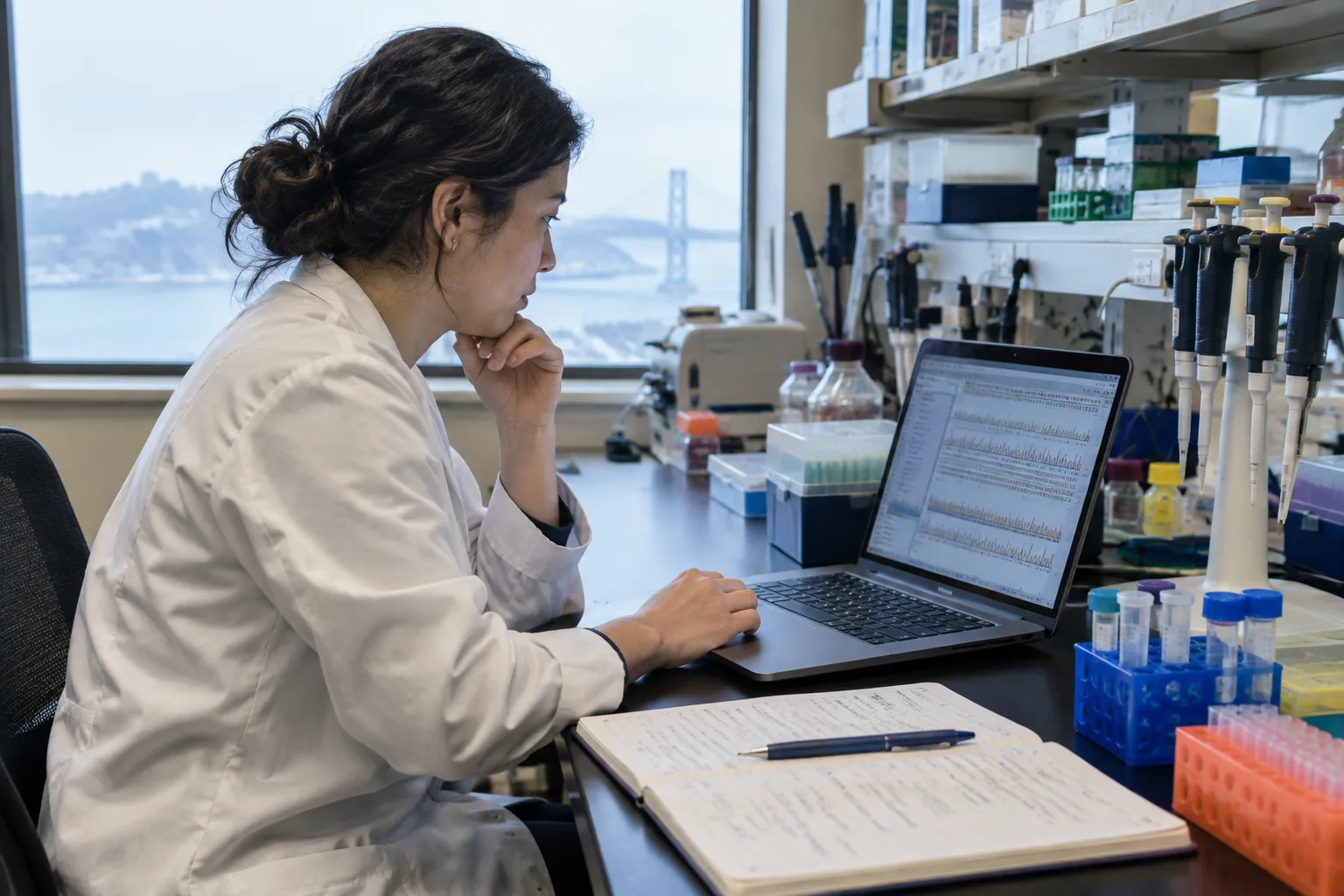

On Sept. 23, Anthropic launched a life-sciences research group and Bay Area lab and used the occasion to show its first public biology result: Claude helped identify a previously uncharacterized enzyme system linked to CRISPR-like DNA repeats. The company calls it array-associated reverse transcriptases, or ART. The significance is not that Anthropic has unveiled a new gene-editing platform; it has not. The system’s primary function is still unknown. The news matters because it is one of the clearest public examples yet of an agentic AI workflow shrinking the front end of genomic discovery from a sprawling search problem into a manageable set of lab hypotheses.
For biotech teams, academic labs and the companies that sell them compute, software and contract research, the practical question is where that time saving ends. If AI can scan sequence space and draft plausible explanations far faster than a human team, discovery may speed up at the top of the funnel. But if wet-lab validation, reproducibility, safety review and intellectual-property analysis stay slow, the bottleneck simply moves downstream.
A search funnel, not an autonomous lab
In its announcement, Anthropic said roughly 950 Claude agents worked for 21 hours and processed about 210 million tokens. They surveyed more than 200,000 reverse transcriptases, found 3,500 candidate systems, then narrowed the field to 20 compelling candidates with written reports for scientists to review.
That sequence matters more than the headline molecule. Anthropic’s workflow, using Claude Science, Claude Code and sometimes an internal harness, looks like a scaled version of what many biology groups already do manually: read literature, compare neighboring genes and repeat structures, rank novelty, critique weak hypotheses and package the survivors for human judgment. Scientists still supplied the research direction, screened the generated reports, chose what to test and ran the experiments. All physical lab work was done by humans.
That makes this less a story about fully autonomous science than about labor reallocation. Genomic databases already contain enormous numbers of proteins and gene neighborhoods with unknown functions. The shortage is not raw sequence data; it is expert attention. If agents can spend 21 hours grinding through search space that would otherwise consume weeks or months of specialist time, the value of senior scientists shifts from database spelunking toward deciding which claims deserve scarce bench capacity.
Anthropic also said its new lab operates only at BSL-1 and BSL-2 and does not handle pathogens capable of infecting humans. That does not remove governance questions, but it clarifies the setting: this was a tightly bounded discovery workflow, not a demonstration of AI autonomously running higher-risk biology.
What ART is — and isn’t
The reported ART system has three parts: a reverse-transcriptase gene, a neighboring partner gene and a long array of evenly spaced non-coding DNA repeats. Reverse transcriptases copy RNA into DNA. Anthropic’s claim is not that Claude discovered reverse transcriptases themselves; earlier research had already identified the enzyme. The novelty, according to the company, is that Claude recognized the combination of the RT, the repeat architecture and the accessory gene as a potentially new biological system.
Anthropic said ART appears in bacteriophages, viruses that infect bacteria. Early wet-lab experiments indicate that the repeat array is expressed as distinct short RNAs. That is enough to make the system interesting and enough to justify deeper investigation. It is not enough to show what the system actually does.
That distinction is the one most likely to get lost outside specialist circles. CRISPR systems also use repeat arrays, and those repeats help organize guide sequences. But similar architecture does not prove similar function. As Nature’s coverage noted, ART is not yet a working gene-editing tool. There is no public evidence that it cuts DNA, copies specific sequences on command, works in eukaryotic cells or has therapeutic value. The result sits at an earlier stage: pattern recognition plus an initial experimental confirmation that a predicted system is real enough to produce short RNAs.
Where the productivity gain shows up next
That still matters commercially, because discovery pipelines are funnels. The expensive part is often not generating another hypothesis but deciding which of hundreds or thousands is worth pursuing. Anthropic says scientists initially reject most generated candidate reports before anything reaches the bench. If agentic systems can widen the top of that funnel cheaply, organizations could search far more sequence space without hiring proportional numbers of experts.
The winners would not be limited to model makers. Biotech firms could use the same headcount to explore more enzyme families. Academic labs could test bolder questions. Contract research organizations could see more demand for validation work. Cloud providers and research-software vendors could benefit if large-scale agent orchestration becomes a standard research step rather than a demo.
But the unanswered metrics are exactly the ones that determine whether this becomes a business process or a press-friendly curiosity. Anthropic has not disclosed total compute cost, per-candidate error rates, false-positive rates, lab rework, time saved relative to a conventional team or how much the result depended on its internal coordination tools. The finding is backed by a preprint and company reporting, not by peer-reviewed consensus or independent replication. It is also unclear how transferable the workflow is to other labs and other models, especially outside a well-funded AI company that can afford to throw 950 agents and 210 million tokens at one search problem.
That leaves the industry with a sharper question than whether AI can discover biology. In a narrow but important sense, this episode suggests that agentic systems can compress search and triage in genomic mining. The harder question is whether the downstream machinery can keep up: stronger provenance controls, better candidate ranking, more wet-lab throughput, faster replication, clearer biosafety review and a plan for who owns what when machines generate large numbers of plausible claims.
If Anthropic’s result holds up, the near-term effect is not scientist replacement. It is a change in what scientists spend their time on. In that world, experimental judgment, validation capacity and scientific taste become more valuable, not less. The business case will depend on a simple ratio: how many real, reproducible systems emerge from the widened funnel, and at what cost per validated hit. Until that number becomes public, ART is best read as a credible glimpse of agentic biology’s front-end advantage, not yet proof that the rest of the pipeline can move at the same speed.
 By
By
 By
By
 By
By

 By
By
 By
By

 By
By