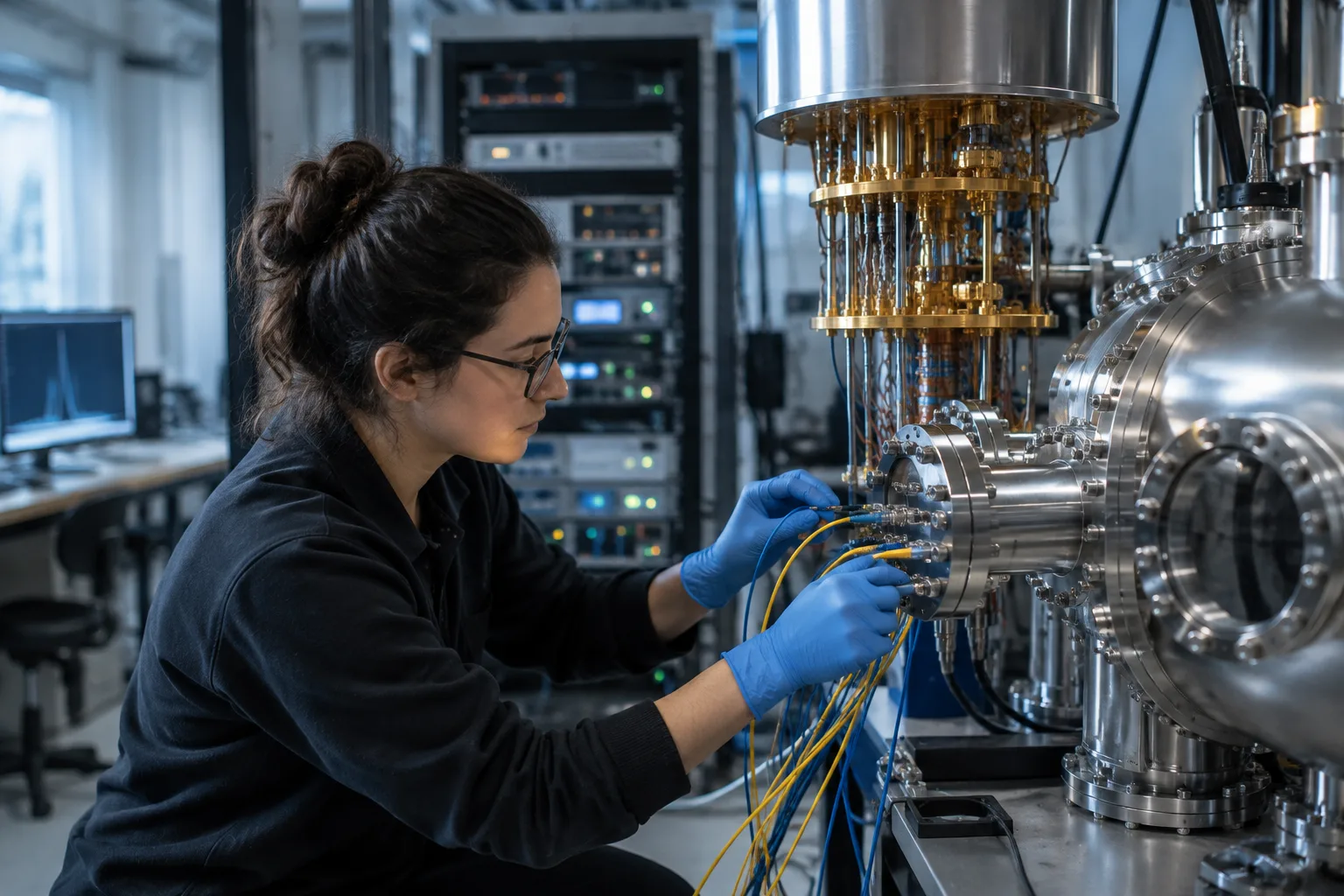

On Oct. 9, IonQ announced a quantum-memory-enhanced photonic interconnect that produced more than 1,000 entanglement events per second between a trapped-ion qubit and a silicon-vacancy quantum memory in diamond. The company’s result, documented in the preprint *Quantum Networking at the Speed of Quantum Computation: Kilohertz Entanglement in a Heterogeneous Quantum System*, matters for a specific reason: it attacks the link between quantum modules, an increasingly important constraint on how large quantum systems may eventually be built.
The real question is not whether 1.03 kilohertz is a respectable laboratory record. It is whether a faster heterogeneous link changes the architecture and economics of quantum machines. The answer, for now, is that IonQ appears to have pushed one important interconnect metric into a useful range without proving that distributed quantum computing is commercially ready. That still leaves three harder gates: repeatability, integration, and useful computation.
Why 1 kHz matters
The preprint reports an average ion-SiV Bell-pair generation rate of 1.03(1) kHz with 87.9(7)% fidelity after accounting for conversion losses. In practical terms, that is about one entangled pair per millisecond. IonQ says the result is four times faster than the prior trapped-ion photonic-link benchmark, and the paper argues that this rate matches the roughly 1 millisecond cycle time of planned trapped-ion processors.
That timing comparison is the heart of the story. If a quantum processor can complete useful operations in about a millisecond, but its connection to another module is materially slower, then a modular architecture starts losing its appeal. The network becomes the bottleneck. By contrast, a link that operates on roughly the same timescale as the processor opens the door to a different system design: smaller compute modules, separate memory or communication modules, and a photonic fabric between them instead of one ever-larger machine.
That could matter beyond laboratory elegance. A modular quantum system could change how vendors package upgrades, how customers expand capacity, and where value sits in the stack. Classical computing learned long ago that scale often comes from linking specialized components well, not from forcing everything into one box. Quantum hardware has been heading toward the same architectural question.
Still, 1 kHz is a link metric, not the throughput of a completed quantum computer. It says something meaningful about one bottleneck, not about the entire system that would have to schedule, route, synchronize, verify, and correct errors across many nodes.
How the link works
IonQ’s setup is heterogeneous by design. On one side is a barium-138 trapped ion, a qubit type known for long coherence. On the other is a diamond nanophotonic cavity containing a silicon-vacancy center, which serves as the memory element and couples efficiently to light. Between them sit photon emission from the ion, wavelength conversion, optical routing, and a detector that heralds successful entanglement.
What makes the protocol important is not just the hardware mix but the mechanism. As Quantum Computing Report noted, the experiment uses a single detected photon to herald entanglement rather than relying on the simultaneous detection of photons from two independent nodes. That changes the efficiency scaling from quadratic in per-attempt photon delivery to linear in the memory-assisted protocol.
In plain English, that means losses stop compounding quite so brutally. In many photonic quantum-link schemes, both sides have to succeed at the same instant, which makes every percentage point of loss painful twice over. A memory-assisted, single-photon approach relaxes that requirement. For quantum networking, that is more consequential than the press-release word “fastest.” It is an architectural trick for making the optics less punishing.
IonQ ties the work to DARPA’s High-Speed Quantum Interconnects, or HARQ, program, which is a useful signal about where the market conversation is moving. Interconnects are no longer just an academic side quest. They are becoming a systems problem with procurement, integration, and program-management implications.
What this changes for quantum system design
If heterogeneous links become reliable, quantum companies gain architectural optionality. They would not need to bet exclusively on one giant processor in one environment. They could sell compute modules, memory modules, photonic interfaces, and networking layers as separable pieces. That would tend to shift some strategic value toward photonics, quantum memories, control electronics, calibration software, and system integration.
It could also widen the field of participants. A vendor strong in optical hardware or cryogenic control might matter more in a modular market than in a race defined only by headline qubit counts. Customers, meanwhile, could eventually gain more flexible upgrade paths: add modules, replace one subsystem without redesigning all of them, or mix specialized hardware where the interfaces permit.
But modularity also creates new dependencies. Proprietary interconnects can lock customers into a single stack. Multi-vendor interoperability becomes its own technical and commercial problem. IonQ has pointed to commercial memory and interconnect sales or deployments involving the University of Maryland and SDT in South Korea, but those company statements are not the same thing as evidence of reproducible, scaled production or a customer running a distributed quantum workload.
The scorecard from here
What buyers, investors, and technical teams should watch next is straightforward. First, is the rate sustained in operation, or is it mainly a controlled experimental average? Second, does the fidelity fit the intended workloads once the rest of the stack is included? An 87.9% Bell-state fidelity is a real research milestone, but it is below what many fault-tolerant protocols would need without purification, error correction, or repeated operations. Third, how does the link behave over actual deployment distance, with real fiber loss, multiple nodes, and the calibration overhead of a working system?
Those questions are not small details. The public announcement and preprint do not show a multi-node computation, a fault-tolerant workload, long-distance fiber performance, or a full resource estimate for a networked quantum computer. They do not answer how many links each processor would need, how much memory lifetime is available under repeated use, how much the cooling and control hardware costs, or how much of the setup can be manufactured reproducibly rather than tuned by experts.
That is why the result should be read as a systems milestone, not a commercial endpoint. IonQ appears to have shown that interconnect speed can be brought into the same rough time budget as quantum computation for a trapped-ion roadmap. That is a serious step for distributed quantum computing. It does not remove the bottleneck so much as move the bottleneck outward, from a single laboratory link to the far messier work of operating many of them together.
For the quantum industry, that may be the most useful kind of progress: narrower than the hype, but closer to the real architecture debate that will determine who supplies the networking layer of future quantum systems.

 By
By
 By
By
 By
By
 By
By

 By
By
 By
By