

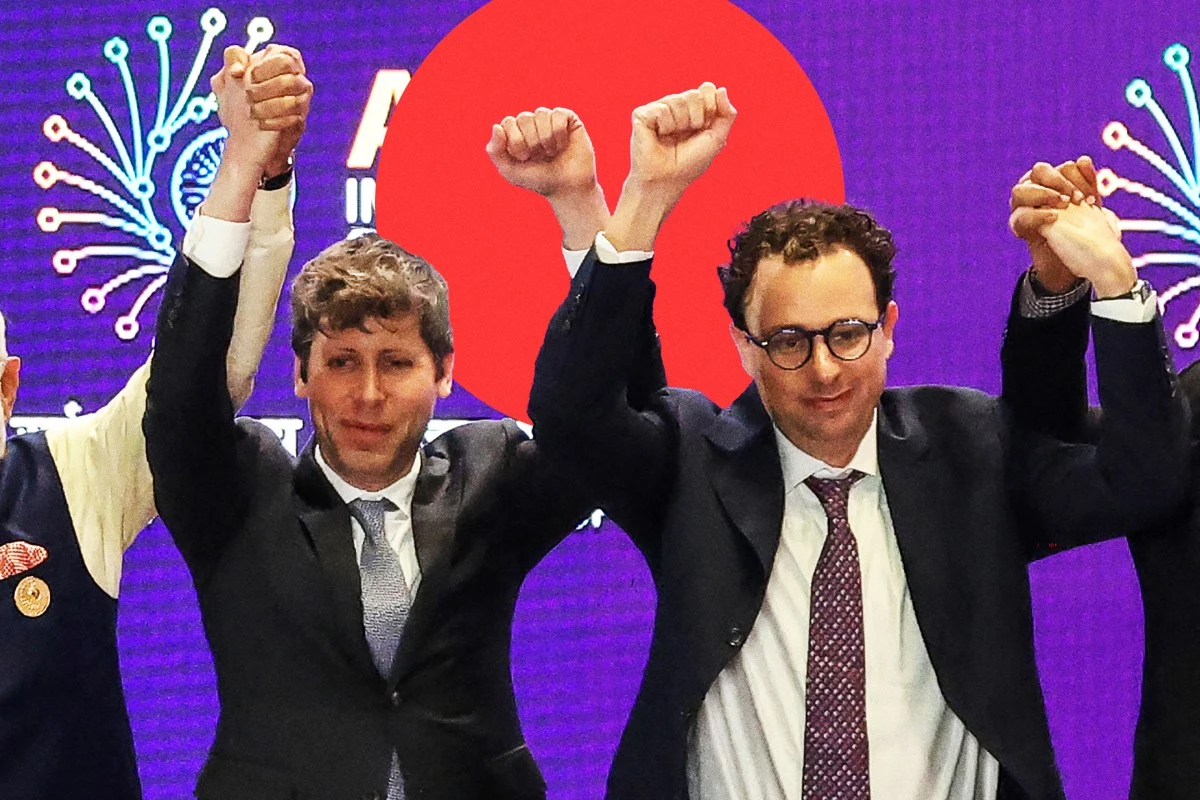

A New Delhi moment that exposed a widening fault line in frontier AI
The AI Summit in New Delhi offered the usual choreography of global tech diplomacy—handshakes, photo ops, and carefully worded commitments to “responsible innovation.” Yet the most revealing signal came from what *didn’t* happen. When Sam Altman of OpenAI and Dario Amodei of Anthropic crossed paths, the exchange reportedly amounted to a tense glance and a closed-fist gesture—an unusually stark tableau in a venue designed to project alignment.
That brief encounter matters because it compresses a much larger reality: frontier AI is entering an era where competition is no longer just about model performance, but about legitimacy—who gets to define “safe,” who gets to define “open,” and who gets to write the rules that will govern the next decade of deployment.
Anthropic’s origin story—founded by former OpenAI leaders amid disagreements over safety and governance—has long suggested philosophical distance. What is changing now is the publicness and political intensity of that distance. The rivalry is moving from product roadmaps and research papers into advertising, narrative warfare, and electoral influence—domains that shape not only market share, but public trust and regulatory outcomes.
Safety-first engineering versus scale-first commercialization—and the standards battle beneath it
At the core of the OpenAI–Anthropic split is a strategic divergence that many enterprise buyers and developers have felt for months, but that now appears to be hardening into competing operating systems for AI governance.
Anthropic’s posture emphasizes built-in constraints, extensive testing, and a “guardrails-first” framing—an approach designed to resonate with regulators and risk-sensitive industries. OpenAI’s posture, increasingly oriented toward mass adoption and monetization, signals confidence in rapid iteration, broad distribution, and product-led refinement. The flashpoint described in the source material—Anthropic targeting OpenAI’s shift toward ad-supported ChatGPT marketing, including Super Bowl-style campaigns—illustrates how monetization choices are becoming proxies for deeper values.
Altman’s reported criticism of the ads as “deceptive,” alongside branding Anthropic “authoritarian,” is notable not only for its sharpness but for what it implies: the debate is being reframed as a contest between freedom and control, rather than a technical discussion about alignment, evaluation, and risk thresholds. That framing is powerful—and potentially destabilizing—because it invites policymakers and the public to pick sides based on ideology rather than evidence.
For the broader AI ecosystem, the practical risk is standards fragmentation:
- Divergent safety frameworks could yield incompatible expectations for audits, red-teaming, and deployment controls.
- API and tooling lock-in may intensify as developers align with one ecosystem’s assumptions about moderation, model behavior, and compliance.
- Interoperability challenges could grow if “responsible AI” becomes a brand-specific doctrine rather than a shared baseline.
In effect, the industry may be drifting toward a world where “frontier AI” is not a single category but two competing stacks: one optimized for provability and constraint, the other optimized for reach and iteration speed.
The political economy of AI: super PACs, midterms, and regulatory capture risk
The most consequential detail in the material is not the summit theatrics—it is the escalation into organized political spending. Anthropic’s pledge of $20 million to a pro-regulation super PAC, alongside reports that OpenAI backers are underwriting a rival PAC favoring lighter oversight, signals a pivotal shift: policy influence is becoming a first-class competitive weapon in AI.
This matters for three reasons.
First, it suggests that both camps believe the next wave of advantage will be determined by regulatory architecture, not just technical capability. If rules mandate pre-deployment testing, licensing, or liability regimes, safety-forward firms may gain structural advantage. If rules emphasize voluntary frameworks and innovation flexibility, scale-forward firms may move faster and entrench distribution.
Second, it raises the risk of regulatory overreach or regulatory capture, depending on which coalition prevails. When firms fund opposing political vehicles, the incentive is not merely to “inform” lawmakers—it is to shape the playing field in ways that can disadvantage rivals and raise barriers to entry for smaller labs.
Third, the timing—ahead of U.S. midterms—suggests that AI governance is being pulled into the gravitational field of electoral politics. That can accelerate legislative action, but it can also polarize it, making durable, technically grounded regulation harder to achieve.
For business and technology leaders, the immediate takeaway is that AI procurement and product strategy are becoming policy-sensitive decisions. Vendor selection increasingly implies alignment with a governance philosophy—and potentially with a future compliance pathway.
India’s summit stage and the emerging multi-polar rulebook for AI deployment
New Delhi’s role as host adds a crucial geopolitical layer. India is positioning itself as an AI hub while also emphasizing sovereignty, domestic innovation capacity, and the public-interest dimensions of digital infrastructure. That makes India not just a backdrop, but a bellwether for how emerging markets may blend growth ambitions with regulatory assertiveness.
As the U.S. and EU debate their own approaches, India’s trajectory could influence a hybrid governance model—welcoming investment and deployment while insisting on localized controls around data, accountability, and societal impact. For OpenAI and Anthropic alike, this means the contest is not simply “Washington rules versus Silicon Valley norms,” but a multi-jurisdictional reality spanning Brussels, New Delhi, and beyond.
Business leaders should read the Altman–Amodei rivalry as a signal that the AI market is entering a phase where trust, compliance readiness, and political legitimacy will be priced into platforms alongside latency and benchmark scores. The companies building the most capable models may not automatically win; the winners may be those that can scale while convincing governments, enterprises, and citizens that their definition of “safe enough” deserves to become the default.

 By
By
 By
By

 By
By
 By
By
 By
By

 By
By







