

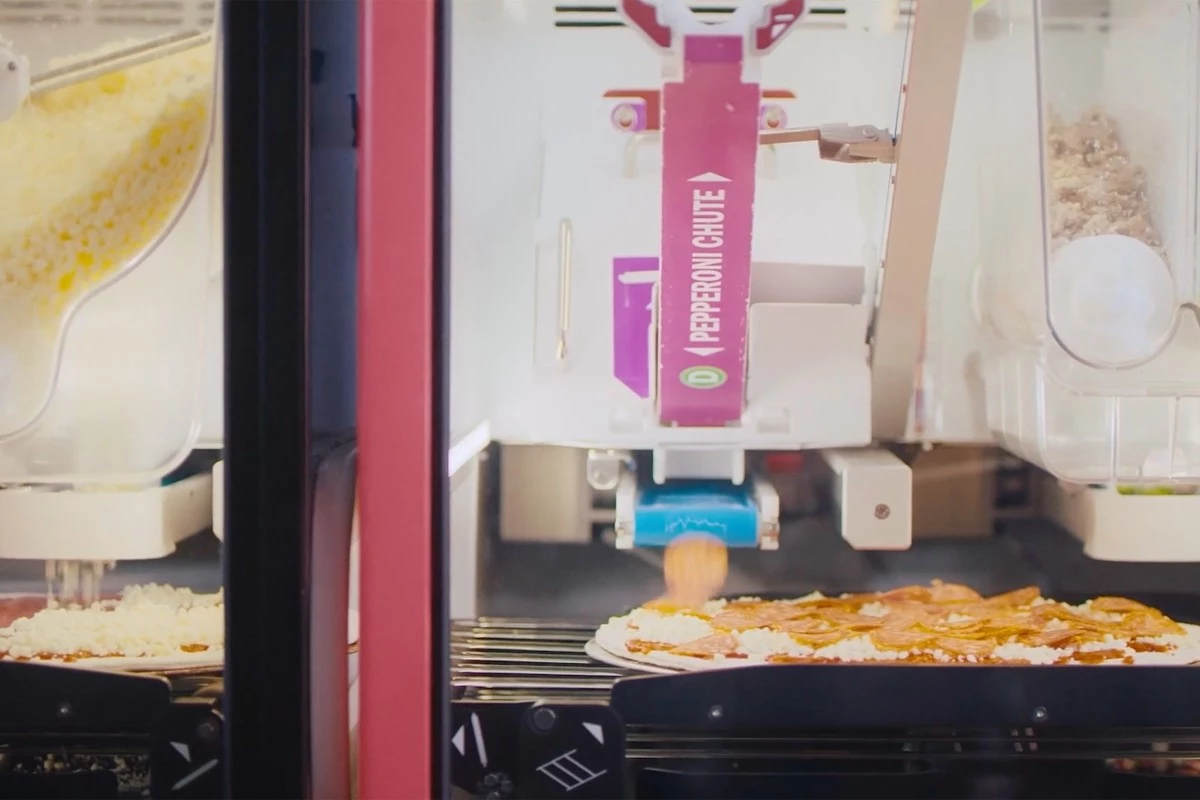

A high-profile robotics bet meets the hard physics of foodservice
Seattle-based Picnic, once positioned as a breakout name in restaurant automation, has ceased operations after becoming insolvent—an abrupt end for a company that raised more than $53 million to commercialize its Picnic Pizza Station, a system designed to automate pizza topping distribution at scale. The shutdown lands as more than a single startup’s failure: it is a stress test of the broader thesis that service robotics can be productized and deployed as predictably as industrial automation.
Picnic’s rise was fueled by a compelling narrative: restaurants face chronic labor volatility, thin margins, and relentless throughput demands. Automation, the pitch went, could stabilize operations while improving consistency. That story gained mainstream credibility when Domino’s partnered with Picnic in 2022, framing robotics not as a headcount reducer but as a growth enabler—a way to redeploy staff into customer-facing roles and keep pace with demand.
Yet the arc from pilot to scalable deployment proved unforgiving. Leadership turnover and layoffs in 2023 signaled mounting strain, and the final outcome—customers and partners left with inoperative equipment—highlights a recurring hazard in hardware-first automation: when a vendor fails, the “asset” can quickly become stranded infrastructure rather than a transferable tool.
Why pizza robotics is deceptively difficult: variability, integration, and feedback loops
At a distance, pizza topping looks like a repeatable task. In practice, it sits at the intersection of messy materials science, real-time control, and restaurant operations—an environment far less deterministic than a factory line.
Key technical and operational friction points shaped Picnic’s challenge:
- Ingredient variability breaks assumptions. Toppings behave differently based on viscosity, moisture, temperature, cut size, and clumping. A robotic dispenser calibrated for one day’s cheese flow can drift the next day as conditions change. This is not a minor tuning issue; it’s a reliability problem that compounds across shifts and locations.
- Restaurants are “unstructured” worksites. Industrial robots thrive in controlled spaces with standardized inputs. Kitchens introduce human interference, hygiene constraints, rush-hour surges, and constant micro-changes—from ingredient substitutions to layout tweaks—making consistent performance harder to sustain.
- Integration costs can exceed the robot itself. Deploying an automated topping station is rarely plug-and-play. It can require retrofits to ovens, conveyors, sensors, and line layouts, plus ongoing calibration. This creates what operators sometimes call the “robot aquarium” effect: a highly visible, expensive installation that is difficult to repurpose if the workflow changes or the vendor disappears.
- Machine learning needs high-quality, real-time feedback. True adaptability depends on rapid sensing and correction—often via computer vision and quality inspection loops. If a system cannot reliably detect coverage gaps, mis-dispenses, or portion drift in real time, it struggles to improve yield and accuracy fast enough to justify its footprint and cost.
The result is a familiar pattern in culinary robotics: impressive demos, followed by the slower reality of uptime, maintenance, sanitation, training, and the operational burden of keeping the system within tolerance during peak service.
The economics that squeezed Picnic: burn rate, payback periods, and shifting venture appetite
Picnic’s trajectory also reflects the macroeconomics of robotics startups—particularly those selling capital equipment into a sector with tight margins and high operational variability.
Several forces converged:
- Capital intensity and long development cycles. With nearly $55 million raised, Picnic exemplified the hardware startup dilemma: significant upfront R&D and manufacturing complexity, paired with slower-than-expected commercial scaling. When timelines slip, burn rate becomes destiny.
- Restaurant buyers demand fast ROI. Franchise operators and chains typically require clear payback periods. If the system’s price point, maintenance overhead, or integration costs push ROI beyond acceptable thresholds, adoption stalls—especially when labor savings are uncertain or politically sensitive.
- Narrative framing can’t outrun operational reality. Domino’s emphasis on automation as a workforce redeployment tool was strategically astute in an era of labor skepticism. But if the technology cannot scale reliably, the narrative becomes moot—because the operational benefit never materializes at network level.
- A cooling market for asset-heavy ventures. Venture capital has increasingly favored software and AI-first models with faster iteration cycles and clearer unit economics. Robotics can be investable, but investors now tend to demand sharper proof of repeatability, serviceability, and margin structure earlier in the journey.
- Supply chain fragility amplified risk. Semiconductor and precision-component constraints have extended lead times and raised costs across robotics. For startups, that can mean delayed pilots, slower redesign cycles, and higher working capital requirements—each one eroding runway.
Picnic’s collapse also echoes the cautionary precedent of Zume Pizza, which raised roughly $500 million before failing—suggesting that the obstacles are not merely about execution quality, but about structural difficulty in turning kitchen autonomy into a scalable product category.
What Picnic’s shutdown signals for restaurant automation and service robotics
The most durable takeaway is not that food robotics is futile, but that the winning model may look less like a fully autonomous “station” and more like modular automation that complements human labor.
Emerging implications for business and technology leaders:
- Hybrid “robot-plus-human” workflows are likely to win near-term. Systems that assist with repetitive sub-tasks—portioning, dispensing, prep staging, or quality checks—can deliver incremental gains without demanding full-line redesign.
- Modularity reduces single-use risk. An all-in-one pizza station is brittle if demand shifts, menus evolve, or a vendor exits. Plug-and-play modules that can be redeployed across formats (pizza, bowls, sandwiches) offer better resilience and broader revenue potential.
- Partnerships must move beyond pilots. Scaling requires early alignment with equipment OEMs, kitchen designers, integrators, and supply chain partners so deployments don’t become bespoke engineering projects at every site.
- Vendor viability becomes part of procurement. Operators will increasingly evaluate robotics providers not only on performance, but on service coverage, spare parts access, software support, and financial durability—because stranded equipment is an operational and reputational liability.
- Standardization and consortia may accelerate maturity. Shared interfaces, data protocols, and testing facilities—potentially via alliances among restaurant groups and robotics vendors—could reduce duplicated R&D and make deployments more repeatable.
Picnic’s story ultimately underscores a central truth of service automation: the breakthrough is rarely the robot arm itself. It is the end-to-end system—hardware, software, integration, maintenance, training, and economics—proving it can survive the lunch rush, the supply chain, and the balance sheet all at once.

 By
By
 By
By


 By
By

 By
By
 By
By







