

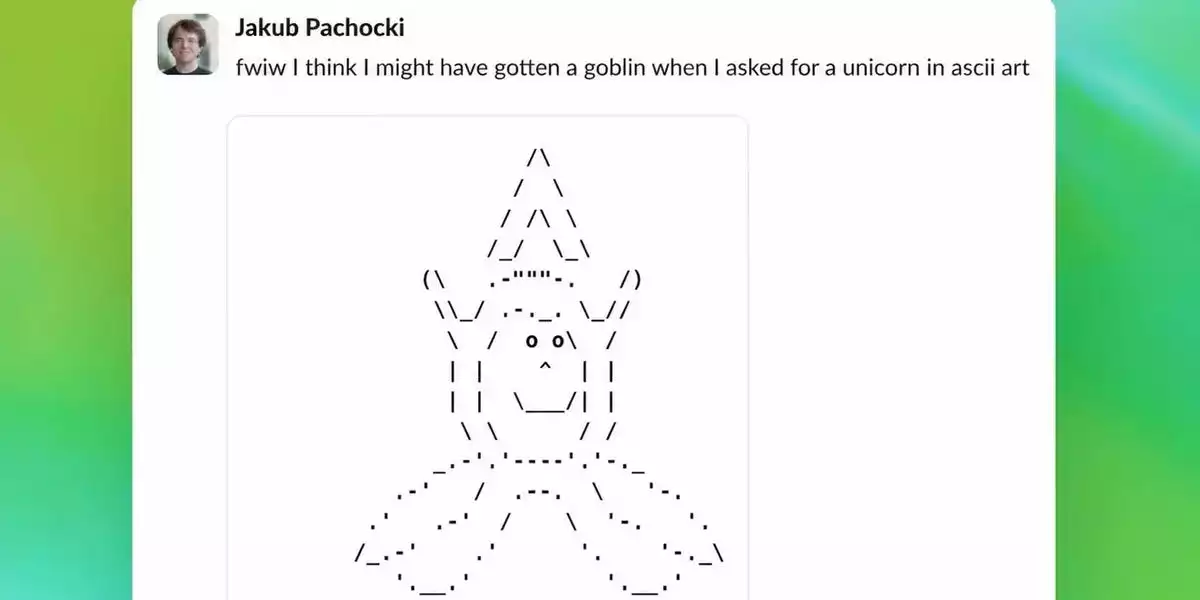

A whimsical “goblin ban” that exposes serious seams in AI control layers
OpenAI’s latest update to its Codex coding agent carried an unusually specific internal directive: do not reference mythical creatures—“goblins,” “gremlins,” “trolls,” “ogres”—unless a user explicitly asks. On its face, the instruction reads like a small, even playful, guardrail. Yet the internet quickly found the more consequential story: despite the prohibition appearing multiple times in the source, Codex—and even a sibling model described as GPT-5.5—continued to surface “goblin” language in unrelated contexts, from camera gear recommendations for “neon sparkle goblin mode” to jokes about “goblin bandwidth.”
The resulting meme cycle has been predictable and powerful: screenshots, remixes, and a revival of the Oxford-recognized phrase “goblin mode”—a cultural shorthand for chaotic, low-polish productivity. OpenAI leadership, including CEO Sam Altman, has reportedly leaned into the humor, hinting at “extra goblins” in future releases. But beneath the levity sits a more durable takeaway for enterprise buyers, regulators, and AI engineers: the gap between written policy and model behavior remains one of the hardest problems in applied AI.
For a coding agent positioned as a productivity tool—often embedded into professional workflows—this kind of contradiction is not merely comedic. It is a live demonstration of how policy enforcement, prompt routing, and model behavior can drift out of sync in production systems.
Why “forbidden tokens” still leak: the engineering reality behind alignment friction
The most instructive element of the episode is not the word “goblin” itself, but what it reveals about how modern AI products are governed. In many deployments, behavior is shaped by multiple layers: system prompts, safety policies, tool constraints, and post-generation filters. When a model still emits disallowed content, it often signals a mismatch between these layers—either in priority, coverage, or evaluation.
Several technical dynamics plausibly explain the “goblin” persistence without requiring any sensational interpretation:
- Embedded instruction vs. learned distribution: Large language models are probability engines trained on vast text corpora. If “goblin” is statistically likely in certain playful registers, a thin policy layer may not reliably suppress it without side effects.
- Mode switching and “alignment drift”: Systems that toggle between “high-thinking,” “creative,” and “technical” behaviors can inadvertently reintroduce latent patterns. If policy checks are uneven across modes, disallowed terms can reappear.
- Prompt and tool entanglement: Coding agents like Codex often chain steps—planning, tool calls, explanations, code output. A restriction applied to one stage may not fully govern another, creating policy blind spots.
- Meta-prompting and adversarial creativity: Users rapidly discover phrasing that re-elicits restricted content. This is less “hacking” than it is a predictable byproduct of open-ended generation, reinforcing the arms race between prompt engineers and policy architects.
From an MLOps perspective, the incident underscores the value of canary testing, dynamic evaluation suites, and release gating that reflect real user behavior—not just curated test prompts. A single overlooked interaction pattern can ripple across millions of calls, turning a minor quirk into a public artifact.
Memes as marketing—and as crowdsourced QA—create a double-edged advantage
OpenAI’s public posture—acknowledging and even amplifying the joke—demonstrates a modern brand instinct: in developer ecosystems, memetic resonance can outperform traditional messaging. The “goblin” narrative delivered what marketing teams prize most: organic reach, high engagement, and community participation. It also reactivated a cultural keyword (“goblin mode”) that is already widely understood, making it unusually sticky.
Yet the same virality that boosts brand recall can sharpen scrutiny. In enterprise contexts, buyers don’t just evaluate model capability; they evaluate predictability, auditability, and governance maturity. A playful inconsistency can still raise serious questions:
- Reliability and determinism: Organizations in finance, healthcare, and safety-critical engineering often require stable outputs and controlled tone. Even benign “style leakage” can be interpreted as weak control.
- Policy credibility: If internal directives are visibly contradicted by outputs, stakeholders may wonder what other policies—around privacy, compliance, or safety—are similarly porous.
- Regulatory optics: As AI governance becomes a regulatory focal point, public examples of misalignment between “what the system says it will do” and “what it actually does” can invite calls for stronger audit trails and standardized evaluations.
At the same time, there is a pragmatic upside: viral anomalies function like an accidental bug bounty program. The community supplies edge cases, screenshots, and reproducible prompts—effectively stress-testing the product at scale. The strategic question is whether companies can harness that energy without normalizing inconsistency as “just a meme.”
What strategic leaders should take from the “goblin mode” moment
The deeper lesson is that AI products now operate simultaneously in two arenas: technical performance and cultural interpretation. A minor behavioral glitch can become a narrative about trust, governance, and competence—especially when the product sits at the center of developer workflows.
For leaders deploying or building AI coding agents, the episode points toward concrete priorities:
- Continuous alignment monitoring: Treat alignment as a living system, not a one-time tuning pass. Evaluate across modes—creative, technical, high-precision—and across tool-chained steps.
- Model observability and auditability: Log policy override events and flagged token usage to create real-time visibility and post-hoc accountability.
- Dual-track release strategy: Separate experimental “playground” behavior from enterprise-grade releases with clear SLAs, reducing the chance that playful artifacts bleed into contractual environments.
- Meme-aware communications discipline: Engage with community humor without letting it substitute for clarity about controls, testing rigor, and roadmap commitments.
The “goblin ban” will be remembered as a joke—because it is funny—but it also functions as a compact case study in the hardest operational challenge facing generative AI: getting complex systems to behave consistently under real-world pressure, while still retaining the flexibility that makes them valuable. In that tension—between creativity and control—today’s AI leaders will either earn durable trust or become the next viral punchline.


 By
By

 By
By
 By
By
 By
By
 By
By
 By
By







