


A two-track launch playbook: discounting without discounting the Nintendo Switch 2
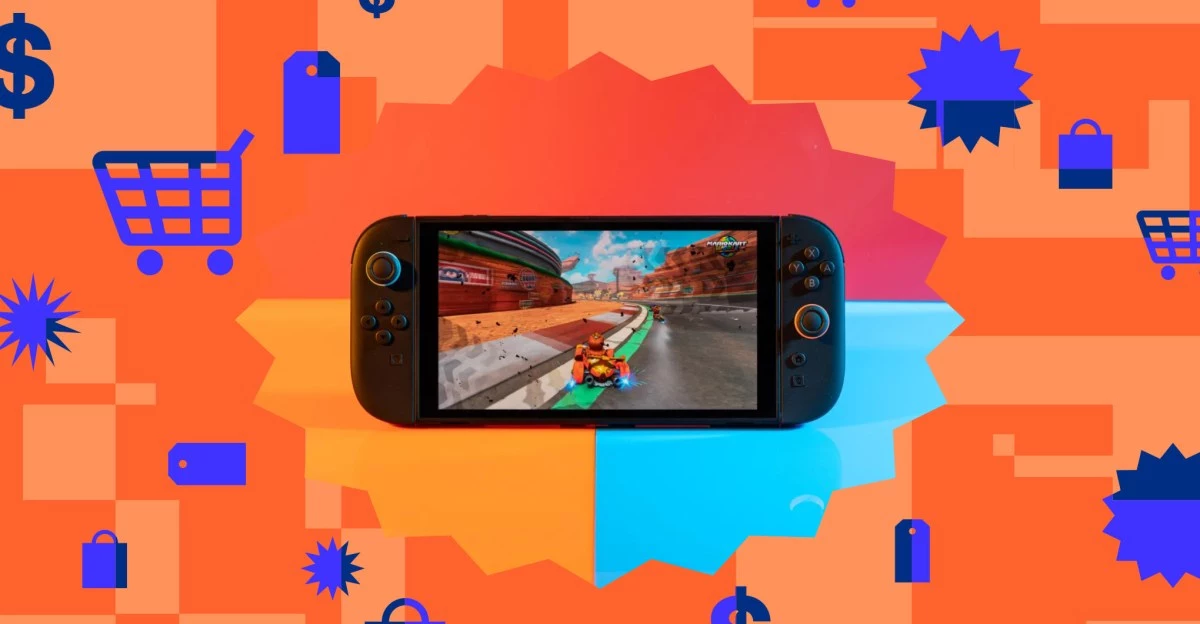
The most revealing signal in the current console cycle isn’t a spec sheet—it’s the pricing architecture forming around the Nintendo Switch 2. On one track, Newegg’s Nintendo gift-card promotion effectively lets consumers buy $200 in Nintendo credit for $170, with stacking mechanics that can be directed toward a Switch 2 purchase. On the other, Nintendo is leaning into a controlled, brand-safe offer: its “Choose Your Game” Switch 2 bundle priced at $499.99, pairing the hardware with a discounted title such as Donkey Kong Bananza, Pokémon Pokopia, or Mario Kart World.
This dual-channel approach is a classic example of value segmentation. Nintendo can preserve the optics and economics of its own MSRP strategy while still allowing price-sensitive buyers to “find” savings through partner channels. The difference matters: a first-party bundle frames the deal as *added value*, while a third-party gift-card arbitrage frames it as *smart shopping*. Both expand the addressable market, but they do so without forcing Nintendo into a headline-grabbing price cut that could reset consumer expectations.
The timing adds a sharper edge. With the Switch 2 MSRP expected to rise by $50 in September to $499.99, the market is being nudged toward earlier commitment. That’s not merely promotional urgency—it’s a confidence statement. Raising price ahead of peak holiday demand suggests Nintendo believes the Switch 2’s brand equity, software pipeline, and hybrid positioning can withstand a more inflation-sensitive consumer.
Key mechanics shaping buyer behavior right now include:
- Gift-card stacking that converts a discount into flexible purchasing power
- Bundling that increases perceived value while protecting MSRP integrity
- A scheduled MSRP increase that creates a clear “buy-before” window for early adopters
Gift cards as yield, loyalty lock-in, and demand telemetry
Newegg’s offer is notable because it turns a retail promotion into something closer to a financial instrument. A consumer paying $170 for $200 in credit is effectively capturing a 17.6% uplift—and doing so in a way that feels safer than financing. Unlike buy-now-pay-later, store credit can be held, stacked, and deployed when inventory appears or when the buyer is ready. In a market where discretionary spending is under pressure, that optionality is powerful.
For Newegg, the upside is equally strategic. Gift cards deliver:
- Immediate cash inflow and improved working capital dynamics
- Customer lock-in, since the value is trapped inside the Nintendo ecosystem
- Higher conversion probability, because credit holders become high-intent shoppers
For Nintendo and its channel partners, gift-card behavior also becomes demand telemetry. Stacking patterns, redemption timing, and basket composition can reveal which cohorts are preparing to buy hardware versus software-only. In an era where supply chains have stabilized compared to 2020–2022, the competitive advantage shifts from “can you ship units” to “can you forecast intent and allocate inventory with precision.”
This is where the broader macro context matters. Persistent inflation and modest wage growth have increased price elasticity in consumer electronics. Gift-card promotions are a way to acknowledge that reality without openly conceding on MSRP. They also reflect a consumer mindset that increasingly favors *controlled spending*: credit can be hoarded, timed, and rationalized as a planned purchase rather than an impulse.
Retail channel signals: inventory normalization and membership-driven pricing power
Alongside the Switch 2 pricing chessboard, the accessory and premium hardware deals circulating in the market read like a map of post-pandemic normalization. Promotions such as the Sonos Roam 2 at $134 (with an Otterbox case), Sam’s Club markdowns on Apple Studio Displays (up to 44% off), and the Sony InZone H9 Mk. 2 wireless gaming headset around $298 indicate retailers are actively managing SKU aging and category transitions.
These are not random discounts; they reflect channel priorities:
- Clearing older inventory to make room for refreshed product lines and seasonal resets
- Driving foot traffic and cross-category baskets, where a discounted hero item pulls in higher-margin add-ons
- Reinforcing loyalty ecosystems, especially where membership gates (e.g., Sam’s Club) convert savings into retention
The bundling of a protective case with a portable speaker is also a subtle industry tell. Portability is no longer just a feature—it’s a “total package” proposition, where durability, accessories, and lifestyle positioning are monetized together. Meanwhile, Sony’s gaming headset strategy highlights technology transfer: leveraging noise-canceling and tuning expertise from flagship audio lines to strengthen gaming peripherals, a category where attach rates and brand affinity can be unusually sticky.
What to watch next: pricing inflection points, attach-rate engineering, and the end of easy discounts
The Switch 2 moment is shaping up as a case study in flexible pricing architectures. Nintendo appears to be smoothing the adoption curve through controlled value additions (bundles) while allowing partners to stimulate demand via indirect discounting (gift cards). If the September MSRP increase holds, it will likely compress decision timelines and intensify the importance of early-cycle attach rates—how quickly buyers add games, controllers, headsets, and subscriptions.
Forward-looking signals worth tracking include:
- Whether gift-card arbitrage becomes a sustained channel tactic or a short-lived acquisition burst
- How quickly Nintendo pivots from launch incentives to value-added services (digital subscriptions, online features, content bundles)
- Whether accessory makers deepen co-branded bundles to capture wallet share as headline discounts fade
- How membership retailers expand exclusive electronics pricing as a retention lever rather than a margin sacrifice
The deeper story is that consumer electronics is learning to sell aspiration under constraint: not by racing to the bottom on price, but by engineering *where* value appears—inside bundles, inside credit, inside loyalty programs, and inside ecosystems that keep the next purchase feeling inevitable.

 By
By

 By
By
 By
By
 By
By

 By
By
 By
By







