

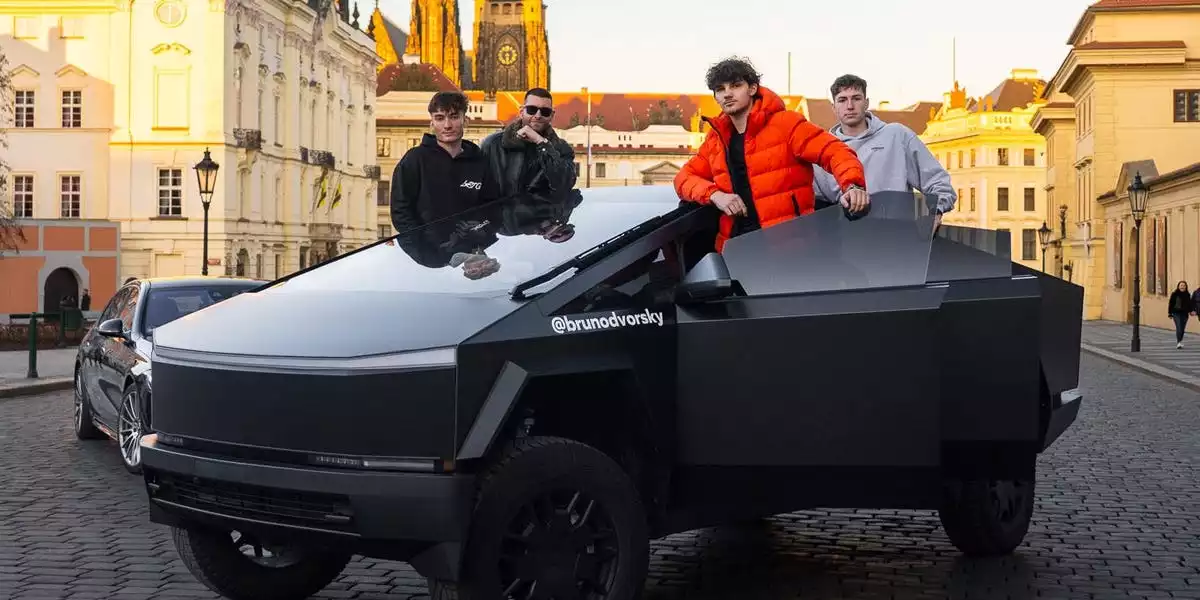

The Cybertruck’s European Odyssey: Where Silicon Valley Ambition Meets Continental Caution
Tesla’s Cybertruck—an angular, stainless-steel icon of American automotive audacity—has become a rolling thought experiment in Europe’s regulatory theater. Two years after its U.S. debut, the Cybertruck remains conspicuously absent from European roads, its passage blocked by a formidable alliance of safety codes, environmental policies, and cultural skepticism. Yet, the Swiss retrofit initiative led by Teslab offers a rare glimpse into what it takes to bridge the chasm between Silicon Valley’s disruptive ethos and the Old World’s methodical gatekeeping.
Engineering a Square Peg for a Round Hole: The Anatomy of a Retrofit
At the heart of the Cybertruck’s European exile lies its very skeleton. The vehicle’s stainless-steel exoskeleton, lauded for its torsional rigidity and corrosion resistance, is precisely what makes it a regulatory pariah. European safety standards—most notably UNECE R127 and R93—demand not only passive protection for occupants but also active safeguarding of pedestrians. The Cybertruck’s sharp panel edges and uncompromising geometry fail these tests spectacularly, forcing retrofitters to add deformable bumpers and rubberized edges, fundamentally altering the truck’s visual language.
The electrical architecture presents another Gordian knot. Tesla’s U.S. model, with its 48-V/400-V blend, collides with Europe’s entrenched 12-V legacy for lighting and signaling. Teslab’s engineers have been compelled to rewire the vehicle, redesigning fuses and connectors to satisfy both current and the looming UNECE R10.06 electromagnetic compatibility standards. Each modification is a reminder: even the most software-centric vehicles are ultimately tethered to the unyielding laws of physics and the even less forgiving statutes of Brussels.
Market Signals and Regulatory Bottlenecks: The Emerging Niche
Despite these formidable barriers, demand for the Cybertruck in Europe is more than a curiosity. Teslab’s pilot program—three of five units already sold, nearly 400 reservations logged, even with a €30,000–40,000 retrofit premium—signals a latent appetite for large, electric pickups. The vehicle’s projected €250,000+ price tag positions it as an exotic, lifestyle asset, echoing the “gray-import” sports car phenomenon of decades past. Yet, this is more than a status symbol for the ultra-wealthy; it is a market signal, a flare fired into the night sky of European automotive strategy.
The after-market homologation niche is poised for growth, but it is tightly constrained by the EU’s second-stage manufacturer approval process and liability exposure. Conversion shops may evolve into certified integrators, much like the continent’s RV industry, but the addressable market will remain boutique—unless Tesla itself decides to engineer a compliant variant.
Competitive and Policy Implications: The Battle for the European Pickup
The Cybertruck’s struggle is not occurring in a vacuum. European OEMs, from Volkswagen’s Amarok joint venture to Stellantis’ RAM import program, are watching closely. If Tesla’s avant-garde form factor can unlock incremental demand, it could force rivals to accelerate their own electric pickup strategies. Conversely, the Cybertruck’s regulatory headwinds may only reinforce Europe’s growing anti-SUV sentiment, emboldening policymakers to extend weight-based taxes and tighten safety standards for oversized EVs.
Brussels, for its part, shows little inclination to bend. The Cybertruck arrives amid simmering U.S.–EU trade tensions—over IRA subsidies, carbon border adjustments, and digital trade rules. In this climate, the prospect of making exceptions for a U.S. “halo” product that flouts Europe’s urban-mobility narrative is remote. Instead, the saga may catalyze a new UNECE working group on exoskeleton safety and recyclable stainless-steel structures, nudging the regulatory apparatus to keep pace with platform innovation.
Strategic Crossroads: What Comes Next for EVs and the European Roadscape
The next 18 months will see Swiss-legal Cybertrucks become rolling testbeds, their social-media presence pressuring regulators elsewhere. Yet, EU-wide certification remains a distant prospect, prolonging uncertainty for would-be buyers and conversion shops alike. In the medium term, the retrofit market may solidify as a boutique segment, but the larger effect will be indirect: Euro 7 negotiations and future safety metrics are likely to draw on the lessons—both technical and political—of the Cybertruck’s European odyssey.
Looking further ahead, the divergence in vehicle archetypes between North America and Europe may harden. Unless Tesla or a rival launches a purpose-built, regulation-ready European pickup, the continent’s automakers may seize the category, leveraging their compliance infrastructure and expertise in lightweight, recyclable materials.
For strategists, supply-chain leaders, and investors, the Cybertruck’s journey is more than a curiosity—it is a litmus test for how Europe will police the next wave of automotive innovation. The outcome will shape not only the competitive landscape for large EVs, but the very definition of what belongs on Europe’s roads.

 By
By

 By
By
 By
By
 By
By
 By
By
 By
By








