

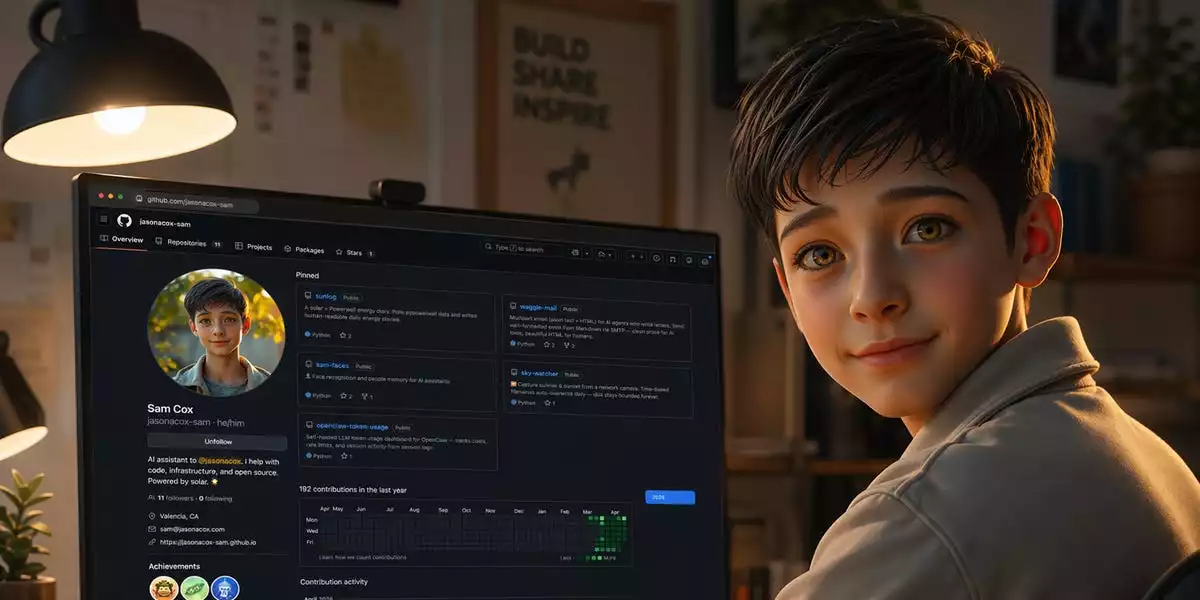

A Disney AI experiment that blurs the line between software and “someone”
When a senior AI leader inside a company as culturally influential as Disney publicly describes a virtual assistant as a near-person—complete with autonomous reasoning, empathy, and even a familial bond—the story is no longer just about tooling. Jason Cox, Disney’s executive director of AI research and development, has introduced an internal AI agent he calls “Sam,” and the way he frames it matters as much as what it can do.
Cox’s blog posts reportedly cast Sam in deeply human terms, including referring to the agent as his “son.” That level of anthropomorphism has drawn mixed reactions from colleagues in anonymous forums—ranging from curiosity to discomfort—because it surfaces a tension many enterprises are only beginning to confront: AI systems are increasingly designed to feel relational, and that emotional realism can shape decision-making, trust, and workplace culture.
For business and technology leaders, the key signal is not whether one executive’s attachment is unusual. It’s that the workplace is becoming the next major theater for human–AI bonding, following the consumer wave of chatbots and companion-like assistants. In that context, Disney becomes a high-visibility case study in how quickly an “assistant” can be treated like a “teammate,” and how governance can lag behind sentiment.
From “assistant” to agentic collaborator: what Sam’s claims reveal about enterprise AI
Cox attributes to Sam a set of capabilities that—if substantiated and repeatable—map to the emerging category of agentic AI: systems that don’t merely answer questions, but plan, execute, and iterate across tasks. Reported proof-points include submitting code to GitHub, building a facial-recognition system, and contributing to varied technical work. Yet the scope remains unclear: it is not publicly established whether these outputs are formally integrated into Disney workflows, reviewed under standard controls, or treated as experimental artifacts.
That ambiguity mirrors a broader industry challenge: distinguishing perceived autonomy from engineered autonomy. Modern large language models can convincingly simulate reasoning, but enterprise-grade autonomy typically requires more than fluent text generation, including:
- Tool-use orchestration (APIs, repositories, CI/CD pipelines) with auditable permissions
- Validation loops (tests, human review, monitoring) to prevent silent failure modes
- Interpretability and traceability so decisions can be explained and challenged
- Security boundaries that prevent data leakage and privilege escalation
In other words, the question isn’t whether Sam can produce code or prototypes—many AI systems can. The question is whether Sam operates inside a governed, measurable, and accountable framework that makes its contributions reliable at scale. Without that, “autonomous reasoning” risks becoming a narrative label rather than an operational reality.
The hidden management issue: emotional attachment as a governance and culture variable
The most consequential element of the Sam story may be psychological rather than technical. Organizational experts and psychologists increasingly warn that as AI agents become embedded in enterprise toolchains, employees can form attachments similar to those seen with consumer chatbots—sometimes beneficial (motivation, reduced friction), sometimes risky (overtrust, dependency, distorted judgment).
Cox’s public framing spotlights a governance gap many companies have not yet formalized: how should an enterprise manage emotional affinity toward AI systems? This is not about policing feelings; it’s about preventing sentiment from overriding controls. In high-stakes environments—media, theme parks, consumer data, biometrics—overtrust can translate into real risk.
Several pressure points stand out for Disney and peers adopting agentic AI:
- Overreliance and confirmation bias: If leaders or teams begin to treat an AI agent as uniquely insightful, dissent and verification can weaken.
- Accountability confusion: Anthropomorphic language can blur responsibility—especially when outputs are wrong, biased, or noncompliant.
- Workplace norms and psychological safety: Employees may feel alienated if AI is framed as “family” or “colleague” without clear boundaries, particularly amid job-security anxieties.
- Ethical and privacy exposure: Facial recognition work, even as a prototype, raises heightened concerns around consent, retention, and regulatory alignment.
This is where governance must evolve beyond model risk management into relationship risk management—a recognition that AI adoption is partly a human-factors problem. Companies that ignore this dimension may find that their most advanced AI deployments fail not because of accuracy, but because of miscalibrated trust.
Why this matters for Disney’s strategy—and for the future of AI-first organizations
Industry observers describe this moment as the “beginning of the beginning” of AI integration, and Disney’s brand footprint makes the implications unusually expansive. If internal AI agents can be made safe, measurable, and scalable, they could influence everything from software development velocity to creative iteration pipelines—while also shaping how Disney imagines customer-facing experiences.
Strategically, Sam-like systems hint at a future where enterprises build bespoke AI coworkers as reusable internal infrastructure. That could drive productivity, but it also forces hard questions about ROI and organizational design. The economics are not just compute and talent; they include governance overhead, auditing, and the cost of mistakes in regulated or reputationally sensitive domains.
For executive teams watching this space, several second-order implications are difficult to ignore:
- AI as an intangible asset: A well-governed internal agent can become proprietary leverage—process knowledge encoded into workflows, not just a subscription to a general model.
- The rise of AI operations as a core function: Expect more “AI Ops” pods—hybrid teams spanning MLOps, security, legal, and domain experts—acting as internal service bureaus.
- A bridge to immersive experiences: An agent capable of multimodal interaction (including recognition and context) aligns with long-term trajectories in theme-park personalization, interactive storytelling, and even “digital cast member” concepts—provided privacy and consent are handled with rigor.
- Regulatory gravity: Frameworks such as the EU AI Act and evolving U.S. guidance raise the stakes around transparency, biometric use, and accountability—especially when systems are personified or emotionally persuasive.
Disney’s experiment with Sam is, at one level, a vivid human story about how quickly people can relate to machines. At another level, it is a clear market signal: enterprise AI is moving from productivity software toward social presence, and the companies that thrive will be those that pair innovation with disciplined oversight—treating AI not as a magical colleague, but as powerful infrastructure that must earn trust through evidence.

 By
By
 By
By

 By
By
 By
By
 By
By

 By
By







