
Climate Migration Moves From Abstraction to Treaty: The Tuvalu-Australia Accord as a Global Signal
When Tuvalu and Australia inked their climate-visa pact—granting 280 annual migration slots to Tuvaluans threatened by rising seas—they did more than open a lifeline for a vulnerable Pacific nation. They signaled, with rare clarity, that the era of climate-driven migration is no longer a distant scenario but a lived reality, demanding new architectures of law, technology, and capital. The agreement’s first application cycle, oversubscribed thirtyfold, underscores both the desperation and the scale of latent demand. For the world’s billion-plus people exposed to coastal flooding, Tuvalu’s exodus is a harbinger, not an outlier.
Geopolitics, Digital Sovereignty, and the Rewriting of Refugee Law
Australia’s climate-visa initiative is as much a chess move in Pacific geopolitics as it is an act of humanitarian stewardship. As China’s influence expands across Oceania, Canberra’s willingness to offer a treaty-based migration pathway doubles as soft-power projection, setting a precedent that other regional players may soon emulate. The University of New South Wales’ modeling suggests that, via Australian and New Zealand routes, up to four percent of Tuvalu’s population could depart each year—implying that within a decade, nearly half the nation may be resettled abroad.
But the implications extend far beyond the Pacific. The agreement pressures multilateral bodies to confront the legal vacuum surrounding climate refugees. The 1951 Refugee Convention, drafted for the aftermath of war and persecution, is silent on environmental displacement. Should climate become a recognized basis for asylum, the ripple effects would recalibrate international liability, aid flows, and even insurance frameworks, as states and corporations alike grapple with new forms of cross-border risk.
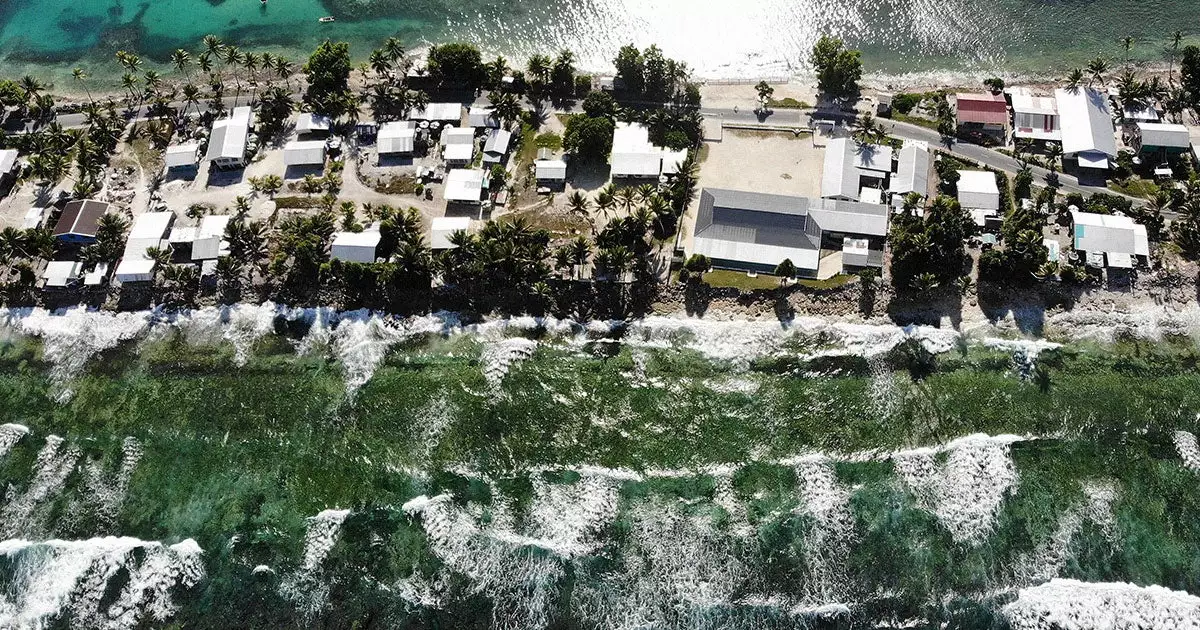
Meanwhile, Tuvalu’s government is racing to preserve its identity in the digital realm. By commissioning high-resolution 3D scans of its islands—a “digital twin” of the nation—it is staking a claim to digital sovereignty. This raises profound questions: Can a country exist as a virtual polity if its land disappears beneath the waves? What becomes of its exclusive economic zone, its tax base, its UN seat? The answers will shape not only Tuvalu’s fate, but the future of nationhood itself.
Technology as Lifeline: Digital Twins, AI Risk Models, and Blockchain Registries
The Tuvaluan crisis is catalyzing a wave of technological innovation. What was once the preserve of urban planners and gaming studios—immersive mapping, LIDAR, photogrammetry—is now being deployed at national scale. The creation of digital twins for entire countries is driving demand for cloud-native geospatial analytics, edge processing, and long-term archiving, opening lucrative opportunities for hyperscale cloud providers and AI firms.
Equally transformative is the influx of migration data, which is sharpening the predictive power of climate-risk models. Insurers, reinsurers, and asset managers are leveraging these real-world datasets to recalibrate their exposure to coastal risk—translating human displacement into actuarial tables and, ultimately, into the cost of capital. As land becomes uninhabitable, blockchain-anchored registries may preserve property rights and legal provenance, offering a lifeline to displaced populations and a new frontier for FinTech and RegTech providers.
Economic Realignment: Labor, Insurance, and the Next Wave of ESG
Australia’s climate-visa program is not merely an act of charity; it is a calculated response to domestic labor shortages, particularly in agriculture and seasonal industries. By welcoming English-speaking Tuvaluans, Australia injects new talent into its workforce, while simultaneously burnishing its credentials on climate justice—a narrative with growing resonance among global investors.
For the insurance and reinsurance sectors, Tuvalu’s migration is a wake-up call. As forced migration probabilities rise, premiums for coastal assets will inevitably follow suit, prompting a reallocation of capital toward resilient infrastructure: ports, sea walls, and inland logistics hubs. The Biden Administration’s $50 billion Climate Resilience Framework and the EU’s €270 billion Green Deal are emblematic of this capital pivot.
Enterprises, too, must adapt. Multinationals with coastal supply chains will need to overhaul their site-selection models, integrating forced-migration risk into continuity planning. Climate-migration exposure is fast becoming a material risk item under ISSB-compliant ESG reporting, with early disclosure likely to differentiate issuers in both debt and equity markets. For HR leaders, the arrival of climate migrants offers a rare chance to build localized onboarding pipelines, capturing both labor efficiency and reputational upside.
The New Strategic Imperative: From Peripheral Risk to Core Value Driver
Tuvalu’s predicament transforms climate migration from a peripheral CSR concern into a core driver of governance, technology, and capital allocation. The next decade will likely witness a proliferation of bilateral migration treaties, the emergence of a “Climate Geneva Convention,” and the recognition of digitally persistent states at the United Nations. For business leaders and policymakers, the imperative is clear: pilot adaptive technologies, stress-test portfolios for migration risk, and engage in policy shaping—before the periphery becomes the new mainstream. As Fabled Sky Research and others have observed, those who move early will define the contours of a world where climate migration is not the exception, but the rule.

 By
By
 By
By
 By
By
 By
By

 By
By


 By
By