
From kamikaze speedboats to modular “drone carriers” at sea
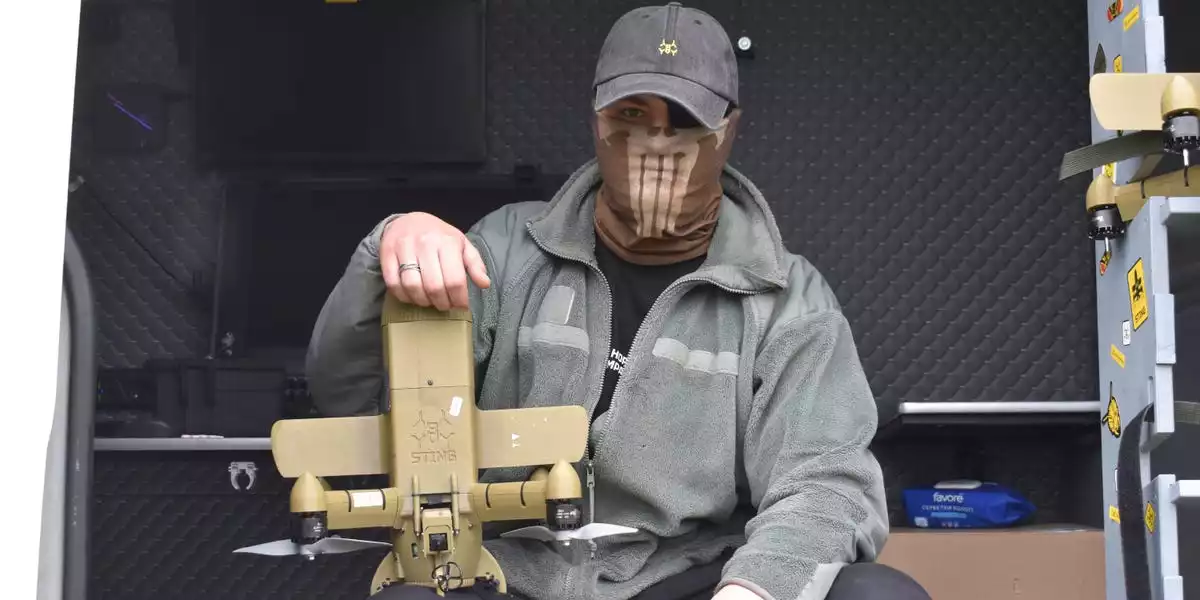
Ukraine’s rapid evolution in uncrewed naval warfare is increasingly defined not by single-purpose, one-way attack craft, but by multi-role “drone motherships”—larger surface drones designed to carry, launch, and in some cases recover smaller drones for both offense and defense. This is a notable doctrinal shift: instead of treating maritime drones as expendable munitions, Ukrainian engineers are treating them as reconfigurable platforms—a move that mirrors broader trends in modern defense technology where adaptability and iteration speed can outweigh sheer platform size.
The operational logic is straightforward. As Russian forces adapt to the threat posed by one-way explosive boats—through layered surveillance, electronic warfare, and physical barriers—Ukraine is responding with multi-axis complexity. A mothership can approach contested waters and then deploy first-person-view (FPV) attack drones or interceptor drones, expanding the engagement envelope beyond what a single hull can achieve. The result is a maritime system that behaves less like a “boat” and more like a distributed launch node in a wider kill chain.
This concept is also part of a visible action–reaction cycle. The summary notes Russian equivalents appearing since mid-2025, underscoring that the Black Sea is becoming a proving ground for unmanned maritime systems where innovation is measured in weeks, not procurement cycles.
—
Resilient autonomy and the rise of “systems-of-systems” warfare
The most consequential technical development is not simply adding launch rails to a larger drone boat; it is the emergence of modular autonomy and networked engagement—a shift toward a systems-of-systems architecture.
Key characteristics define this maturation:
- Modular payload design: A single mothership hull can host interchangeable payloads—attack FPVs, reconnaissance drones, or defensive interceptors—reducing the need for bespoke redesign and enabling rapid field upgrades.
- Hardened command-and-control (C2): In a battlespace saturated with jamming and spoofing, the ability to maintain control links, operate with degraded communications, and navigate in GNSS-denied environments becomes a primary differentiator.
- Cross-domain utility: The reported use of a sea-based interceptor against an aerial threat (e.g., Shahed-type drones) illustrates how maritime nodes can contribute to air defense—an early indicator of cross-domain fusion where the sea becomes a launch and sensing layer for aerial engagements.
This is where the story becomes larger than naval tactics. Ukraine’s experimentation with hybrid manned–unmanned architectures, including repurposing crewed aircraft such as an Antonov An-28 as an aerial drone carrier, signals a pragmatic approach: use existing logistics and airframes to solve persistent constraints like drone endurance, range, and basing vulnerability. The same design philosophy is spilling into ground robotics—uncrewed land vehicles carrying loitering munitions—suggesting a convergent model of warfare in which platforms are increasingly hosts rather than single-purpose weapons.
—
Industrial economics: why low-cost maritime drones are reshaping defense procurement
The economic implications are as disruptive as the technical ones. Drone motherships reinforce an asymmetric cost-exchange ratio that challenges traditional naval investment logic. A relatively low-cost uncrewed surface vessel can deploy multiple micro-drones, forcing an adversary to spend disproportionately on detection, interception, and protection. For navies built around expensive surface combatants, this dynamic raises uncomfortable questions about survivability, mission assurance, and fleet composition in contested littorals.
From an industrial standpoint, Ukraine’s push toward indigenous production is equally significant. Building hulls domestically, integrating launch racks, and relying on open-architecture software stacks can catalyze a local unmanned-systems ecosystem spanning:
- marine fabrication and materials
- electronics integration and secure communications
- autonomy software, computer vision, and edge AI
- commercial UAV supply chains repurposed for defense
This creates a dual reality for Western defense contractors. On one hand, there is clear demand for advanced sensors, secure datalinks, electronic warfare resilience, and AI modules. On the other, Ukraine’s wartime innovation environment—where startups and small engineering teams iterate quickly—can become a competitive force in its own right, especially in the mid-tier unmanned market where speed and cost often dominate.
The dual-use nature of the enabling technologies—battery energy density, lightweight propulsion, mesh networking—also broadens the proliferation risk. As commercial maritime robotics and consumer drone ecosystems feed military adaptation, the barrier to entry drops not only for states, but potentially for non-state actors, increasing pressure on export controls and supply-chain governance.
—
Strategic implications for the Black Sea—and for any navy operating in the littorals
Operationally, drone motherships extend Ukraine’s reach into contested waters near Crimea and other choke points, complicating Russian maritime denial and creating a form of littoral anti-access/area denial (A2/AD) optimized for ambiguity, speed, and distributed lethality. The strategic value is not merely in sinking ships; it is in forcing an adversary to operate under persistent uncertainty—never fully confident whether a contact is a decoy, a sensor node, a strike platform, or a carrier for something else.
For NATO and other maritime powers, the lesson is not limited to the Black Sea. Any constrained maritime theater—the Baltic, the Eastern Mediterranean, the Persian Gulf, the South China Sea’s littorals—could see similar pressures. Navies may need to reassess:
- patrol patterns and standoff distances in drone-saturated waters
- electronic warfare posture as a frontline defensive layer, not a niche capability
- rules of engagement and attribution frameworks, since uncrewed systems can blur responsibility and compress decision timelines
Looking ahead, the next competitive frontier is likely AI-enabled C2 at the edge: onboard target classification, threat prioritization, and decentralized replanning that reduces dependence on vulnerable links. That implies growing demand for maritime-hardened edge compute, anti-spoof navigation, and secure communications—technologies with direct spillover into civilian marine autonomy, from offshore inspection to search-and-rescue.
Ukraine’s drone mothership concept ultimately signals a broader shift in modern conflict: advantage accrues to forces that can distribute capability, reconfigure quickly, and impose disproportionate defensive costs—a formula that is steadily rewriting the balance between exquisite platforms and adaptable, networked autonomy.


 By
By

 By
By
 By
By

 By
By
 By
By