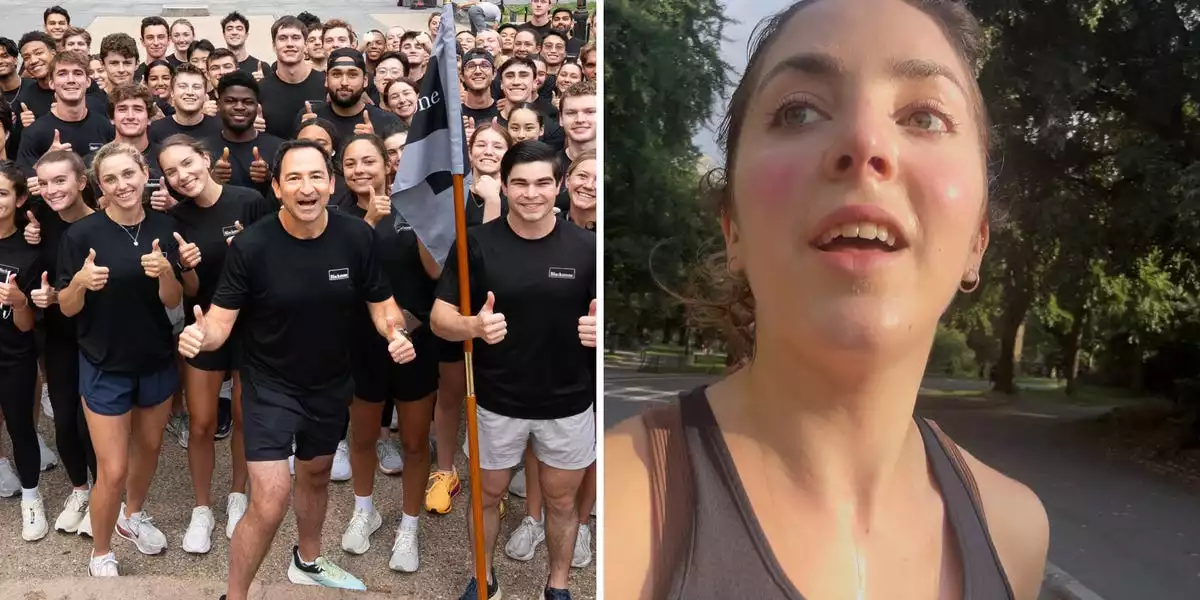

A Central Park run that doubles as a modern leadership signal
When Jon Gray, President and COO of Blackstone, laced up for a 9:22-per-mile group run in Central Park alongside more than 110 interns, first-year analysts, and pre-MBA summer associates, the optics were unmistakable: a senior leader choosing proximity over distance. Yet the deeper significance lies not in the pace or the photo opportunity, but in what the moment communicates about executive accessibility, culture-building, and employer branding in financial services.
The run also carried emotional weight, serving as a tribute that honored the memory of Wesley LePatner, a Blackstone executive who recently passed away. In a sector often characterized by controlled messaging and formal rituals, the combination of informal community, visible leadership, and remembrance created a rare kind of corporate narrative—one that is simultaneously human and strategic.
Participants described a relaxed atmosphere: conversation flowed, hierarchy softened, and the event felt less like a staged initiative than a shared experience. That distinction matters. In today’s attention economy, audiences—especially early-career professionals—are highly attuned to the difference between performative culture and lived culture. Gray’s presence, and the ease of the setting, implicitly argues that leadership is not only something you observe from afar; it can be something you encounter in real time.
LinkedIn microcontent and the rise of the executive as brand infrastructure
Gray’s Central Park run is best understood as an extension of his now widely circulated LinkedIn running videos, which blend casual fitness footage with quick business reflections. The format is deceptively simple: low-friction, repeatable, and tuned to how professionals actually consume information—between meetings, during commutes, or in brief scroll sessions. This is microcontent as corporate infrastructure, where the executive becomes a durable distribution channel for the firm’s values and narrative.
Several forces converge here:
- Platform mechanics: LinkedIn’s algorithm tends to reward content that drives dwell time, comments, and shares—metrics that conversational, “in-the-moment” posts often outperform compared to polished corporate videos.
- Audience expectations: Gen Z and younger Millennials have grown up with two-way digital communication. They expect leaders to be visible, responsive, and legible as people—not only as titles.
- Employer brand competition: In elite finance recruiting, differentiation is increasingly cultural and experiential. Compensation remains important, but so do mentorship signals, belonging, and perceived access to decision-makers.
For Blackstone, the strategic upside is clear: a senior executive’s authentic presence can amplify recruitment reach, strengthen internal pride, and shape external perception at a fraction of the cost of traditional brand campaigns. The content also travels beyond candidate pools into the broader investment and business community, reinforcing Blackstone’s positioning as a modern, talent-centric alternative-asset manager.
Crucially, Gray has emphasized authenticity over production value, arguing that hyper-produced content often fails to resonate. That stance aligns with a broader shift across industries: credibility increasingly comes from consistency and candor, not cinematic polish.
Authenticity under regulation: the governance challenge finance can’t ignore
Financial services has historically been cautious about executive social media for good reason: compliance risk, reputational exposure, and regulatory scrutiny are real. Gray’s approach suggests a workable middle path—one where leaders can be present and personable without drifting into the hazards that have tripped up firms and employees across the industry.
The key governance question is not whether executives should engage, but how organizations operationalize safe authenticity. That typically requires:
- Clear social media policies that define boundaries without defaulting to blanket restrictions
- Training for leaders and junior employees on what “safe” looks like in practice (material nonpublic information, endorsements, political content, client confidentiality, and performance claims)
- Real-time review and escalation paths for ambiguous posts, especially during market-moving events
- Consistent enforcement that protects culture from becoming a double standard—where senior leaders can post freely while junior staff are penalized for missteps
Gray’s public acknowledgment of the risks younger employees face online is notable because it frames governance as a shared responsibility rather than a top-down constraint. That framing can improve compliance outcomes: people are more likely to follow rules they understand and perceive as fair.
What this signals for talent strategy, analytics, and AI-enabled communications
The Central Park run also points to a broader evolution: executive advocacy is becoming measurable, systematized, and increasingly augmented by technology. Communications teams can already track sentiment, engagement, and referral traffic; HR teams can correlate brand momentum with applicant flow and offer-acceptance rates. The next step is integrating these signals into a coherent talent and reputation strategy.
Forward-looking organizations are likely to formalize:
- Executive advocacy programs: lightweight playbooks for storytelling, cadence, compliance guardrails, and platform fluency
- ROI measurement: KPIs linking executive content to recruiting outcomes (application volume, acceptance rates, retention deltas, and recruiting-cost efficiency)
- Hybrid culture rituals: in-person moments like the run, complemented by scalable analogs—virtual “walk-and-talks,” wellness challenges, and mentorship communities that persist across geographies
AI will likely accelerate this shift. Automated editing, captioning, and compliance-aware drafting tools can help leaders produce higher volumes of “natural” content while reducing risk and time burden. Just as importantly, AI-driven analytics can help firms understand which narratives resonate with which audiences—candidates, investors, employees—without reducing leadership communication to mere optimization.
Seen through this lens, Jon Gray’s run is not simply a viral moment or a feel-good leadership anecdote. It is a case study in how social capital, executive presence, and cultural credibility are becoming competitive assets—ones that can influence recruiting pipelines, internal cohesion, and the long-term strength of a firm’s brand in a market where talent increasingly chooses employers the way consumers choose products.

 By
By

 By
By
 By
By
 By
By
 By
By

 By
By