

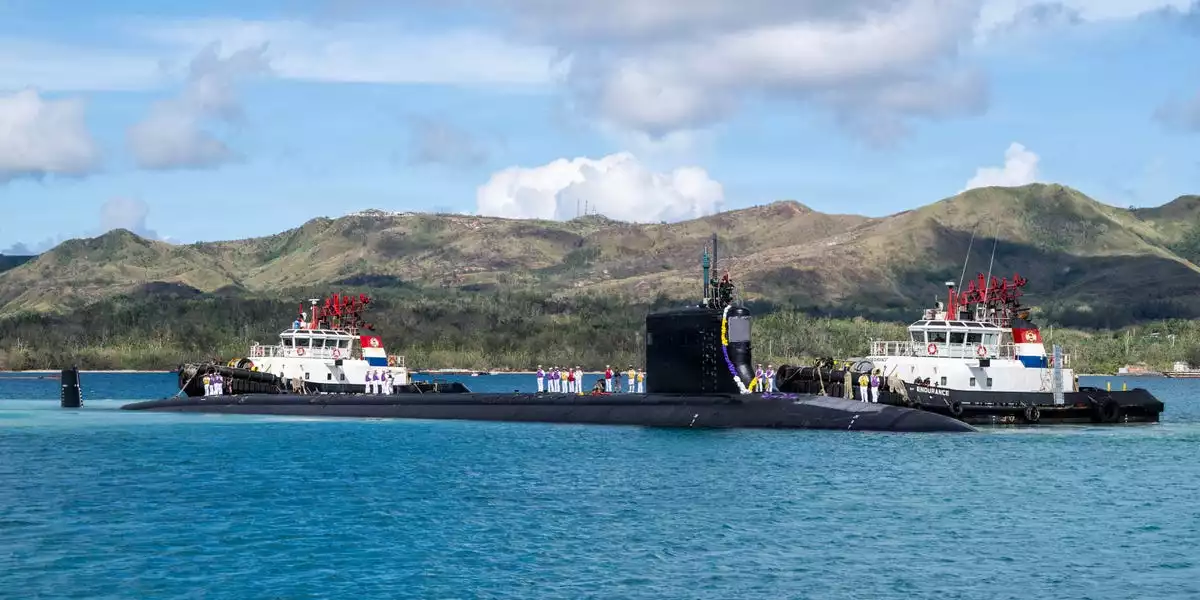

A $76.6B submarine award that doubles as industrial policy
The U.S. Department of Defense’s $76.6 billion award to General Dynamics Electric Boat and Huntington Ingalls Industries is more than a procurement headline—it is a deliberate attempt to re-architect the U.S. submarine industrial base for a period defined by great-power competition, persistent supply-chain fragility, and a tightening skilled-labor market. The contract covers construction of 14 nuclear-powered submarines—five Columbia-class ballistic missile submarines (SSBNs) and nine Virginia-class Block VI attack submarines (SSNs)—while also funding the less visible, but increasingly decisive, enablers: shipyard modernization, workforce expansion, supplier resilience, and automation.
This dual-track approach reflects a hard-earned lesson from recent naval programs: the fleet’s readiness is constrained not only by design ambition or congressional appropriations, but by the throughput capacity of yards, the health of Tier-2 and Tier-3 suppliers, and the availability of certified trades. By bundling platforms and production infrastructure in one large commitment, the Pentagon is effectively purchasing schedule credibility—or at least improving the odds of it—at a time when delays and cost pressures have become structural rather than episodic.
Key elements embedded in the award signal the government’s intent to stabilize a sector historically plagued by “lumpy” demand:
- Multi-year visibility that supports long-lead material buys and steadier hiring
- Capital upgrades to shipyard equipment, facilities, and production lines
- Supplier-base reinforcement to reduce single points of failure
- Automation investments aimed at improving quality and compressing timelines
Digital shipbuilding, modularity, and the new production playbook
Technologically, the scale and mixed-class nature of the award underscores a shift toward modular design and digital engineering, where submarines are increasingly treated as evolving product lines rather than one-off marvels. Both the Columbia-class and Virginia-class programs have been moving toward shared approaches in hull fabrication, combat-system software, and mission-bay modularity, enabling faster “block” upgrades and more predictable mid-life refits.
At the center of this transition is the growing use of digital twin methods—high-fidelity virtual models that integrate design, manufacturing, and sustainment data. In practice, this can reduce rework, improve configuration control, and accelerate change incorporation. For nuclear submarines—where tolerances are unforgiving and certification burdens are heavy—digital continuity can become a competitive advantage in its own right.
The contract’s emphasis on automation is equally telling. U.S. shipyards are confronting a persistent labor constraint, particularly in specialized roles such as welding, pipefitting, and nuclear-qualified work. Investments in robotics, additive manufacturing, and AI-assisted planning are intended to augment scarce labor rather than replace it—shifting human effort toward the highest-skill tasks while machines handle repeatable processes and inspection workflows.
Several technology spillovers are likely to matter beyond defense:
- Advanced alloys and composites developed for acoustic stealth and survivability may migrate into offshore energy and high-end industrial systems
- Digitally controlled welding and metrology can raise precision standards in civilian manufacturing
- Power-management and noise-reduction innovations often find second lives in medical devices and specialized machinery
In this sense, the submarine program functions as a high-cost but high-leverage innovation engine—one that can seed broader industrial capability if supply chains and standards are managed with intent.
The economics of stability: jobs, inflation risk, and supplier resilience
Economically, the award attempts to solve a problem that has quietly undermined U.S. shipbuilding competitiveness: instability. When order books swing unpredictably, suppliers hesitate to invest, workers leave for steadier industries, and yards struggle to maintain learning curves. A large, multi-platform commitment offers a counterweight—creating the conditions for workforce retention, training pipelines, and more disciplined supplier contracting.
The regional impact will be substantial, particularly around Electric Boat’s Quonset Point, Rhode Island, and Ingalls’ Pascagoula, Mississippi. These shipbuilding hubs tend to act as economic anchors, pulling in secondary employment across logistics, machining, engineering services, and construction. For policymakers, that makes the program both a national security instrument and a regional development lever.
Yet cost control remains a central tension. Locking in major spending now can hedge against future commodity inflation in inputs such as steel, titanium, and electronics. At the same time, the biggest uncertainty often sits in labor—where wage escalation, overtime, and competition for certified trades can erode budgets quickly. The success of this award will be measured not only by hulls delivered, but by whether primes and the Navy can:
- Maintain schedule discipline without triggering runaway overtime
- Expand capacity without diluting quality and nuclear certification rigor
- Prevent supplier bottlenecks from becoming program-wide delays
Undersea deterrence and the emerging logic of allied shipyard collaboration
Strategically, the rationale is straightforward: the United States is reinforcing undersea dominance as a hedge against a rapidly modernizing Chinese navy and a more contested Indo-Pacific. The Columbia-class SSBNs are central to nuclear deterrence, designed to ensure second-strike survivability as the Ohio-class ages out. The Virginia-class Block VI SSNs provide the versatile edge—intelligence collection, special operations support, and multi-domain strike options that complicate adversary planning.
What is newly notable is the parallel exploration of deeper industrial collaboration with South Korea and Japan—a signal that Washington may be willing to relax long-standing instincts for exclusively domestic sourcing in order to gain capacity, speed, and resilience. If structured carefully, allied shipyard participation could take multiple forms:
- Maintenance and repair partnerships to free U.S. yards for new construction
- Component or module production under tightly controlled certification regimes
- Joint working groups to harmonize safety protocols, quality standards, and technology protection
This is not a trivial shift. Submarine construction is among the most sensitive industrial activities in defense, and any technology transfer must be balanced against security, intellectual property, and political constraints. Still, the logic is compelling: deterrence is not only about what is designed on paper, but what can be produced, sustained, and surged in a crisis.
Ultimately, the $76.6 billion award reads as a bet that the United States can rebuild the industrial stamina required for a long competition—pairing platform procurement with factory modernization, and pairing national capacity with a pragmatic openness to allied augmentation. If that bet pays off, the result will be measured in something rarer than tonnage: sustained undersea readiness that adversaries must plan around every day.

 By
By
 By
By
 By
By

 By
By

 By
By
 By
By







