

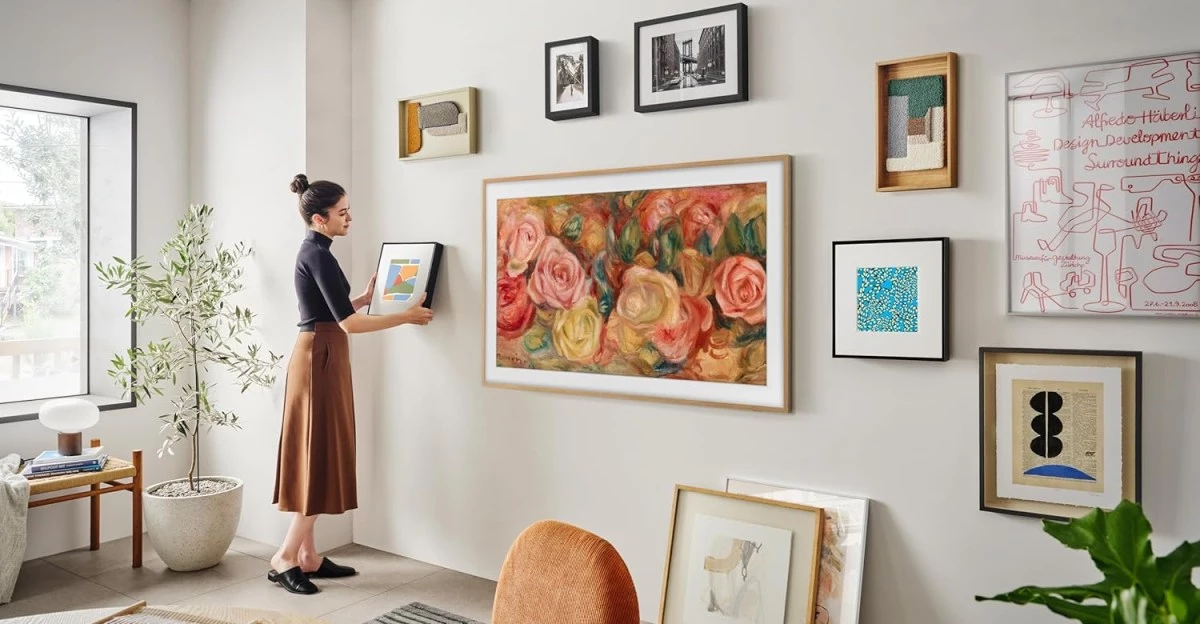

A television that behaves like décor: the rise of the “ambient screen” category
Samsung’s 2025 iteration of The Frame reinforces a clear direction in consumer electronics: the TV is no longer expected to dominate a room when it’s off. Instead, it’s being reimagined as an ambient device—a screen that can recede into the background, complement interior design, and still deliver modern entertainment capabilities when called upon.
At the center of this proposition is a 55-inch 4K QLED panel wrapped in a gallery-inspired aesthetic: matte “art-mode” presentation, picture-frame-style bezels, and an intent to visually read as wall art rather than a black rectangle. This is not merely a styling exercise; it reflects a broader shift in how premium households treat screens—less as a single-purpose appliance and more as a permanent architectural element.
The current market signal is also unmistakable. Listed on Amazon at $697.99—about $200 below its typical price—the product is being positioned as a more accessible entry point into Samsung’s “Lifestyle TV” strategy. For buyers, that discount reframes The Frame from a niche indulgence into a plausible mainstream upgrade, particularly for consumers who prioritize aesthetics and space integration over benchmark-leading picture performance.
Engineering choices behind the gallery illusion—and what they cost
The Frame’s appeal is built on a set of deliberate trade-offs. Reviewers consistently describe a product that excels at design-led integration, while conceding ground to similarly priced TVs on core image metrics such as peak brightness, color accuracy, and black-level performance. That tension is central to understanding the device’s market role.
From a technical standpoint, the matte finish and art-first tuning are meant to reduce reflections and make displayed artwork feel more “print-like” under typical room lighting. Yet the same design constraints—thin profile, emphasis on uniformity, and the need to look convincing as art—can limit how aggressively the panel is driven for high dynamic range impact. In practice, this can translate into less punch in bright HDR scenes and less depth in dark content compared with TVs optimized purely for cinematic performance.
Where The Frame does push forward is in usability and installation architecture. Samsung’s One Connect box—which routes power and inputs through a single cable—remains a differentiator for wall-mounted setups and clean cable management. The included connectivity is also a nod to modern usage patterns, spanning both streaming-first households and console-heavy living rooms:
- HDMI with 4K at 144 Hz support, targeting high-refresh gaming
- USB-A, Ethernet, optical audio, and antenna inputs for legacy and hybrid setups
- A decoupled electronics module that simplifies wall aesthetics and may reduce friction for future modularity
The broader implication is that TV innovation is increasingly split into two lanes: raw panel performance on one side, and industrial design plus system architecture on the other. The Frame is firmly in the second lane, and it is betting that a meaningful segment of consumers will accept “good enough” picture quality in exchange for a TV that visually belongs in a curated living space.
Pricing pressure, margin defense, and the business of “adjacent experiences”
The $200 discount is more than a retail footnote; it reads as a tactical move in a market where televisions are increasingly exposed to commodity pricing dynamics. As panel supply chains mature and feature parity rises, manufacturers face a familiar challenge: how to defend margins when consumers can buy “excellent” picture quality at aggressive prices.
Samsung’s answer with The Frame is to sell perceived value—a blend of design, lifestyle positioning, and ecosystem integration—rather than competing solely on spec sheets. This strategy can support premium pricing in normal cycles, but discounting suggests a need to maintain momentum amid cautious discretionary spending and intense competition.
Just as important is the monetization logic that sits beyond the hardware. By turning the TV into a canvas, Samsung expands the addressable market from “people buying a screen” to “people curating a space.” That opens multiple revenue paths that are structurally more attractive than one-time device sales:
- Art subscription services and rotating digital collections
- Exclusive artist partnerships and curated marketplaces
- Bundled offerings tied to SmartThings, content discovery, and ambient experiences
- Potential collaborations with museums, galleries, or licensing platforms
For business leaders, this is a familiar playbook: shift from product to platform, then monetize the platform through content, services, and partnerships. The Frame is effectively a hardware gateway into a lifestyle ecosystem—one that can be refreshed continuously without requiring the consumer to replace the panel.
Competitive positioning and what comes next for AI-driven home aesthetics
Strategically, The Frame functions as a form of niche differentiation in a crowded premium TV landscape, where competitors such as LG and Sony pursue their own “gallery” concepts through ultra-thin designs and wall-forward form factors. Samsung’s distinctive angle is the explicit prioritization of art-mode credibility and installation cleanliness, even if that means conceding some performance leadership to more cinema-centric sets.
The more consequential forward-looking story is how this category could evolve once AI becomes a first-class feature rather than a background optimization tool. The next generation of ambient displays is likely to incorporate:
- AI-driven art curation that learns user taste and rotates works accordingly
- Automatic adaptation to ambient light and room tone for more convincing “art realism”
- Context-aware modes that shift between décor, information display, and entertainment
- Expansion into hospitality, retail, and commercial real estate, where dynamic art and branding can be licensed at scale
Over time, the endpoint may not be a “TV that looks like art,” but a wall surface that behaves like a display—a convergence of architecture, software, and content licensing. Samsung’s 2025 Frame TV, especially at a newly aggressive price point, is best understood as a pragmatic step toward that future: a product that treats the living room not as a theater, but as a gallery—while quietly building the business scaffolding to monetize what hangs on the wall.

 By
By

 By
By
 By
By
 By
By

 By
By
 By
By







