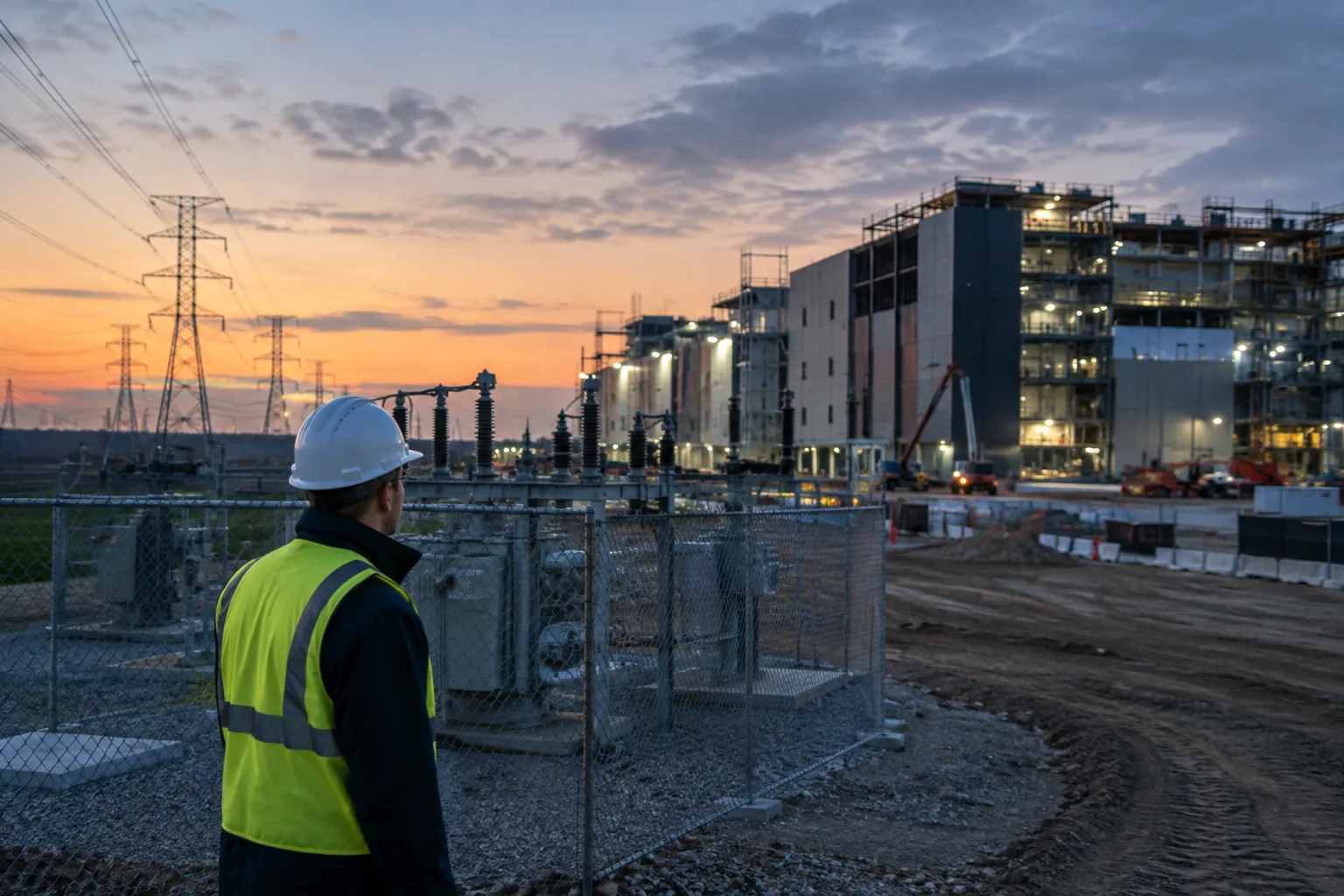

New York’s AI data-center pause reframes “compute” as a public-utility question
New York Governor Kathy Hochul’s one-year moratorium on new hyperscale AI data-center permits is more than a permitting slowdown; it is a signal that the era of treating large-scale compute as routine commercial real estate is ending. By explicitly tying the pause to grid reliability, water consumption, and environmental impacts, the state is positioning hyperscale AI infrastructure alongside other resource-intensive industries that must prove compatibility with public systems before scaling.
The move is notable for its scope and symbolism: it is described as the first statewide pause of its kind in the United States, and it arrives at a moment when AI demand is rapidly reshaping electricity load forecasts, utility investment plans, and local land-use politics. In practical terms, the moratorium creates a regulatory “breathing space” for New York to define standards that could govern:
- Power-density thresholds and interconnection requirements
- Cooling and water-use constraints, including reporting and mitigation
- Environmental performance expectations, potentially aligned with decarbonization goals
- Community-benefit obligations, such as local hiring, tax structures, or infrastructure contributions
For developers and cloud operators, the immediate implication is uncertainty: projects in the pipeline may stall, and capital may be redirected to jurisdictions where approvals are faster and utility capacity is perceived as more expandable.
The infrastructure bottleneck: power, cooling, and the limits of legacy grids
Hyperscale AI facilities are not simply “bigger data centers.” AI training and inference clusters can drive unprecedented power density, creating sharp demand spikes that stress transmission, distribution, and substation capacity. New York’s moratorium reflects a growing recognition that legacy grid architectures—built for more predictable load growth—can be destabilized by sudden, concentrated compute demand unless upgrades are planned in advance.
Cooling is the second constraint, and it is increasingly political. Many high-performance facilities rely on water-intensive cooling because it can be efficient at heat removal. Yet water use is not an abstract metric; it is a local resource question that intersects with municipal supply planning and climate variability. Even in regions not typically associated with drought, hotter summers and competing demands can turn water allocation into a flashpoint.
This is where the moratorium becomes a forcing function for technical adaptation. Operators already have alternatives, but each comes with trade-offs that regulators may now codify:
- Liquid immersion cooling: high efficiency, but higher upfront costs and operational complexity
- Air-side economization: can reduce water dependence, but depends on climate conditions and filtration requirements
- Closed-loop systems and heat reuse: promising for sustainability, but often requires district energy partnerships and new permitting pathways
New York’s pause implicitly argues that hyperscale AI cannot remain “plug-and-play.” The next phase of AI infrastructure will likely be judged on resilience-by-design, not just speed-to-market.
Political economy and interstate competition: “Money Machines” versus managed growth
Former President Donald Trump’s public criticism—framing the moratorium as surrendering “Money Machines” and “Cash Cows”—captures the central political tension: whether AI infrastructure should be accelerated as a jobs-and-investment engine or constrained until externalities are priced and mitigated. His warning of capital flight to Texas, Arizona, Alabama, and Florida reflects a broader reality: data-center site selection is increasingly shaped by permitting velocity, utility posture, and political risk, not only land cost and fiber proximity.
For New York, the economic stakes are real. Hyperscale projects can represent billions in investment, with employment effects spanning:
- High-wage technical roles (facility engineering, network operations, security, reliability engineering)
- Construction and skilled trades during buildout
- Ongoing maintenance, logistics, and vendor ecosystems supporting operations
Yet the fiscal and social calculus is not uniformly positive. Communities and policymakers are scrutinizing whether tax incentives and abatements deliver net benefits once grid upgrades, water impacts, and carbon implications are accounted for. The moratorium suggests New York is shifting away from a pure “race to attract” posture toward a model that attempts to internalize externalities—a framework that may appeal to ESG-minded investors but frustrate developers seeking predictable timelines.
Nationally, similar battles are unfolding wherever residents question the trade-offs between economic development and resource constraints. What changes now is that New York’s statewide action may embolden other jurisdictions—especially dense, infrastructure-constrained states—to consider their own pauses or stricter standards.
What executives and investors should watch next: standards, innovation, and a potential federal response
The next 6–12 months will likely be defined by regulatory drafting and stakeholder negotiation. Utilities, environmental agencies, local governments, and industry groups will have incentives to shape rules that are stringent enough to protect public systems but clear enough to restore investment certainty. For companies, early engagement is not optional; it is a competitive strategy.
Key signals to monitor include:
- Permit criteria: energy-use benchmarks, peak-load management requirements, and interconnection timelines
- Water accounting rules: withdrawal limits, seasonal constraints, and disclosure obligations
- Grid modernization commitments: storage buffering, smart controls, and distributed energy resource integration
- Community-benefit frameworks: local procurement, workforce development, and infrastructure contributions
Over the mid-term, the market may rebalance toward designs that reduce regulatory friction: modular builds, edge-optimized facilities, and architectures that pair compute with on-site renewables and battery storage to smooth demand. Over the longer horizon, fragmented state-by-state outcomes could invite a national AI infrastructure policy conversation, potentially through federal energy and reliability bodies seeking harmonized efficiency and water-use guidelines.
New York’s moratorium ultimately tests a pivotal thesis for the AI economy: whether the next wave of compute can scale fastest by outrunning constraints—or by engineering directly into them. The states that set credible, technically literate standards without paralyzing deployment may end up defining not just where data centers get built, but how AI infrastructure earns its social license to operate.

 By
By
 By
By

 By
By

 By
By

 By
By