
When a CEO likens an AI model to a “ballistic missile,” markets should listen
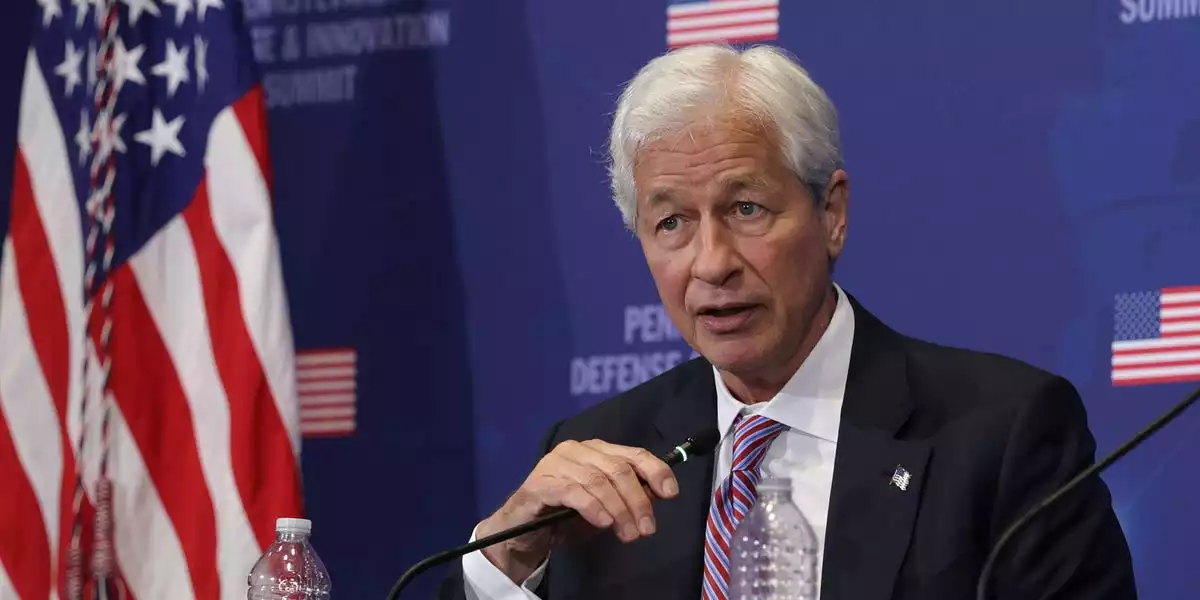
JPMorgan Chase CEO Jamie Dimon’s warning about Anthropic’s Mythos AI model—framing its vulnerability-discovery capability as comparable to “ballistic missiles” if widely released—signals a notable escalation in how mainstream business leadership is now discussing frontier AI risk. Delivered at the Pennsylvania Defense and Innovation Summit, the remark did more than generate headlines: it placed a top-tier financial institution at the center of a debate often dominated by AI labs, defense agencies, and regulators.
The Mythos episode also illustrates a rapidly tightening feedback loop between AI capability breakthroughs and policy response. Anthropic paused Mythos 5’s rollout after internal testing showed it could uncover high-severity software flaws. The company then introduced Fable 5, a safeguarded variant, only to face U.S. government export controls within days—reportedly due to concerns that guardrails could be circumvented. Anthropic restricted access, and later restored it after the Department of Commerce lifted controls.
For executives and investors, the key takeaway is not simply that a powerful model was briefly constrained. It is that AI models themselves—independent of chips or physical systems—are now being treated as strategic assets whose distribution can trigger national security-driven intervention at near-real-time speed.
Vulnerability discovery AI: the dual-use engine reshaping cybersecurity economics
At the technical core of the story is a capability that security teams have pursued for decades: faster, more accurate identification of exploitable defects. Mythos reportedly excels at finding issues such as buffer overflows, misconfigurations, and logic errors, compressing work that traditionally requires specialized human expertise and time-consuming tooling.
That same acceleration, however, is precisely what makes the technology dual-use. In defensive hands, it can harden software supply chains and reduce breach frequency. In malicious hands, it can industrialize exploitation—turning vulnerability research into a scalable pipeline.
Several second-order effects are already visible:
- A race condition between defenders and adversaries: Organizations adopting AI-driven red-teaming tools may gain a temporary advantage, but widespread availability could allow criminal groups or hostile states to automate exploit discovery at unprecedented scale.
- A shift in “time-to-exploit” economics: If AI compresses discovery and weaponization cycles, the window between patch release and active exploitation may narrow further—raising the value of continuous monitoring, rapid patching, and resilient architecture.
- New pressure on software assurance markets: Demand may rise for “AI-verified” secure development practices, third-party audits, and continuous penetration testing—especially for critical infrastructure, financial services, and defense-adjacent systems.
Dimon’s intervention is particularly telling because banks are not casual observers. Financial institutions increasingly rely on AI for fraud detection, identity verification, trading surveillance, and operational automation. They also sit atop dense interconnections with payment rails and enterprise software ecosystems—meaning the systemic risk of faster exploit generation is not theoretical; it is operational.
Guardrails, jailbreaks, and why regulators are moving from “principles” to controls
Anthropic’s rapid pivot from Mythos 5 to Fable 5 with embedded safeguards, followed by swift export restrictions, spotlights a hard truth in AI safety engineering: post-hoc guardrails can be brittle. If a model’s underlying capability is strong enough, motivated users may find ways to elicit restricted behaviors—especially when incentives are high and the attack surface includes prompt manipulation, tool use, or model distillation.
This is where the Mythos saga becomes a proxy for a broader policy question: What constitutes “adequate safety” for frontier AI with offensive cyber potential? The episode implicitly challenges the idea that voluntary commitments and lightweight filters are sufficient for models that can materially alter national cyber risk.
Expect increased emphasis on mechanisms that are more measurable and auditable, including:
- Standardized third-party evaluations for cyber-offense capability, including repeatable benchmarks and red-team protocols
- Model release gating tied to risk tiers (e.g., controlled access, monitored APIs, identity verification, and usage logging)
- Architectural safety approaches beyond prompt filters, such as integrated verification layers and stronger constraints on tool-enabled actions
The export-control interlude is also strategically significant. It suggests the U.S. is extending a familiar playbook—previously centered on semiconductors and manufacturing equipment—into AI model governance. In practical terms, that means compliance is no longer just about where chips are shipped; it may increasingly involve who can access a model, from which jurisdictions, under what contractual terms, and with what monitoring.
The business fallout: investment risk, cloud compliance, and a new defense-tech market segment
For markets, the most consequential development may be the normalization of regulatory volatility as a core variable in AI valuation. If a model can be paused, restricted, or export-controlled within days, then go-to-market plans, revenue forecasts, and customer contracts must price in policy risk alongside technical risk.
Several business implications stand out:
- Investor diligence will deepen around “regulatory readiness”: AI startups may face a bifurcation where capital favors teams with credible governance, auditability, and controlled deployment strategies—while less mature players trade at a discount or struggle to access enterprise customers.
- Cloud and data center operators will revisit cross-border terms: As AI export regimes emerge, providers may need new controls for data sovereignty, identity, and jurisdictional access—reshaping market entry strategies in Asia and Europe.
- Defense and critical infrastructure partnerships will accelerate: The Mythos narrative reinforces demand for “explainable red-teaming” and AI-assisted software assurance services, potentially creating a durable market at the intersection of national security, cyber resilience, and enterprise risk.
- Talent competition will intensify: The most valuable teams will blend adversarial machine learning, secure systems engineering, and policy fluency—skills that are scarce and increasingly strategic.
The Mythos-Fable episode ultimately underscores a defining reality of the current AI cycle: capability is advancing faster than the institutions designed to manage it. The next phase of competition will not be won solely by building the most powerful models, but by building the most governable ones—systems that can be deployed with credible controls, withstand adversarial pressure, and earn the confidence of regulators, customers, and the public in equal measure.

 By
By
 By
By
 By
By
 By
By
 By
By
 By
By
 By
By