


Regulatory tailwinds are turning SAF from aspiration into procurement reality
Sustainable aviation fuel (SAF) has moved decisively from pilot projects to board-level supply strategy, propelled by a tightening web of mandates and market mechanisms. The European Union’s trajectory—a 6% SAF blend by 2030 rising to 70% by 2050—is not merely a climate signal; it is a demand schedule that forces airlines, refiners, and fuel distributors to secure scalable volumes years in advance. Parallel policy momentum in the UK, Singapore, Japan, and Brazil amplifies the effect, creating a multi-region pull on the same limited pool of low-carbon molecules.
This is where the industry’s near-term constraint becomes stark: the most widely used SAF feedstocks—used cooking oil, animal fats, and agricultural residues—are finite, geographically uneven, and increasingly contested. Many of these inputs are already being absorbed by renewable diesel and biodiesel mandates, and the resulting competition introduces price volatility and supply insecurity precisely when aviation needs predictable, certifiable fuel streams.
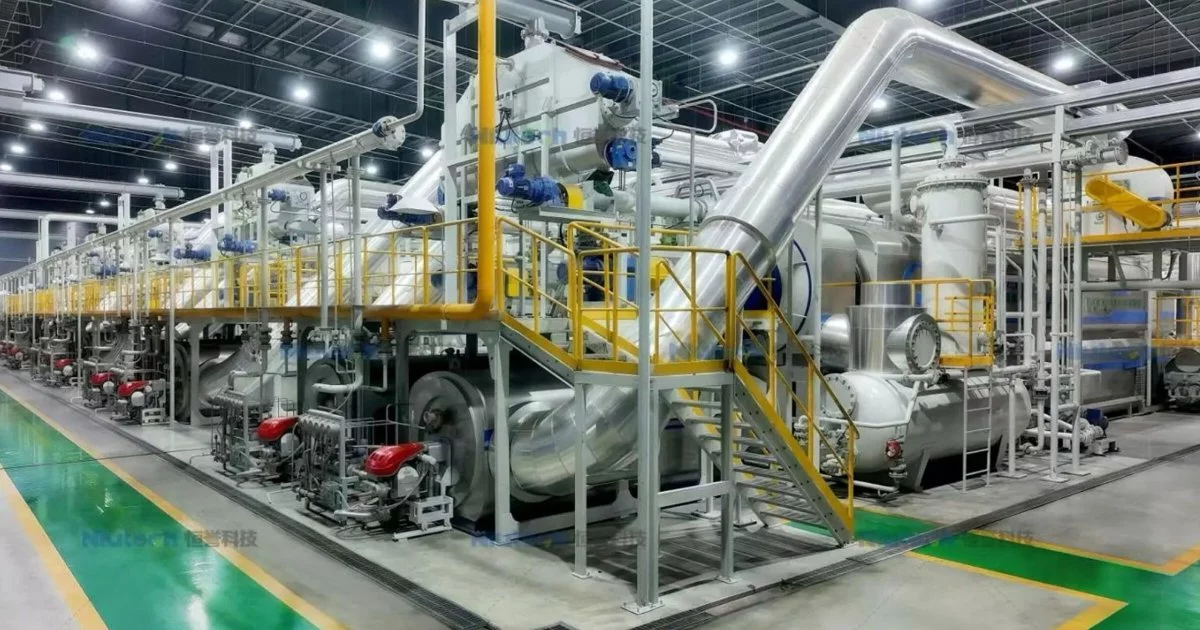
Against that backdrop, the announcement that China’s Niutech has signed a major contract with a global energy player to deploy an industrial-scale continuous pyrolysis line—designed to convert 10,000 to 50,000 tons of waste plastics per year into jet fuel—lands as more than a technology story. It is a strategic response to a structural feedstock bottleneck, and a test of whether plastic-to-SAF can graduate from niche pathway to mainstream supply chain.
—
Continuous pyrolysis and the industrialization test: why this approach is different
Pyrolysis is not new, but the industry has long wrestled with a familiar gap between demonstration success and industrial reliability. Niutech’s proposition centers on continuous pyrolysis, a configuration that—if engineered and operated effectively—can outperform batch and semi-batch systems on the metrics that matter to fuel markets: uptime, throughput stability, and unit economics.
Key technical claims embedded in the project’s design are particularly consequential for scaling:
- Stable, high-utilization operations: Continuous systems are built for steady-state processing, which can translate into higher uptime and lower per-ton operating costs—critical for competing in a SAF market where premiums may compress over time.
- Feedstock flexibility with mixed polymers: The ability to process polyethylene (PE), polypropylene (PP), nylon, and ABS without extensive washing or sorting targets one of the most stubborn barriers in plastics circularity: mixed, contaminated streams that mechanical recycling struggles to monetize.
- “One-roof” integration to reduce friction: Consolidating sorting, feeding, thermal conversion, and downstream refining in a single facility aims to reduce inter-facility transport and handling—an operational advantage that also influences lifecycle carbon intensity, an increasingly decisive factor in SAF eligibility and crediting.
The strategic significance lies in what this configuration attempts to bypass: the costly pre-treatment and logistics complexity that often erode the economics of waste-to-fuel pathways. If Niutech’s model can reliably convert heterogeneous plastic waste into a consistent intermediate suitable for jet fuel upgrading, it could help establish a more industrial template for plastic-derived SAF.
Still, aviation fuel is unforgiving. The pathway’s credibility will ultimately be measured by product consistency, contaminant control, and the ability to meet stringent certification requirements. Scaling hardware is one challenge; scaling quality assurance and certification alignment is another—and it is the latter that determines whether output becomes a tradable aviation fuel component rather than a constrained specialty product.
—
The economics of scarcity: plastics as a contested “new feedstock” for SAF
The market logic behind plastic-to-jet fuel is straightforward: when conventional SAF feedstocks tighten, marginal feedstocks become strategic. Waste plastics—particularly mixed streams with low recycling value—can appear attractive as a price-competitive input. Yet the economics will be shaped by local realities more than global theory.
Several forces will determine whether plastic waste becomes a stable SAF feedstock at scale:
- Collection and aggregation capacity: Plastic is abundant in aggregate, but supply is fragmented. Municipal systems, informal collection networks, and industrial waste streams vary widely in reliability and contamination profiles.
- Policy shifts on plastics: Regulations that restrict single-use plastics or mandate recycling content can change the availability and price of feedstock—sometimes improving collection, sometimes diverting material into other pathways.
- Capital intensity versus operating leverage: Pyrolysis plants are typically capex-heavy, but continuous operations can offer economies of scale once stabilized. Early movers may benefit if SAF premiums persist and if long-term offtake contracts lock in favorable spreads.
- Carbon markets and crediting frameworks: The ability to monetize emissions reductions under mechanisms such as EU ETS and CORSIA can materially affect project returns. But credit eligibility depends on lifecycle accounting rules, which are still evolving for plastic-derived pathways.
A central tension sits beneath these dynamics: plastic-to-fuel can be framed as both waste management and energy transition. That dual identity can unlock partnerships and incentives—or invite scrutiny if stakeholders perceive it as prolonging fossil-like combustion rather than reducing plastic production. For project developers, the commercial pathway runs through transparent lifecycle data, credible traceability, and alignment with emerging SAF definitions.
—
Strategic ripple effects: refinery transformation, circular economy alliances, and geopolitics
If validated at industrial scale, Niutech’s deployment model could influence how energy majors and airlines think about SAF security. For refiners facing long-term declines in conventional fuel demand, plastic-to-SAF offers a potentially complementary route to repurpose infrastructure, talent, and distribution networks—especially if pyrolysis outputs can be integrated into existing upgrading units.
The broader strategic implications are already visible:
- Oil majors and refiners may accelerate competitive responses through acquisitions, licensing, or joint ventures to avoid being structurally short SAF in mandated markets.
- Airlines could pursue vertical integration—equity stakes or long-term offtake agreements—to hedge SAF price volatility and meet decarbonization targets with greater certainty.
- Circular economy partnerships become commercially material: Municipal waste managers, packaging value chains, and technology providers can form consortiums that solve feedstock fragmentation while sharing technology and market risk.
- Geopolitical shifts may follow waste flows: Regions with abundant mixed plastics and limited recycling infrastructure could become exporters of feedstock or finished SAF components, reshaping trade patterns in low-carbon fuels.
What makes this moment distinctive is the convergence of pressures: aviation’s regulatory deadlines, bio-feedstock scarcity, and the need for industrially repeatable conversion technologies. Niutech’s continuous pyrolysis initiative sits at that intersection. If it performs as promised—at scale, with certifiable outputs—it could help redefine SAF supply chains around a new category of feedstock, turning one of the world’s most persistent waste problems into a strategically valuable input for aviation’s decarbonization race.

 By
By
 By
By
 By
By
 By
By


 By
By








