

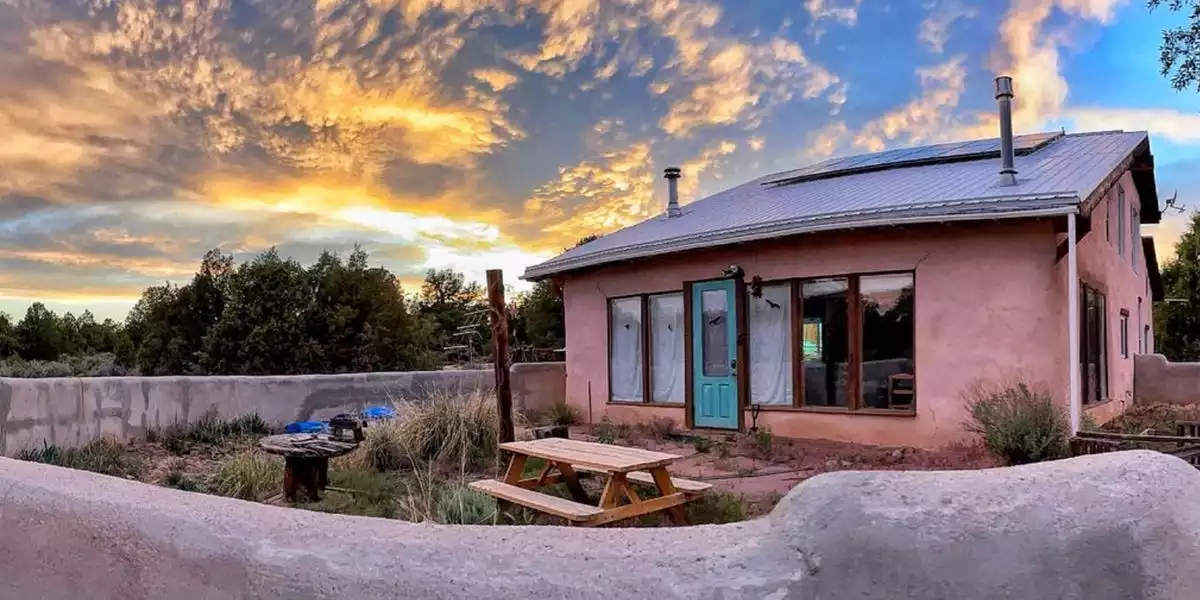

From solar nomadism to off-grid real estate: a case study in autonomy under stress
Jayme and John Serbell’s move from a solar-powered van to a 40-acre straw-bale homestead in northern New Mexico reads, at first glance, like a clean narrative arc: mobility gives way to permanence; experimentation matures into a durable lifestyle. Yet the operational realities of their off-grid residence—powered by rooftop photovoltaic (PV) arrays, supplied by a private well, and supported by an on-site septic system—reveal something more instructive for business and technology leaders: self-sufficiency is not a single technology choice, but a tightly coupled system of dependencies.
The Serbells’ experience underscores a core principle of resilient infrastructure: the moment you remove municipal backstops—grid power, waste pickup, centralized maintenance—you inherit the full stack of reliability engineering. Their homestead delivered genuine continuity during neighboring grid outages, but it also exposed how quickly a “green” setup can become fragile when a single point of failure emerges. In their case, winter snow accumulation effectively turned solar modules into inert surfaces, cutting power to the very services—water pumping and sanitation—that make a home livable.
For investors, insurers, utilities, and product teams, the story is less about lifestyle branding and more about what breaks first, what fails gracefully, and what must be redesigned to make distributed living scalable.
Winterized solar and the hidden coupling of energy, water, and sanitation
The most consequential technical lesson is not that solar can be interrupted—engineers already model intermittency—but that snow cover creates a binary failure mode for many small-scale PV systems: output can drop from sufficient to near-zero, instantly. In an off-grid context, that’s not an inconvenience; it’s a cascading outage.
Key vulnerabilities and design implications stand out:
- PV resilience is now a mechanical problem as much as an electrical one. Snow-induced shutdown points to a market shift toward:
– Tilt-adjustable mounts optimized for seasonal shedding
– Automated snow-clearing mechanisms (robotic brushes, vibration systems)
– Integrated heating elements or thermal films for critical arrays
– Service contracts that treat “snow management” as routine O&M, not an edge case
- Energy storage is necessary but not sufficient. Batteries buffer shortfalls, but prolonged coverage events can exceed storage capacity. Hybridization—storage plus backup generation or demand shedding—becomes the practical design center.
- Water and sanitation are electrically coupled to energy availability. A well pump and modern fixtures can turn electricity into a prerequisite for basic hygiene. The Serbells’ loss of power affecting pumps and toilets highlights the need for redundant, low-energy alternatives, such as:
– Gravity-fed cisterns or elevated storage for emergency water pressure
– Manual pump options for critical supply
– Composting toilets or systems that degrade gracefully without electricity
This is where off-grid living becomes a blueprint for edge infrastructure more broadly. Remote telecom sites, mining outposts, and field research stations face the same coupling: power failure becomes water failure becomes operational shutdown. The Serbells’ homestead simply compresses that reality into a household scale—making it easier to see, measure, and redesign.
Wildlife encounters and the emerging market for rural IoT security
The badger encounter—serious enough to threaten domestic pets—adds a dimension often absent from clean-tech narratives: biotic risk. Rural living is not only about energy and utilities; it is also about managing a living perimeter where humans, livestock, pets, and wildlife intersect.
This creates a credible opening for low-power, long-range sensor networks tailored to remote properties:
- IoT-enabled motion detection with LoRaWAN or similar protocols for wide coverage and low energy draw
- Edge AI classification to distinguish benign movement from threats (reducing false alarms and unnecessary deterrence)
- Automated deterrents aligned with wildlife-management guidance—light, sound, or non-lethal barriers triggered contextually
- Analytics dashboards that translate encounters into actionable patterns (time-of-day risk, seasonal migration, den locations)
What looks like a homestead anecdote maps cleanly onto broader rural security and agri-tech needs: protecting poultry, small livestock, and equipment across large parcels where traditional surveillance is expensive and power budgets are tight. For startups, the differentiator will be accuracy, low maintenance, and humane compliance—a product category that sits between consumer smart-home devices and industrial perimeter systems.
Waste logistics, circularity, and the resilience premium reshaping rural economics
Perhaps the most economically revealing detail is not the solar array or straw-bale construction, but the 70-mile round-trip to a landfill due to the absence of municipal waste collection. That distance is a price signal: it exposes a service gap and forces behavioral change. The Serbells reduced consumption and avoided single-use items not primarily through ideology, but through friction—because every bag of trash carries a measurable time and fuel cost.
That dynamic points to several business implications:
- A new “micro-haul” market for remote corridors where traditional refuse services don’t pencil out. Small-fleet operators—potentially using electric vehicles optimized for low-volume routes—could monetize scheduled pickups, consolidation, and backhaul logistics.
- Community-based circular economy hubs become more than sustainability rhetoric. Localized composting, material recovery, and shared drop-off infrastructure can reduce transport externalities while creating micro-enterprises in rural regions.
- Total cost of ownership (TCO) for off-grid property is changing. High upfront capex—PV, storage, well, septic, high-performance straw-bale envelope—can be offset by reduced recurring utility costs. But the true model is more nuanced: autonomy shifts spending from monthly bills to maintenance, redundancy, and risk management.
- Resilience is becoming a priced attribute. As grid reliability faces climate stress, assets that can sustain essential services during outages may command a resilience premium—in valuation, financing terms, and insurance underwriting. Expect “off-grid autonomy” to be quantified across energy, water, waste, and safety as a standalone risk category.
For utilities and energy-service companies, this is also a strategic inflection point. Microgrid-as-a-Service offerings—bundling PV, storage, backup generation, and winterization maintenance—could decouple resilience from individual expertise, making distributed living and remote operations more bankable and less brittle.
The Serbells’ homestead ultimately functions as a real-world stress test: it demonstrates that distributed infrastructure can outperform the grid on continuity, while also revealing the unglamorous failure modes—snow load, waste distance, wildlife intrusion—that will define the next wave of product design, service innovation, and investment underwriting in resilient, decentralized living.

 By
By
 By
By
 By
By
 By
By

 By
By









