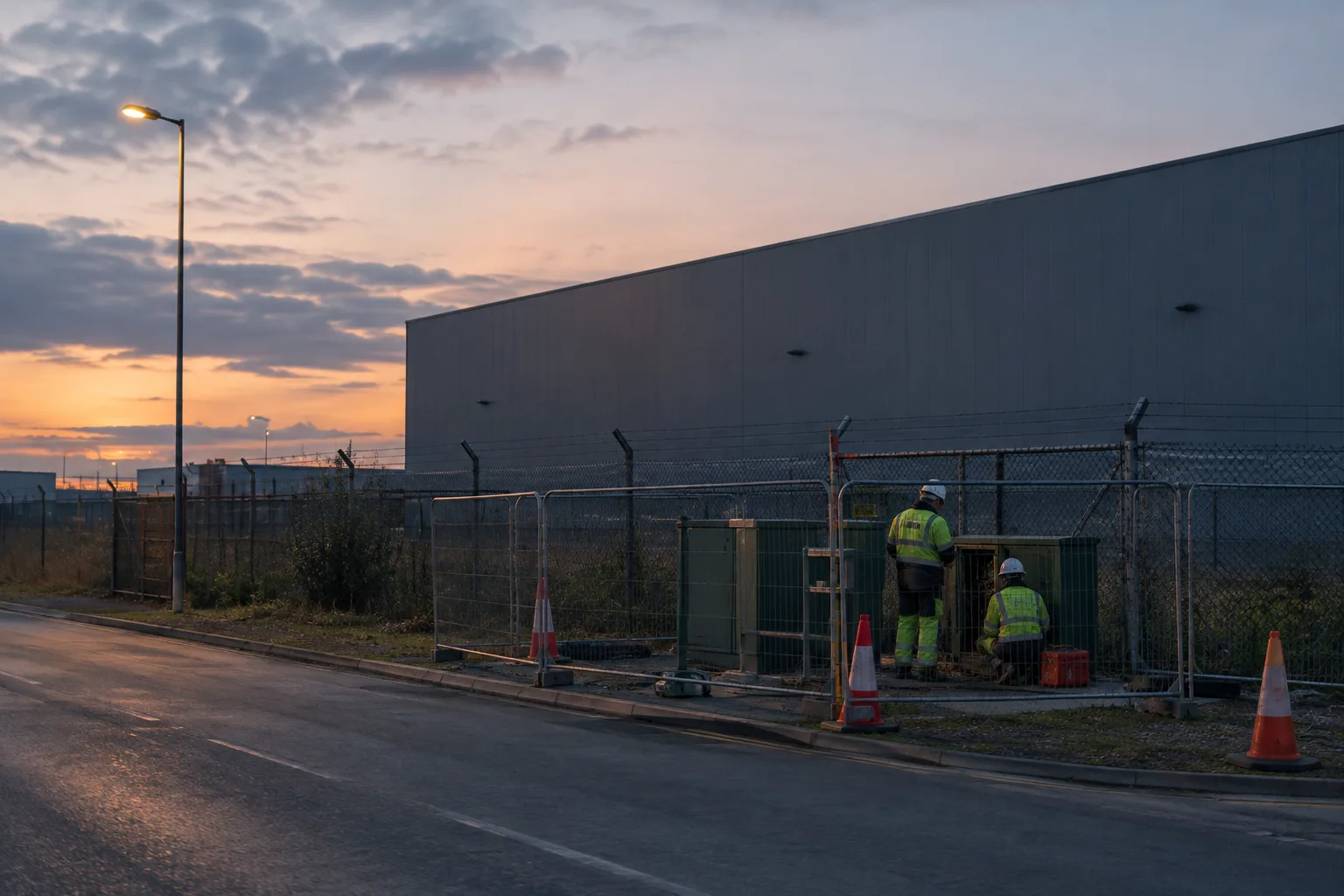

NEXTDC is stopping work on data-centre projects that do not yet have customer contracts after a power-connection and community-consent problem at its M3 Melbourne campus forced a sharp cut to FY27 guidance. The immediate issue is one Australian site. The broader significance is much bigger: in the AI infrastructure boom, demand for compute is not the same thing as bankable, billable capacity.
As Reuters reported on November 9, CEO Craig Scroggie told the UBS Australasia conference that NEXTDC’s immediate priority is to fix the delayed M3 Melbourne expansion, win community backing and focus capital on capacity customers have already committed to. He did not say how many projects would be paused.
That makes this more than a company-specific setback. Cloud and AI buyers want to know whether reserved capacity will show up on time. Utilities and councils are seeing how much influence a delayed network upgrade can exert over private investment. Infrastructure investors are being reminded that a credible energization date can matter as much as land, concrete and server demand.
The practical question for readers is whether this signals weakening AI demand, or a tougher but rational financing model for data-centre growth. On the available facts, it looks much more like the second.
Where the chain broke
NEXTDC’s M3 campus in West Footscray depends on Jemena Electricity Networks’ 66kV augmentation works. In its October 21 ASX release, NEXTDC said Jemena had suspended parts of those works in September 2026 because of safety concerns, community and stakeholder opposition, and missing local-council consent while consultation continued. Jemena did not expect to restart before February 2027. That moved NEXTDC’s next increase in grid supply from FY27 to FY28.
This is the critical mechanism. A data-centre operator can keep building halls, but if the grid upgrade slips, the new capacity cannot be fully energized and billed on the original schedule. NEXTDC said M3 hall construction was continuing, but that did not prevent the commercial hit.
The financial effect was immediate. NEXTDC cut FY27 net-revenue guidance to A$475 million to A$500 million from A$615 million to A$640 million, and underlying EBITDA guidance to A$245 million to A$265 million from A$385 million to A$410 million. The affected M3 contracts represented about A$140 million of both net revenue and underlying EBITDA in the prior guidance. The company also said the capacity remains under contract, subject to customer rights.
That last phrase matters. This is not the same as saying demand disappeared or the customer walked away. But it does mean the economics are no longer clean. Service-level credits, renegotiation or termination rights could still affect the final outcome, and the affected customer has not been publicly named. The revised power ramp and final billing schedule are still unresolved.
Why a contract-first pause makes sense
Once a third-party grid project starts pushing revenue out by a year, speculative expansion becomes harder to justify. NEXTDC’s answer is to protect near-term economics by concentrating capital on capacity that already has customer backing and by deferring work that does not.
That logic was already visible in the October guidance reset. NEXTDC cut FY27 capital-expenditure guidance to A$4.5 billion to A$5.0 billion from A$5.25 billion to A$5.75 billion, with the reduction primarily reflecting deferred spending on uncontracted expansion and other projects. At September 30, it reported A$8.675 billion of liquidity and said it remained within covenants.
So this does not read like a liquidity crisis or a retreat from data centres altogether. It reads as capital discipline after a deliverability shock. The company’s 2026 annual report listed 11 centres in development or planning, but NEXTDC has not said which sites are affected, how many are now paused, or how much capital will ultimately be deferred or recycled. Its board is due to report on the capital-expenditure review at the November 20 AGM.
For lenders and equity investors, the distinction matters. A customer-backed build can justify billions because the buyer absorbs some of the demand risk. An uncontracted campus leaves the operator carrying demand risk as well as power, permitting, construction and financing risk before revenue is visible. In a world where utility schedules and local consent can slip, that speculative model becomes much less attractive.
Who feels the change first
The first effect is on customers. Buyers with committed contracts are more likely to stay at the front of the queue for powered capacity. Companies hoping to secure capacity later, or without long-term commitments, may find regional supply comes more slowly than AI headlines imply. Contract-first growth protects the operator, but it can also strengthen the hand of hyperscale customers that can sign early and at scale.
The second effect is on utilities and local governments. M3 shows that social licence and grid access are no longer peripheral planning issues. They can alter a listed company’s guidance, capital budget and project sequencing. For councils and network owners, that raises the stakes of consultation, approvals and timing. For developers, a grid queue position and a workable community process start to look like strategic assets in their own right.
The third effect is on portfolio strategy. On November 9, NEXTDC said in an ASX response that Goodman Group and Digital Realty had acquired 75,215,528 shares between November 3 and 6 at an average A$9.22 a share, with a maximum purchase price of A$10.40, taking a 9.9% stake worth about A$715 million. The investors said they had no present intention to make a takeover offer, though they reserved that right.
That stake does not solve the M3 bottleneck, and it is not a control transaction. But it does suggest that strategic buyers still see value in the portfolio despite the setback. The more interesting question is whether episodes like this push the sector toward partnerships, minority influence or consolidation around operators with better grid access and deeper customer books.
The clearest answer to the reader’s question is that AI data-centre demand still looks real, but demand alone is no longer enough to finance expansion on the old assumptions. Revenue has to make it through the full chain from customer contract to planning consent to utility works to energized halls. M3 broke at the grid-and-community gate. NEXTDC’s pause on uncontracted projects is a recognition that in this market, deliverability is part of demand.

 By
 By

 By

 By


 By


 By