

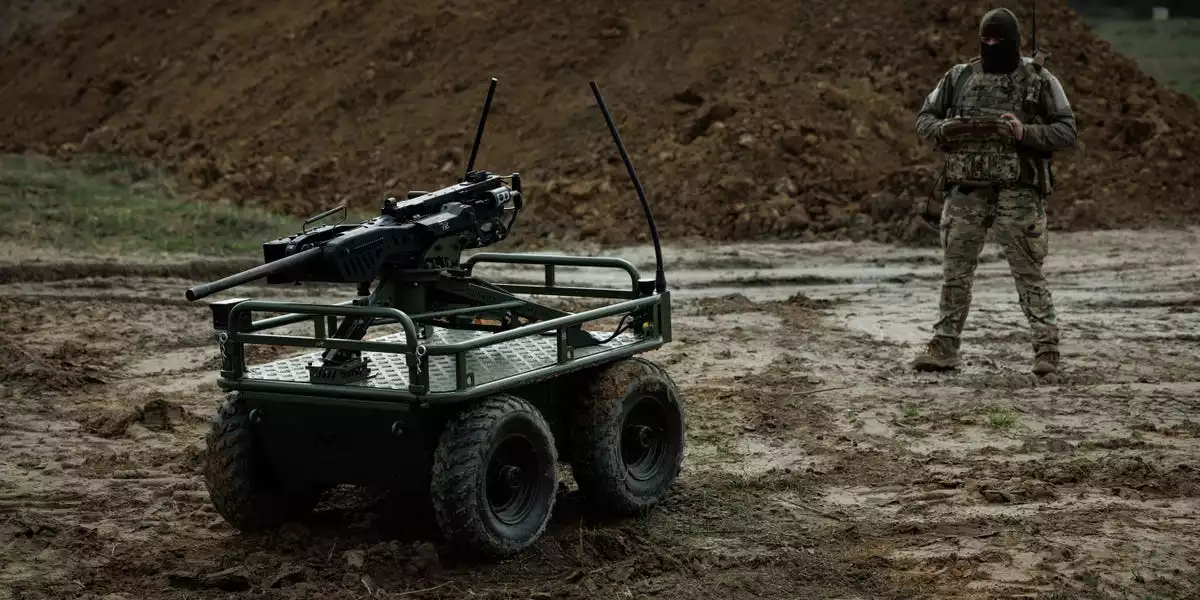

Camp Jomsborg as a live laboratory for NATO’s next ground-robotics doctrine
The collaboration unfolding at Camp Jomsborg in Poland, under Operation Legio—a Norway-led multinational effort—signals a notable shift in how military innovation is being generated and shared inside NATO. Rather than the traditional model where alliance doctrine flows outward from established training centers, Ukrainian forces are bringing front-line, high-tempo operational experience directly into the training pipeline. The subject is not abstract future warfare, but the practical realities of deploying uncrewed ground vehicles (UGVs) at scale under fire, under jamming, and under relentless iteration pressure.
Ukraine’s reported contracting of more than 22,000 UGVs since January, roughly doubling the prior year’s pace, is more than a procurement headline. It reflects an industrial and tactical pivot: ground robotics are moving from niche experimentation into a repeatable, systematized capability spanning logistics, casualty evacuation, reconnaissance, and direct support roles. For NATO partners observing—and now actively learning—this is a rare opportunity to compress years of concept development into months of validated practice.
At the same time, commanders are emphasizing a constraint that often gets lost in technology-first narratives: tactics do not travel frictionlessly. What works across Ukraine’s open fields and dense electronic warfare environment must be revalidated for Norway’s snow, cold-weather battery performance, traction limits, and line-of-sight constraints. The exchange at Camp Jomsborg is therefore not simply “Ukraine teaches, NATO absorbs,” but a more complex process of doctrinal hybridization—combat-tested methods meeting alliance standardization, safety regimes, and theater-specific requirements.
The UGV technology stack is hardening: modularity, autonomy, and comms resilience
Ukraine’s battlefield conditions have accelerated a design philosophy that many defense-tech firms have advocated but rarely proven at scale: modular, rugged, and rapidly reconfigurable platforms. The emphasis on payload swaps—lethal, non-lethal, logistics, and engineering functions—points toward an emerging architecture where the vehicle is a standardized “base layer,” and mission capability is delivered through interchangeable modules.
Several technical themes stand out as likely to shape NATO’s ground robotics roadmap:
- Field-driven modularity and interoperability
UGVs that can accept different payloads and sensors reduce procurement complexity and shorten upgrade cycles. For alliance forces, this aligns with the push toward open architectures that avoid vendor lock-in and enable faster integration of new subsystems.
- Sensor fusion and semi-autonomy under constraint
The integration of multispectral sensors, LIDAR, and AI-enabled obstacle avoidance is not merely about sophistication; it is a response to environments where GPS may be unreliable and operators may be forced to drive with degraded situational awareness. The direction of travel is clear: layered autonomy—machines that can navigate locally, avoid obstacles, and maintain mission progress even when remote control is intermittent.
- Electronic warfare as the defining design requirement
Sustained UGV operations in contested spectrum conditions elevate communications from a supporting function to a core survivability feature. Mesh networking, resilient datalinks, encryption, anti-jam, and anti-spoofing are becoming baseline expectations rather than premium add-ons. For NATO, these lessons are especially relevant because interoperability across national systems will require not only shared standards, but shared assumptions about operating under persistent electronic attack.
This is where the Camp Jomsborg exchange becomes strategically important for technology leaders: it is effectively a real-time validation loop for what “military-grade robotics” must mean in the 2020s—less about pristine autonomy demos, more about degraded operations, maintainability, and rapid repair.
Industrial scaling and the business spillover: from defense surge to dual-use markets
Contracting tens of thousands of UGVs in a short period implies a maturing supply chain—one that can source motors, controllers, batteries, sensors, radios, and ruggedized compute at speed. That surge demand is already shaping investment priorities across Eastern Europe and partner ecosystems, particularly in:
- Printed circuit board assembly and rugged electronics
- Battery production and thermal management
- Additive manufacturing for rapid parts replacement
- Specialized drive systems and mobility components
For business and technology stakeholders, the more consequential story may be what follows the initial surge: cost-curve reduction. As defense demand scales, unit costs for proprietary sensors, drive components, and hardened compute can fall, making advanced ground robotics more viable in civilian sectors. The technical features refined in combat—modular payload bays, rugged power systems, autonomous navigation in degraded conditions—map directly onto commercial needs in:
- Mining and hazardous industrial operations
- Energy infrastructure inspection and maintenance
- Disaster response and search-and-rescue
- Remote logistics in extreme environments
Procurement dynamics are also likely to evolve. As Western militaries allocate more budget toward unmanned ground systems, competition will intensify between traditional prime contractors and agile defense-tech startups. That competition tends to favor new contracting models—such as performance-based logistics, subscription-like maintenance, and software-defined capability upgrades—because robotics fleets behave more like managed platforms than static equipment.
Strategic implications: risk redistribution, northern-flank readiness, and a faster learning alliance
UGVs change the calculus of force employment by redistributing risk. When robots can conduct resupply runs, reconnaissance, or casualty evacuation, commanders can sustain operations with fewer personnel exposed to direct fire. That does not remove risk—it shifts it toward systems resilience, supply continuity, and cyber/electronic protection. In practical terms, deterrence and posture may increasingly depend on whether a force can keep unmanned fleets functioning under attack, not simply whether it possesses them.
Norway’s focus on adapting UGVs to snow and sub-zero operations also carries broader NATO relevance. Arctic-capable ground robotics reinforce the alliance’s northern flank by enabling persistent mobility and logistics in conditions where manned operations are slower, more visible, and more physically taxing. The same adaptation logic will apply elsewhere—desert heat, jungle humidity, dense urban canyons—suggesting a future where UGV doctrine is less universal and more theater-validated.
Perhaps the most durable shift is institutional: the two-way exchange indicates a NATO learning model that is becoming more bottom-up and iterative, with battlefield improvisation feeding directly into training, procurement, and doctrine. If that feedback loop is formalized—captured, standardized, and disseminated quickly—it could become a competitive advantage in an era where the decisive edge is often not a single breakthrough technology, but the ability to adapt faster than the adversary while scaling reliably across an alliance.

 By
By
 By
By

 By
By
 By
By

 By
By
 By
By







