

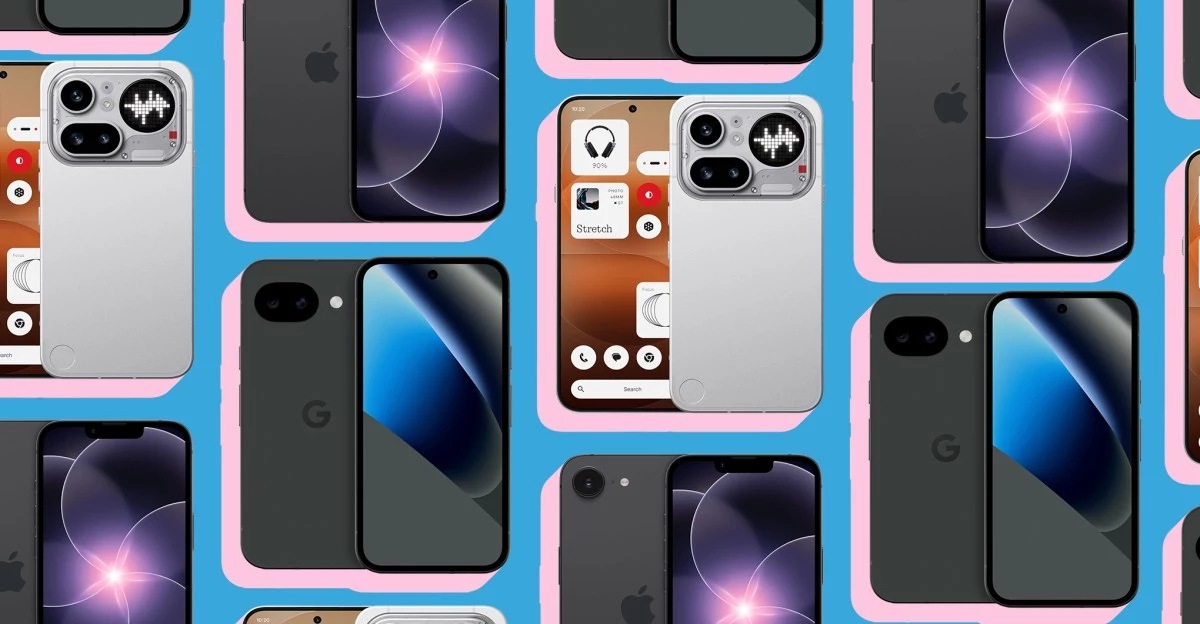

A new center of gravity in smartphones: performance-first, frills-second
A distinct sub-$600 smartphone market is no longer merely a “budget” afterthought—it is becoming the industry’s most strategically contested middle ground, shaped by inflation-aware consumers, maturing silicon, and a growing expectation that longevity should not be a luxury feature. What’s emerging is a class of function-first devices that deliberately trim the flashiest hardware—extra camera modules, high-refresh displays, always-on panels—while protecting the attributes most users feel every day: speed, battery life, screen quality, and software support.
The product line-up illustrates how broad this value rebalancing has become. Apple’s iPhone 17E (US$599) signals a notable shift in Cupertino’s mid-tier posture: it reportedly carries the same A19 processor as the iPhone 17, pairs it with 256 GB storage, and emphasizes battery strength—while conceding features like ultrawide optics, always-on display, and higher refresh rates. On Android, Google’s Pixel 10A (US$499) leans into a familiar Pixel formula—strong camera fundamentals and a high-quality 6.3-inch OLED—but its sharpest spear may be policy rather than pixels: seven years of OS and security updates, a commitment that reframes the entire midrange value equation.
Meanwhile, challengers such as Nothing’s 4A Pro (US$499) and Motorola’s Moto G Power (US$299.99) compete with visible, retail-friendly strengths—display size, battery capacity, water resistance—often paired with trade-offs that matter over time, such as update cadence or the degree of bundled software. Samsung, for its part, stretches across the bracket with the Galaxy S25 FE (US$649) and A-series models, while TCL’s Nxtpaper 70 Pro (notably tied to a carrier-exclusive arrangement) experiments with a mattified LCD intended to reduce eye strain—an example of differentiation that is experiential rather than spec-sheet maximalism.
Mature silicon, smarter trade-offs: why “good enough” now wins
Under the hood, the sub-$600 segment is increasingly powered by a pragmatic engineering playbook: reuse proven platforms, optimize yields, and redirect savings into user-perceived benefits. Whether it’s Apple amortizing its A-series development across multiple tiers or Android OEMs leaning on midrange Snapdragon/MediaTek stacks, the industry is effectively building a two-tier structure: flagship experimentation at the top, and high-volume refinement below.
This is not simply cost-cutting—it is value engineering aligned with how mainstream buyers actually experience a phone:
- Battery and efficiency are prioritized over peak GPU clocks that only a subset of users fully exploit.
- Screen quality (OLED adoption, brightness, calibration) becomes a daily-visible differentiator.
- Camera strategy shifts from multi-lens abundance to fewer sensors with stronger processing and more consistent results.
- Durability and water resistance increasingly function as trust signals, especially for buyers stretching replacement cycles.
TCL’s Nxtpaper approach and Nothing’s design language underscore another important dynamic: constraints can catalyze creativity. When raw component spend is limited, brands look for distinctive UX narratives—eye-comfort displays, recognizable aesthetics, or tactile identity—to stand out in crowded retail environments where many devices share similar internal architectures.
The update wars: software lifespan becomes the real spec
If there is one arena where the midrange battle is becoming unusually consequential, it is software support. Google’s seven-year promise for the Pixel 10A doesn’t just raise the bar; it challenges long-standing assumptions about Android lifecycle economics. Extended support transforms a phone from a two-to-three-year commodity into a longer-lived asset—one that can credibly compete on total cost of ownership (TCO), not just upfront price.
That shift has several second-order effects:
- Replacement cycles may lengthen, pressuring OEMs that rely on frequent upgrades for volume.
- Ecosystem lock-in deepens, because long-lived devices keep users inside a services orbit longer.
- Security becomes a mainstream purchase driver, particularly for families, small businesses, and cost-conscious professionals.
- Rivals face a strategic choice: match the support window, or differentiate through services, UI features, and channel pricing.
This is where Apple’s iPhone 17E becomes especially disruptive. By delivering near-flagship compute at a mid-tier price, Apple compresses the space where Android historically held an advantage—“good performance for less”—and forces competitors to sharpen their counter-positioning around updates, camera value, and platform features.
Carriers, margins, and the next wave: AI features and service monetization
The economics of this segment are inseparable from distribution. Carrier exclusives—such as TCL’s arrangement—remain a powerful lever to drive store traffic and justify plan economics, while OEMs trade some margin for volume and visibility. At the same time, using legacy or prior-generation components improves supply-chain resilience: steadier sourcing, fewer surprises, and a smoother balance between premium wafer starts and high-volume midrange runs.
Looking ahead, the next competitive layer is already forming: AI and software as value levers. Over the next 18–24 months, generative AI features that debut on flagships are likely to cascade into sub-$600 devices, becoming a new proxy for innovation—summarization, photo editing, on-device assistance, and productivity workflows. Because hardware margins are thinner here, the business model naturally tilts toward subscription attach:
- cloud storage bundles
- security and identity protection
- device care programs
- AI feature tiers tied to ecosystem accounts
Regionally, the stakes are equally high. Growth in Asia, Latin America, and parts of Africa will reward OEMs that combine affordable 5G with long support promises and localized software. Operationally, regional assembly and modular manufacturing will matter more as tariffs, logistics costs, and currency volatility shape pricing power.
The sub-$600 smartphone is no longer a compromise purchase; it is where platform strategy, supply-chain pragmatism, and consumer economics intersect most visibly. The brands that win this tier won’t merely ship more units—they’ll secure longer relationships, stronger service revenue, and a durable foothold in the industry’s most volume-rich battleground.

 By
By
 By
By

 By
By
 By
By
 By
By

 By
By







