

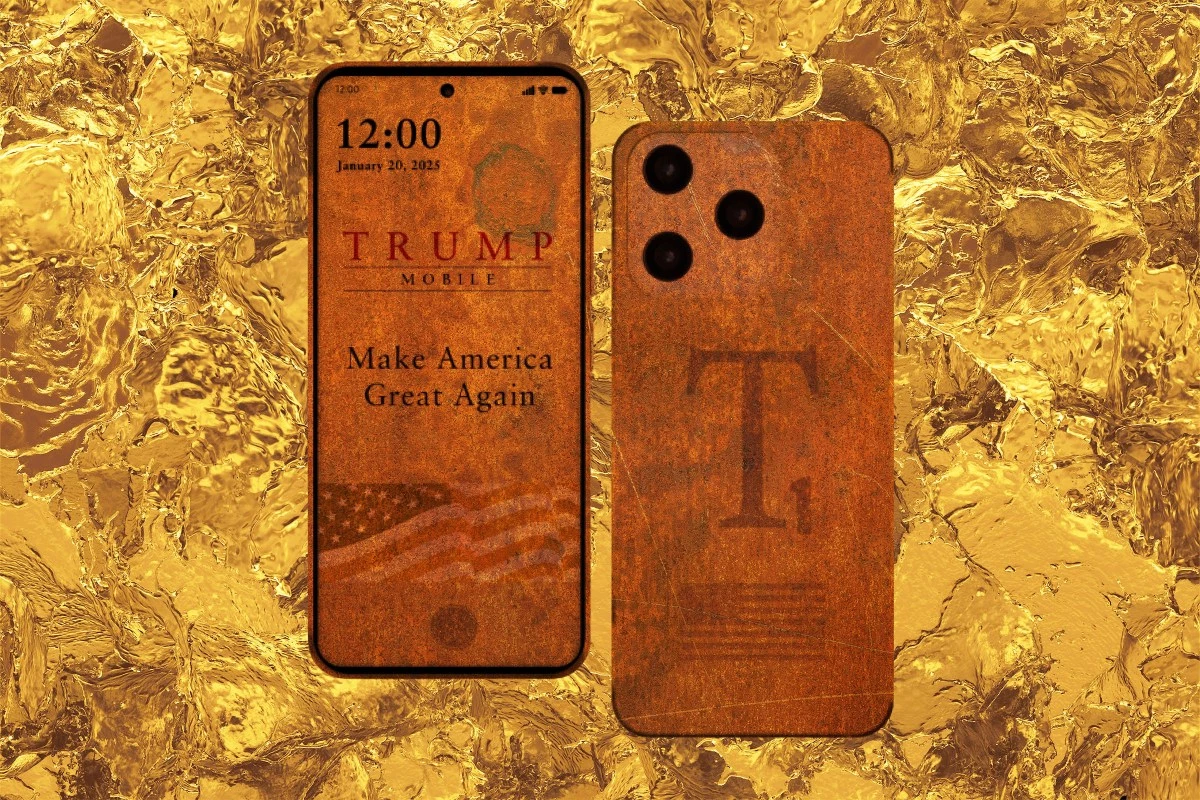

A gold-tone handset meets the unforgiving physics of smartphone execution
Trump Mobile’s unveiling of the $499 “T1 Phone”—a new wireless-adjacent venture backed by Donald Trump Jr. and Eric Trump—was designed to signal more than another mid-range device launch. The product’s visual identity and messaging leaned into a familiar blend of spectacle and symbolism: a gold-tone aesthetic, a patriotic narrative, and an implied promise that this would be a smartphone aligned with a particular cultural and political worldview.
Yet the story has quickly shifted from aspiration to operational credibility. After reportedly collecting $100 deposits from early supporters, the company’s launch timeline has repeatedly slipped—first targeting August 2025, then moving to November 2025, later to March of the current year, and ultimately removing a firm ship date altogether. Most notably, the website now carries a warning that a pre-order may never result in delivery, a rare admission in consumer electronics where confidence and certainty are core to conversion.
That change reframes the T1 Phone not as a typical product rollout, but as a live stress test of whether political brand affinity can substitute for supply-chain maturity—and for how long.
Certification signals progress, but not product readiness
A recent PTCRB certification is the most concrete technical milestone disclosed so far. In North American telecom, PTCRB approval is meaningful: it indicates that a device has met baseline requirements for radio-frequency and cellular network compliance used by major carriers and MVNOs. For any new entrant, that hurdle is non-trivial.
Still, certification is not synonymous with a shippable, supportable smartphone. The gap between “certified” and “consumer-ready” is where many hardware projects falter—especially those without a proven track record in device lifecycle management. Key uncertainties remain unresolved in public view:
- Carrier interoperability and field performance: PTCRB does not guarantee seamless real-world behavior across carrier configurations, roaming scenarios, or congestion conditions.
- Software stability and update cadence: Modern smartphones live or die by over-the-air updates, security patch discipline, and long-term OS support—areas that require sustained engineering investment.
- Ecosystem integration: Competing in smartphones is less about the chassis than the surrounding stack—app store access, cloud services, identity management, and device security posture. No credible alternative ecosystem or exclusive software strategy has been announced.
Compounding the skepticism are observer claims that the T1’s design cues resemble existing Chinese OEM handset templates, a common practice in white-label or lightly customized smartphone programs. That approach can accelerate time-to-market, but it also raises questions about differentiation, component sourcing, and the authenticity of branding claims.
“Made in the USA” retreats into values-based marketing—and that matters
One of the most consequential shifts has been rhetorical: marketing language reportedly moved from “Made in the USA” to the more elastic phrase “designed with American values.” In consumer technology, such wording changes are rarely cosmetic. They often reflect the collision between brand promise and manufacturing reality.
The reality is stark: U.S. smartphone assembly at scale is marginal. The global smartphone supply chain is deeply optimized around East Asian manufacturing ecosystems—tooling, component clustering, labor specialization, and logistics throughput. Attempting to build a domestically assembled smartphone at competitive cost and volume is not impossible, but it is structurally difficult without:
- long-term manufacturing partnerships,
- stable component procurement,
- predictable yield and quality control, and
- a service and returns infrastructure that can handle consumer expectations.
This is where Trump Mobile’s narrative intersects with broader U.S. industrial policy. Legislation such as the CHIPS & Science Act and the Inflation Reduction Act has accelerated domestic investment in semiconductors and advanced manufacturing, but smartphones remain a different category: high-volume, low-margin, and brutally sensitive to supply-chain efficiency. The T1’s messaging taps into a national “industrial sovereignty” impulse, but the product’s shifting claims highlight how far consumer electronics still sits from meaningful reshoring.
Deposits, reputational risk, and the economics of a crowded $499 battlefield
At $499, the T1 Phone would enter one of the most competitive price bands in the market—where consumers can choose from established, heavily optimized offerings across Apple, Samsung, and value-driven Android brands. In this segment, buyers expect clear, measurable advantages: camera performance, battery longevity, display quality, durability, and multi-year software support.
Absent a differentiated technical proposition, the T1’s primary lever becomes identity-based demand—a niche but potentially motivated customer pool. That can work, but it is fragile. The longer a product remains undelivered, the more the venture risks converting enthusiasm into backlash, particularly when money has already changed hands.
The deposit model introduces several business and legal pressures:
- Refund exposure and consumer protection scrutiny if delivery remains uncertain.
- Reputational compounding as delays become a narrative of mismanagement rather than ambition.
- Litigation risk, including potential class-action claims, if customers argue they were misled by timelines or origin claims.
The viral TikTok of an aggrieved customer demanding answers underscores a modern reality: in the social media era, customer frustration is not a support ticket—it is a broadcast event. For a politically branded product, that amplification can be especially potent, because disappointment may be framed not merely as a bad purchase, but as a perceived breach of trust within an in-group community.
Strategically, a smartphone could have served as a platform for broader ambitions—an MVNO bundle, proprietary messaging, curated media distribution, or a direct-to-supporter communications channel. But hardware delays erode the credibility required to cross-sell any adjacent service. In smartphones, the device is not just the product; it is the passport into an ecosystem. If the passport never arrives, the ecosystem never opens.
What the T1 saga is revealing—day by day—is that symbolic branding can generate attention and even deposits, but it cannot compress manufacturing lead times, conjure software support operations, or negotiate the hard constraints of telecom compliance and supply-chain execution. In consumer electronics, the market ultimately rewards what ships, what works, and what stays secure after the unboxing glow fades.

 By
By
 By
By

 By
By
 By
By

 By
By







