


A century-old canvas icon finds new relevance in the modern professional economy
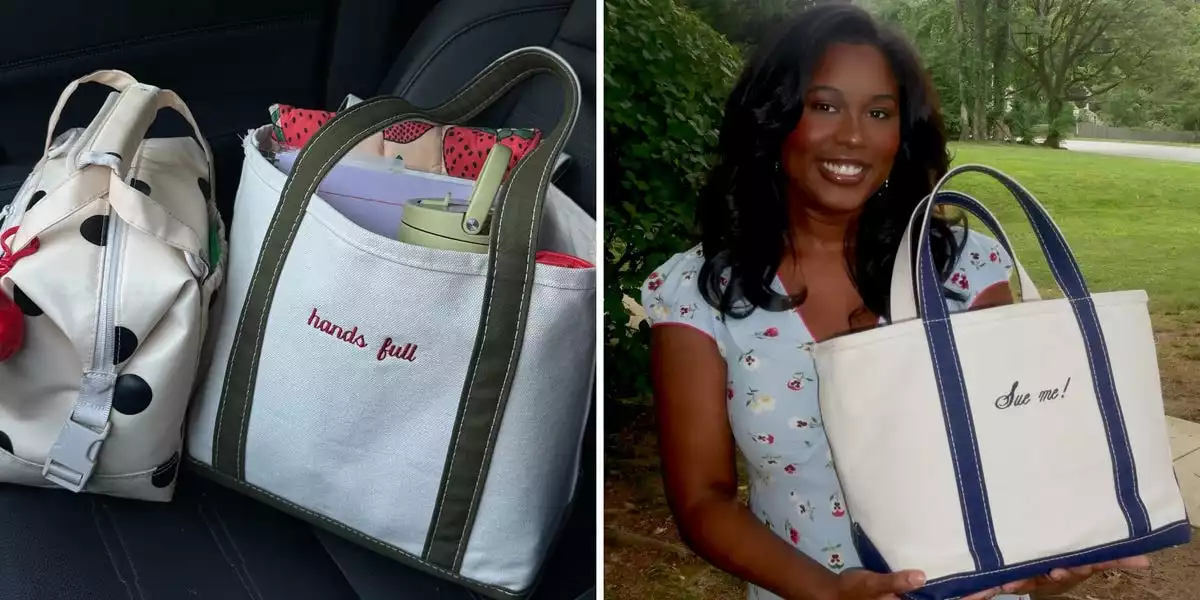
L.L.Bean’s Boat and Tote—a utilitarian staple with deep New England roots—has become an unexpectedly sharp lens on today’s consumer and workplace dynamics. The headline numbers are striking: demand is up roughly 50% year-to-date, and about 80% of recent orders include customization. Even more telling is *what* customers are choosing to add. Rather than traditional monograms, many buyers—particularly female professionals—are opting for embroidered, job-coded phrases that read like insider shorthand: “Circle Back,” “Sue me!,” or “Hands full.”
This is not merely a fashion moment. It reflects a broader shift in how consumers assign value to everyday objects. In a hybrid-work era where the boundaries between office, commute, and personal life blur, the tote becomes a mobile identity artifact—part tool, part signal. The bag’s renewed popularity also suggests that “heritage” brands can still win with younger cohorts when they pair durable products with modern self-expression and fast personalization.
From a business standpoint, L.L.Bean’s spring performance—reportedly among the tote’s strongest sales months on record—illustrates how legacy products can be re-platformed for contemporary demand without abandoning their core proposition: reliability, simplicity, and longevity.
The technology behind “batch-of-one” retail and why it changes the margin equation
The most consequential element of this story may be operational rather than cultural: L.L.Bean is effectively scaling a form of mass customization that would have been prohibitively complex a decade ago. The enabling stack is familiar across advanced manufacturing and modern retail:
- On-demand embroidery equipment capable of short runs with minimal setup time
- Digital design and ordering interfaces that translate customer inputs into production-ready instructions
- Modular workflows that reduce friction from SKU proliferation (colors, fonts, placement, add-ons like charms)
This is the consumer-facing version of “batch-of-one” production—an idea long discussed in smart-factory circles and increasingly practical due to automation, software integration, and improved production planning.
Strategically, personalization also reshapes the economics of a classic product. When customers co-design, the brand isn’t just selling canvas and stitching; it’s selling participation. That often supports:
- Higher willingness to pay for customized units
- Lower price sensitivity because the item feels unique and “made for me”
- Stronger repeat behavior as customers return for new phrases, gifts, or role changes
In other words, personalization can be a margin lever and a loyalty engine—provided the company can keep lead times tight and quality consistent. The tote’s resurgence shows how a mature product category can be revitalized when customization is treated as a core capability rather than a novelty add-on.
Identity-driven accessories in the hybrid-work era: status, community, and cultural signaling
The demand spike is also a signal about the evolving nature of professional identity—especially among younger workers and women building careers across law, healthcare, education, engineering, and corporate roles. As formal office dress codes loosen and remote work normalizes, the objects that travel between home and work—totes, water bottles, laptop sleeves—become high-visibility carriers of narrative.
The embroidered phrases function as micro-status markers and community cues. They are legible to insiders, lightly humorous to outsiders, and often calibrated to the tone of modern work: ironic, self-aware, and role-specific. This dynamic mirrors other markets where personalization and scarcity confer prestige, from sneaker drops to limited-run collaborations—except here the scarcity is self-generated through customization.
Equally important is the social amplification loop. A customized tote is inherently shareable: it photographs well, communicates quickly, and invites imitation. That creates a form of network effect:
- Customers become content producers, not just buyers
- The brand benefits from organic distribution and reduced acquisition costs
- Trends emerge from the crowd, not solely from top-down marketing
For L.L.Bean, this is a subtle but meaningful shift: the Boat and Tote becomes not just a product, but a platform for expression. Each phrase is a small act of affiliation—profession, temperament, values, humor—stitched into a durable object that moves through public space.
Operational complexity, data advantage, and what other brands should learn from the tote boom
Personalization at scale is not free. It introduces SKU complexity, planning challenges, and fulfillment risk. The more combinations a brand offers—colors, sizes, fonts, icons, placement—the more it must rely on disciplined orchestration:
- Real-time inventory visibility to prevent bottlenecks
- Just-in-time material flow to avoid overstocking variants
- Tightly integrated supplier and production partnerships to maintain speed and consistency
Yet the upside is not only revenue. Customization generates high-quality first-party data: every choice reveals preference, profession-coded language, gifting behavior, and aesthetic trends. Over time, those signals can strengthen CRM segmentation, inform product roadmaps, and improve targeting—especially as third-party tracking becomes less reliable.
For executives watching this moment, the tote’s resurgence offers a clear strategic template:
- Treat customization as a core product capability, not a seasonal gimmick
- Use personalization to build community and repeat purchase loops
- Invest in operational resilience so complexity doesn’t erode customer trust
- Align durable, customizable goods with sustainability expectations—because longevity plus emotional attachment can reduce churn and disposability
L.L.Bean’s Boat and Tote is proving that a 100-year-old product can still behave like a modern growth engine when it’s paired with scalable personalization, identity-aware merchandising, and the operational discipline to deliver “made for you” at mainstream speed.

 By
By
 By
By
 By
By

 By
By

 By
By








