

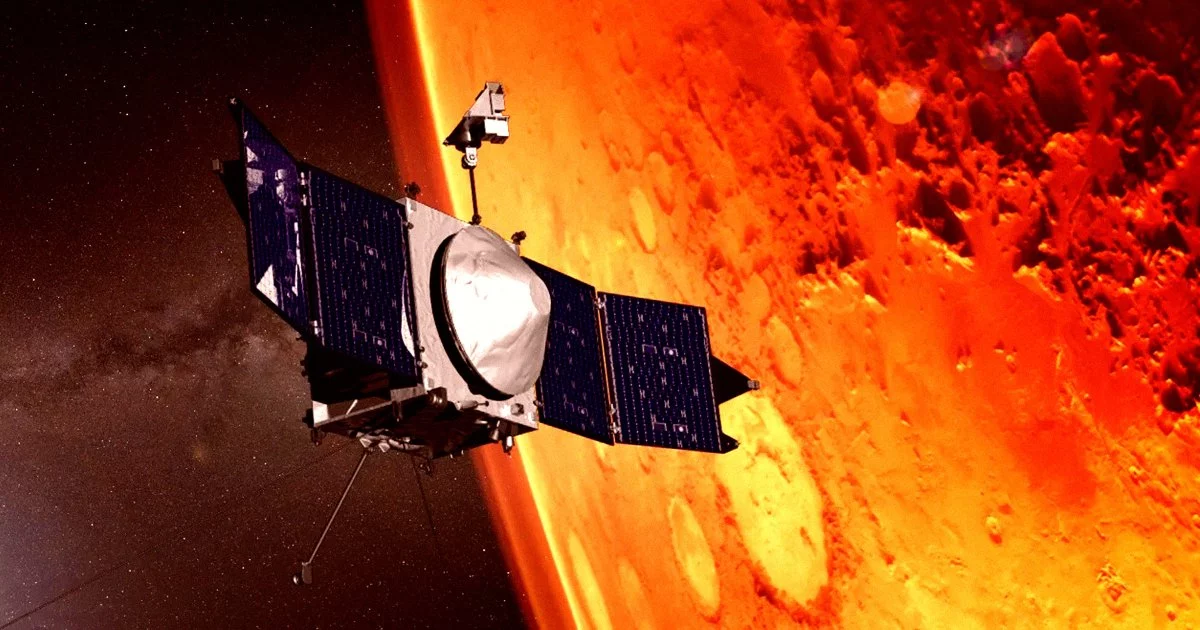

MAVEN’s Silence: A Crucible for Mars Relay Resilience and the Future of Deep-Space Communications
The abrupt silence of NASA’s MAVEN orbiter, following a catastrophic spin event on December 6, has sent a tremor through the corridors of planetary science and deep-space operations. Once a linchpin for Mars atmospheric research and a vital relay for surface missions, MAVEN’s likely demise is not merely a technical footnote—it is a clarion call, exposing the fragility of the current Martian communications web and accelerating a reckoning with the realities of aging infrastructure, escalating mission risk, and the shifting tectonics of space industry strategy.
The Anatomy of Failure: Legacy Systems Under Strain
Telemetry fragments, the final whispers from MAVEN, paint a portrait of a spacecraft pushed beyond its design horizon. An uncontrolled rotation, possibly triggered by inertial measurement unit drift or reaction-wheel saturation, left the orbiter unable to point its high-gain antenna—a fatal flaw for a platform without autonomous re-pointing or modern optical fallback. This incident is emblematic of a broader challenge: legacy attitude-control systems, once the gold standard, are now outpaced by the demands of extended missions and the unforgiving realities of deep space.
Compounding the crisis is the overstretched Deep Space Network (DSN). With its 34- and 70-meter antennas already rationed among Artemis, Psyche, Europa Clipper, and a swelling tide of commercial lunar ventures, the emergency sweeps for MAVEN have exposed the chronic undercapacity and aging risk of the DSN. The network, the circulatory system of interplanetary exploration, is showing its age at a moment when demand is set to explode.
MAVEN’s probable loss trims Mars relay redundancy by a full quarter, leaving just three aging orbiters—Mars Odyssey, Mars Reconnaissance Orbiter, and ESA’s Trace Gas Orbiter—to shoulder the communications load. Each is itself well past its prime, a reminder that the Martian relay architecture is a patchwork, not a fortress.
Strategic and Economic Reverberations: Mars Exploration at a Crossroads
The implications ripple outward. Mars Sample Return (MSR), NASA’s flagship planetary endeavor, is deeply reliant on robust relay handoffs. Any erosion in link margin injects new risk, potentially forcing the procurement of fresh communications assets at a time when planetary budgets are under the microscope. The specter of hundreds of millions in additional costs looms—a politically fraught proposition.
Congress, sensing both vulnerability and opportunity, has revived the Mars Telecommunications Orbiter in the FY24 authorization bill. The appetite is clear: a next-generation, hardened platform with hybrid optical-RF downlinks, built for the rigors of multi-mission support. MAVEN’s crisis could catalyze bipartisan momentum, compressing decision cycles and opening the door for both established primes and ambitious new-space suppliers.
The insurance calculus is shifting as well. While NASA self-insures, private Mars ventures—envisioning landers and science payloads—face a harsher risk environment and steeper premiums without proven relay coverage. This may be the inflection point for commercial relay-as-a-service models, distributing risk and enabling bundled coverage across governmental and private operators.
Geopolitically, the stakes are rising. China’s Tianwen-2/3 ambitions and Europe’s ExoMars reboot underscore the strategic premium on sovereign deep-space communications. The potential vacuum left by MAVEN could invite cross-support agreements—or, just as likely, accelerate the race to independent national networks.
Charting a New Course: Commercial Synergies and Autonomous Futures
The MAVEN episode is not isolated; it is a microcosm of industry-wide transformation. Hybrid commercial-government networks are on the horizon, with Starlink, Kuiper, and Lockheed-OneWeb testing cislunar extensions—a logical precursor to Mars segments, especially if NASA steps in as an anchor tenant. Optical communications, as demonstrated by NASA’s LCRD and DSOC, promise exponential bandwidth gains and lighter, more agile architectures. The days of single-string RF paths are numbered.
The future will demand:
- Accelerated procurement of next-gen Mars orbiters with disaggregated payloads—combining Ka-band, optical terminals, and GN&C experiment kits—ideally through public-private partnerships that tap commercial satellite production and spread operational costs.
- Expanded DSN capacity via commercial time-buy, leveraging smaller dishes or phased-array apertures to relieve bottlenecks and support surging Artemis and MSR traffic.
- Mandated autonomy in future probes, embedding AI-driven momentum management and real-time fault isolation to sidestep ground-command dependence during anomalies.
- Deployment of in-situ relay “pods”—SmallSats or tethered balloons providing ad-hoc UHF/optical gateways near landers, insulating missions from single-point orbital failures.
- A rolling “critical asset redundancy” index to inform portfolio risk and guide congressional prioritization.
MAVEN’s silence is not just a technical setback; it is a crucible for Mars relay resilience and a harbinger of the next era in deep-space communications. The organizations and leaders who move swiftly—embracing commercial partnerships, autonomy, and optical innovation—will define the backbone of interplanetary science and commerce for decades to come. In this pivotal moment, the future of Mars—and perhaps humanity’s broader extraterrestrial ambitions—hangs in the balance.

 By
By
 By
By
 By
By

 By
By

 By
By
 By
By







