


Carbon Dioxide as a Battery: Rethinking Energy Storage for a Renewable Grid
In the heart of Milan, a start-up is quietly reimagining the future of energy storage—not with lithium, vanadium, or rare earths, but with a molecule more familiar as a climate villain than a grid hero: carbon dioxide. Energy Dome’s so-called “CO₂ battery” is not just a feat of engineering, but a signal flare for an industry at the threshold of transformation. As renewables surge and the world’s data centers strain against the limits of conventional storage, this technology offers a pragmatic, scalable answer to the most pressing question in clean energy: how do we store the sun and wind, not just for hours, but for days?
Inside the Dome: Thermodynamics and the Architecture of Abundance
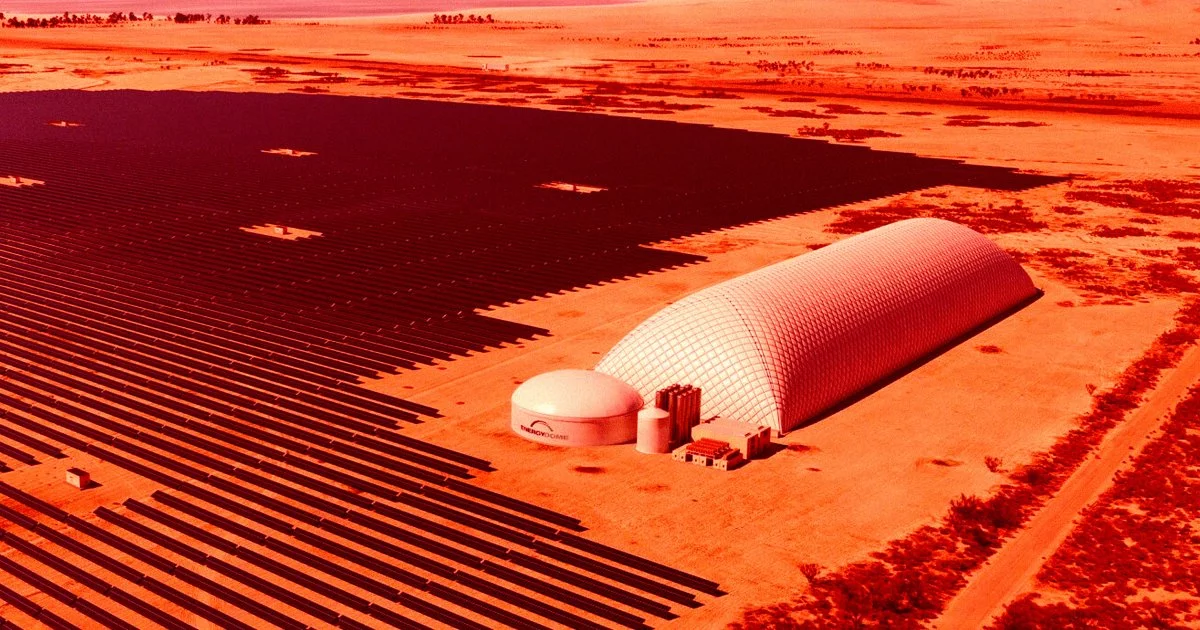
At its core, the CO₂ battery is a masterclass in thermodynamic ingenuity. The system leverages the dramatic energy-density swing between gaseous and liquid CO₂. When excess wind or solar power is available, the battery compresses CO₂ gas, storing not just the pressurized gas but also the heat generated in the process. When the grid demands power, the heat is used to re-gasify the liquid CO₂, which then expands through a turbine, generating electricity in a closed loop. The result: round-trip efficiencies of 75–80%, rivaling established technologies, but without the material and geographic constraints of lithium-ion or pumped hydro.
The practical implications are profound:
- Duration: The technology fills a critical gap, offering 4–24 hours of storage—bridging the chasm between short-duration lithium-ion and the massive, site-dependent infrastructure of pumped hydro or compressed air.
- Footprint and Modularity: Pressure-based storage means a compact site area, with modular 20–100 MW blocks that can be tailored to both utility-scale renewables and the voracious appetites of hyperscale data centers.
- Material Independence: By eschewing lithium, cobalt, and vanadium, the CO₂ battery sidesteps the ESG and geopolitical risks that shadow much of the battery supply chain, relying instead on steel and off-the-shelf turbomachinery.
The Economic and Strategic Calculus: From Grid Resilience to Data Center Survival
The timing could not be more acute. Last year, global ancillary services—peak shaving, time shifting—represented a $16 billion market. Yet, the true bottleneck for renewables is not generation, but the ability to dispatch clean power on demand. Long-duration storage is the missing link that could vault renewables from “as-available” to reliable baseload, fundamentally reshaping utility procurement and capacity markets.
Google’s recent multi-regional agreement to pilot Energy Dome’s technology is a harbinger of what’s to come. For data-center operators, the dual pressures of decarbonization and surging electricity intensity—driven by AI clusters and hyperscale expansion—make long-duration storage not a luxury, but a necessity. In this context, Google’s move is as much a hedge against volatile energy prices and carbon regulation as it is a technological experiment.
Policy winds are also shifting in favor of such innovations. The U.S. Inflation Reduction Act’s 30% investment tax credit for standalone storage, alongside the EU’s Net-Zero Industry Act, rewards domestically manufactured, low-risk clean-tech hardware. CO₂ batteries, free from the fire risks and permitting hurdles of chemical batteries, are well-positioned to capitalize on this regulatory tailwind.
Strategic Pathways: Portfolio Diversification and the Next Wave of Grid Innovation
For utilities, corporates, and policymakers, the emergence of CO₂-based storage reframes the calculus of grid modernization. Consider the following strategic imperatives:
- Portfolio Diversification: Modeling CO₂ batteries alongside flow and iron-air chemistries for 6–24 hour durations is now essential. Only a diversified storage stack can support >80% renewable penetration without overbuilding generation.
- Brownfield Redeployment: Decommissioned industrial sites—mines, thermal plants—offer ready-made interconnection and transmission. Repurposing these with CO₂ batteries not only monetizes stranded assets but also sustains regional employment.
- Risk and Regulatory Alignment: While leakage risk is low, robust insurance and environmental protocols are critical. Pre-negotiated frameworks with regulators can expedite siting, drawing on precedents from food-grade CO₂ handling.
- Commercial Innovation: Expect new revenue models—combining capacity payments, demand-charge reduction, and renewable time-shifting. Early adopters can secure premium contracts before the market commoditizes.
- Competitive Signaling: Google’s endorsement will likely prompt hyperscale peers to accelerate procurement of long-duration storage, catalyzing the broader industrial ecosystem.
The architecture of the CO₂ battery also hints at future convergence with carbon management. Its proximity to supercritical CO₂ cycles and carbon capture systems suggests a coming era where storage, carbon abatement, and grid services are intertwined—potentially arbitraging both carbon credits and energy markets.
As grid operators, corporates, and policymakers confront the inflection point where renewable penetration erodes residual capacity margins, the CO₂ battery stands as a pragmatic, industrially compatible solution. Those with ambitious 24/7 clean-energy targets—or with stranded thermal infrastructure—would do well to weigh this technology in their resource planning. The window for first-mover advantage is open, but it will not remain so for long.

 By
By
 By
By
 By
By

 By
By
 By
By
 By
By
 By
By







