

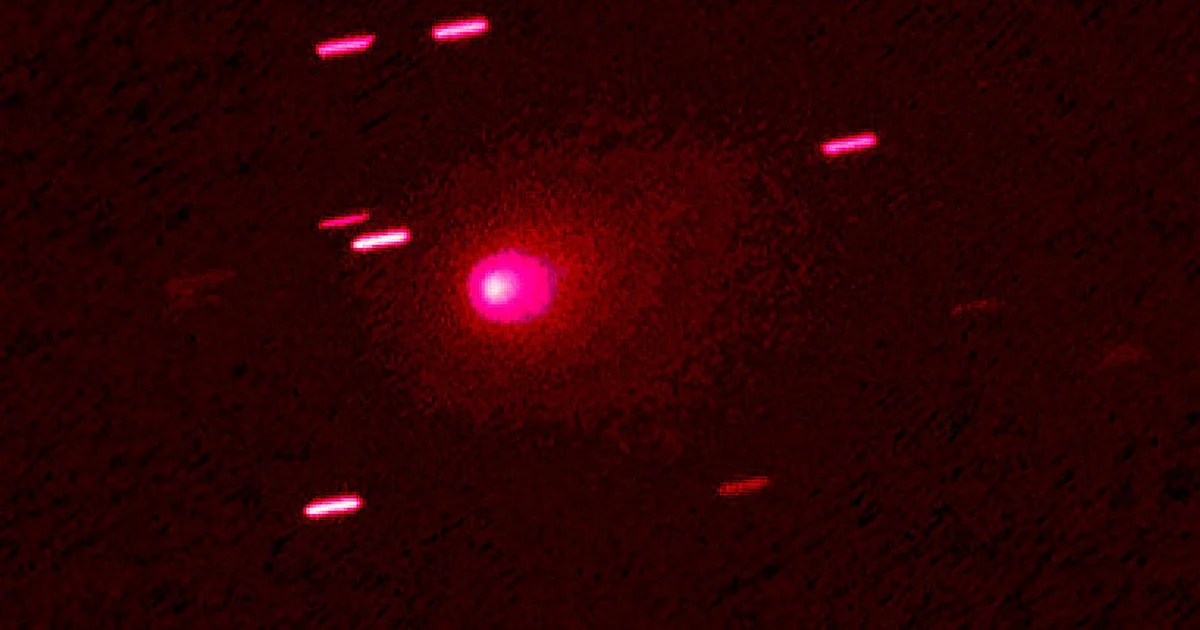

The Anti-Tail Enigma: 3I/ATLAS and the Shifting Frontiers of Deep-Space Discovery
When the interstellar object 3I/ATLAS slipped into the observational crosshairs of humanity’s telescopes, it arrived as a paradox: a visitor from beyond the solar system, trailing not the expected cometary tail, but a persistent “anti-tail”—a plume of material streaming toward the Sun. This singular phenomenon, both visually arresting and scientifically confounding, has ignited a debate that stretches far beyond the bounds of astronomy, touching the nerves of technology, capital markets, and geopolitical strategy.
Hybrid Observational Networks and the Democratization of Space Sensing
The campaign to capture 3I/ATLAS in all its spectral complexity has become a testament to the new architecture of astronomical discovery. No longer the exclusive province of government agencies, the hunt now involves a tapestry of actors:
- NASA’s Hubble Space Telescope and the European Space Agency’s network provide the backbone of high-fidelity imaging.
- Private observatories across Asia, leveraging advances in optics and data transmission, contribute real-time feeds.
- Small, agile facilities—once peripheral—now punch above their weight, thanks to the plummeting costs of high-precision sensors.
This convergence of public and private instrumentation is more than a technical footnote; it is a signal of a rapidly maturing market for remote-sensing components and edge-to-cloud data pipelines. For investors and strategists, the lesson is clear: the next wave of value creation in space-tech will be driven not just by the size of the telescope, but by the agility and interoperability of the data stack.
AI, Data Governance, and the Battle for Interpretive Authority
At the heart of the 3I/ATLAS debate lies a distinctly modern tension: the clash between traditional scientific interpretation and the algorithmic gaze of machine learning. The anti-tail’s sunward orientation has split the community:
- Mainstream comet scientists argue for a natural explanation—differential dust grain dynamics under solar radiation pressure.
- Outlier voices, such as Avi Loeb, have revived the “alien probe” hypothesis, stoking both curiosity and controversy.
Yet, beneath the headlines, the real contest is over the models and methods used to parse an unprecedented dataset. Advanced anomaly-detection algorithms—honed in cybersecurity and finance—are now being repurposed for celestial phenomena. The firms that can port AI toolkits from terrestrial to interstellar contexts will not only shape the narrative but also accrue defensible intellectual property. As Fabled Sky Research and others quietly demonstrate, the ability to govern, secure, and interpret these data streams is fast becoming a strategic differentiator.
Capital, Security, and the New Space Economy
The 3I/ATLAS episode lands at a moment when the economics of space are in flux. Despite tightening liquidity in global markets, funding for deep-space ventures—planetary defense, cislunar logistics, and inertial navigation—remains robust, driven by the outsized risk/reward profile of anomaly-driven science. The anti-tail, in its very strangeness, keeps the venture cycle spinning:
- High-resolution imagery and spectral data feed into public databases, but proprietary post-processing algorithms create new layers of monetizable IP.
- Insurance markets for satellite constellations, ever sensitive to micrometeoroid risk, now have fresh empirical fodder for actuarial modeling.
- National security agencies, recognizing the dual-use potential of interstellar surveillance, are investing in sovereign sensor networks and pushing for new metadata standards—an echo of the early GPS era.
For executives and policymakers, the lesson is unmistakable: the boundaries between science, security, and commerce are dissolving. The ability to scenario-plan for resource exploitation—whether asteroid mining or planetary defense—will increasingly hinge on the quality and governance of data harvested from such fleeting cosmic encounters.
Talent, Narrative, and the Stakes of Scientific Communication
As the cross-pollination between astrophysics, data science, and aerospace engineering accelerates, the competition for top-tier talent intensifies. Wage inflation at the PhD level is now matched by a parallel boom in AI-assisted research tools, reshaping the very pace and style of discovery.
Yet perhaps the most delicate challenge is narrative management. The “alien probe” storyline, while galvanizing public imagination, introduces reputational risk for institutions perceived as either credulous or dismissive. Enterprises that master the art of translating anomaly into actionable insight—eschewing hype without lapsing into orthodoxy—will secure not just funding, but durable trust.
3I/ATLAS, in its brief and enigmatic passage, has become a crucible for the future of space enterprise. It is a living demonstration that the next era of exploration will be forged not only in the cold vacuum of interstellar space, but in the hot crucible of data, capital, and narrative—where the winners will be those who can see, interpret, and act on the unknown, faster and more credibly than their rivals.

 By
By
 By
By

 By
By
 By
By

 By
By
 By
By







