

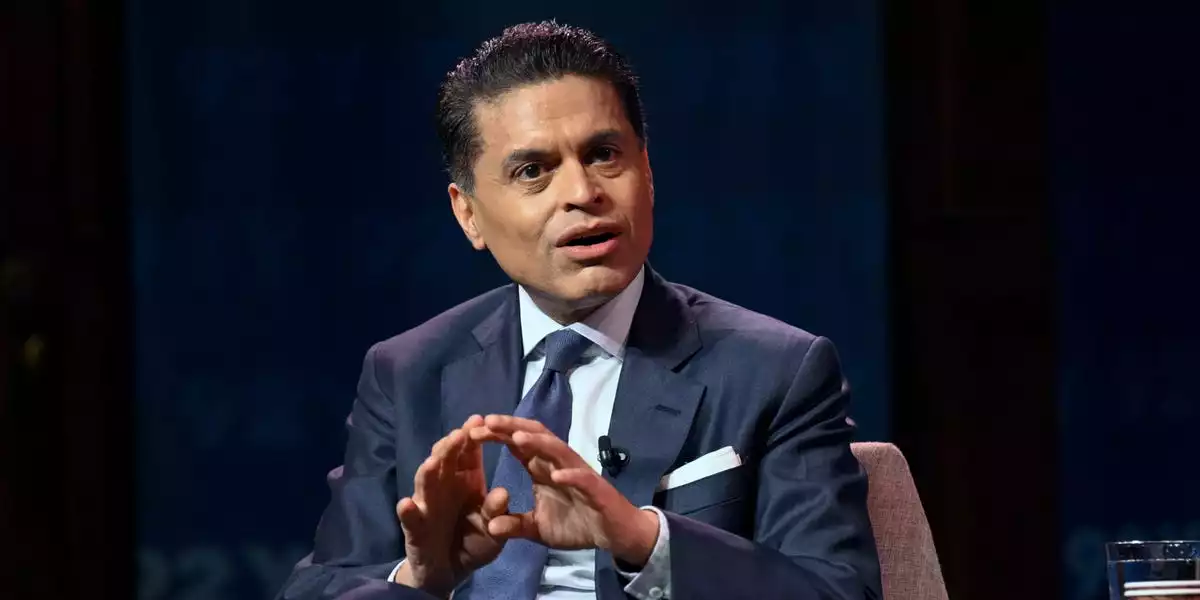

Zakaria’s Bard Commencement Message: AI as a Mirror, Not a Rival
At Bard College’s commencement, Fareed Zakaria delivered a pointed corrective to a dominant storyline in business and public discourse: that artificial intelligence (AI) is primarily a force that will strip humans of purpose, dignity, and work. With a deliberately playful “trigger warning,” he signaled both the emotional charge around AI and the need to interrogate it with more precision than panic allows.
Zakaria’s central reframing was deceptively simple and strategically potent: shift the question from “What will AI take from us?” to “What does AI reveal about what humans uniquely are?” That pivot matters because it moves the debate away from fatalism and toward design—how institutions, companies, and societies can structure technology adoption to amplify human strengths rather than merely chase automation.
A key contrast in his remarks was the engineering and biological asymmetry between today’s AI systems and the human brain. Modern AI increasingly depends on vast data centers—capital-intensive, energy-hungry, and operationally complex. The human brain, by comparison, performs remarkably rich cognition—learning, empathy, contextual judgment, creativity—on roughly tens of watts. Zakaria used that disparity to underscore a broader point: AI can simulate outputs that look intelligent, but it does not inhabit meaning, relationships, or lived experience in the way humans do.
The Technology Reality Check: Scaling AI Meets the Physics of Power
The last several years of AI progress—large-scale neural networks, self-supervised learning, and generative models—have produced systems that can write, code, summarize, design, and recognize patterns at extraordinary speed. Yet Zakaria’s emphasis on energy and cognition highlights a growing tension in AI strategy: the industry’s default playbook is scale, and scale collides with physical constraints.
For business and technology leaders, this creates a practical paradox:
- Marginal gains in model capability often require disproportionate increases in compute, storage, and cooling.
- The operational footprint of AI (electricity demand, data center buildouts, supply chain pressure for chips) is becoming a first-order constraint, not a footnote.
- The brain’s performance-per-watt becomes less a poetic comparison and more a benchmark for future architectures.
This is where Zakaria’s argument becomes relevant beyond commencement rhetoric. If AI’s next phase is constrained by energy economics and infrastructure realities, then R&D incentives may gradually shift toward:
- Efficiency-first model design (better performance per watt, not just bigger parameter counts)
- Bio-inspired or neuromorphic approaches that mimic parallel, low-power cognition
- Hybrid systems that rely on smaller, specialized models orchestrated intelligently rather than one monolithic “do-everything” model
In other words, the next competitive edge in AI may be less about raw scale and more about sustainable intelligence engineering.
Labor Markets and the New Premium on Human Intelligence (HI)
Public anxiety about AI is inseparable from economic history. Mechanization displaced manual labor; software automated routine office work; AI now targets tasks inside knowledge and creative professions once considered relatively protected. Zakaria’s intervention doesn’t deny displacement risk—it reclassifies the opportunity: as AI absorbs routine cognitive production, the market value of distinctly human capabilities can rise.
In practical terms, his “human intelligence” emphasis points to skills that are difficult to reduce to pattern completion:
- Emotional depth and empathy (especially in care work, leadership, and conflict resolution)
- Contextual awareness (reading a room, sensing unstated constraints, navigating ambiguity)
- Relationship building and trust (client advisory, negotiation, diplomacy, coalition formation)
- Meaning-making and narrative (strategy, culture, brand identity, mission-driven leadership)
- Original creativity that is anchored in lived experience rather than recombination alone
For employers, this implies a shift in workforce strategy. The question is no longer whether AI will “replace jobs,” but which job components are automated and which become more valuable. Organizations that treat AI as a tool for elevating human work—rather than simply compressing headcount—may gain advantages in productivity *and* retention, particularly as skilled labor markets tighten in many developed economies.
Strategy, Governance, and the Emerging Human–Machine Operating Model
Zakaria’s remarks also land amid a broader convergence of board-level concerns: AI regulation, climate impact, digital sovereignty, and human capital scarcity. His framing supports a strategic pivot away from a zero-sum “humans vs. machines” narrative toward hybrid operating models—where AI handles high-volume, data-intensive tasks and humans retain accountability for judgment, ethics, and stakeholder impact.
For executives and policymakers, several implications follow:
- Sustainability becomes an AI KPI. Energy consumption and carbon footprint are no longer externalities; they shape cost of goods sold, reputational risk, and compliance exposure.
- Geopolitics shapes AI supply chains. Semiconductor access, AI IP, and data governance increasingly influence trade policy and cross-border R&D collaboration.
- Organizational design will change. Companies may formalize roles and functions dedicated to human–AI workflow orchestration—whether as a new C-suite remit or a cross-functional governance layer.
Actionable priorities that align with Zakaria’s “AI as mirror” thesis include:
- Rebalancing R&D portfolios toward efficiency and bio-inspired architectures alongside frontier-scale models
- Building hybrid skill ecosystems that pair AI fluency with emotional intelligence, ethical reasoning, and narrative strategy
- Embedding governance and measurement, tracking not only model performance but also energy intensity and workforce impact
- Designating accountable leadership for human–machine integration so deployments enhance judgment rather than dilute it
- Engaging proactively with policy, advocating for AI governance that protects innovation while reinforcing privacy, creativity, and social cohesion
Zakaria’s deeper provocation is that AI’s most important contribution may not be what it can do, but what it clarifies: human value is not reducible to output. In an era captivated by synthetic fluency, the durable advantage—commercially and culturally—may belong to institutions that treat intelligence not as a commodity to be scaled, but as a human capacity to be cultivated.

 By
By
 By
By

 By
By
 By
By
 By
By
 By
By
 By
By







