

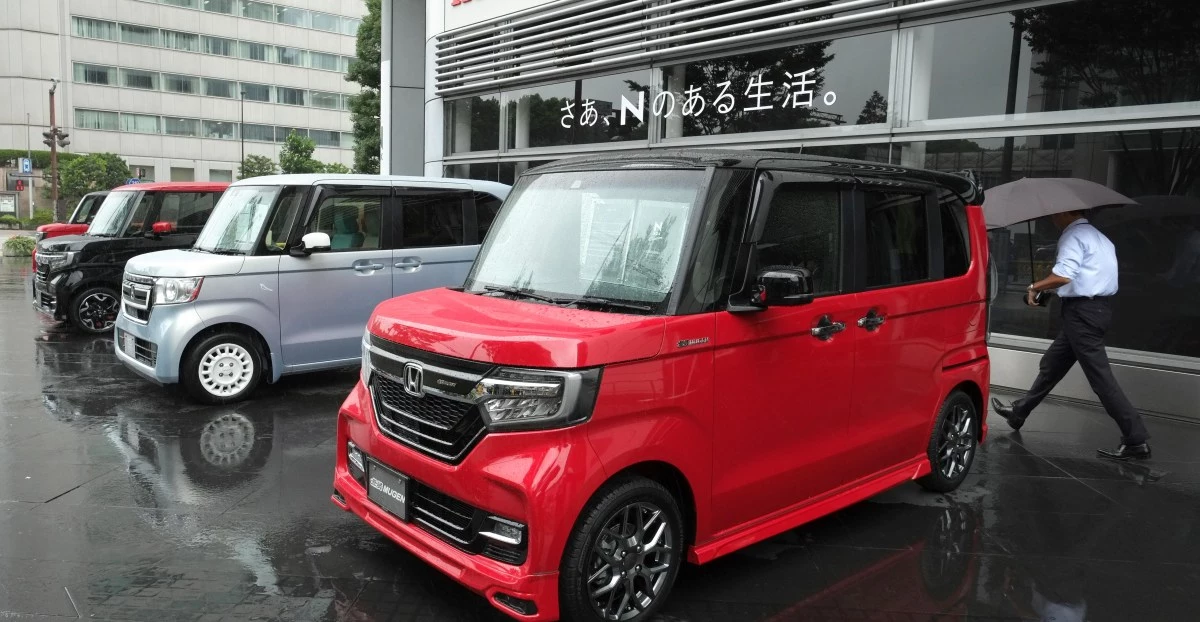

The Kei Truck’s American Moment: Micro-Mobility at the Crossroads of Policy and Culture
President Trump’s recent embrace of Japanese “kei” mini-trucks—those diminutive, utilitarian vehicles that have long been a fixture on Japan’s narrow roads—has thrust a niche automotive subculture into the heart of America’s regulatory and economic debate. By instructing the U.S. Department of Transportation to expedite domestic production approvals, the administration is not merely championing a quirky import; it is probing the boundaries of what American mobility could become, at a time when the nation’s vehicle market is otherwise defined by ever-larger SUVs and pickups.
The kei truck’s U.S. sales, though modest at just 7,500 units last year, have tripled in five years—a trajectory that hints at a latent appetite for alternatives to automotive gigantism. This surge is not an isolated phenomenon, but an inflection point shaped by converging forces: regulatory recalibration, technological innovation, and shifting consumer priorities.
Engineering Minimalism Meets Regulatory Complexity
At the heart of the kei proposition is a radical efficiency. These vehicles, typically weighing less than 1,600 pounds and powered by engines no larger than 660 cc, are marvels of functional design. Their lightweight frames offer a fertile testing ground for advanced composites, compact battery systems, and modular drivetrains—technologies that could ripple across the broader mobility landscape.
Yet, the regulatory maze is formidable. Federal law currently restricts kei imports to vehicles over 25 years old or those qualifying as Low-Speed Vehicles (LSVs), neither of which supports mainstream adoption. The path forward hinges on two uncertain prospects: the creation of a new micro-utility class by the DOT, or a willingness among automakers to engineer U.S.-specific variants that meet stringent Federal Motor Vehicle Safety Standards (FMVSS).
Complicating matters is the policy crosswind generated by Trump’s push to relax CAFE and greenhouse gas rules, which would temporarily reduce the regulatory cost of vehicle mass and horsepower. However, California and a coalition of zero-emission vehicle states are charting a stricter course, forcing automakers to navigate a bifurcated regulatory map. The result is a climate of uncertainty that tempers enthusiasm for kei-sized bets—unless those vehicles can also serve as compliance tools in an increasingly electrified market.
Micro-Vehicles in the Macro-Economy: Where Kei Trucks Could Break Through
The economic rationale for kei trucks is nuanced. Their low sticker prices—typically $8,000 to $12,000 in Japan—are attractive to cost-sensitive buyers, but the lifetime value proposition is sensitive to fuel prices and potential carbon costs. If gasoline remains cheap, or if carbon pricing escalates, the calculus shifts.
Still, there are clear penetration points where kei trucks could excel:
- Last-Mile Logistics: As e-commerce continues its relentless expansion, kei trucks offer an ideal platform for dense, short-range delivery routes, where right-sizing vehicles to parcel volume can yield 20–30% cost reductions.
- Municipal and Campus Fleets: Their modest speed and size make them perfect for city maintenance, university campuses, and industrial parks—environments where agility trumps brute force.
- Rural and Agricultural Roles: Bridging the gap between quad-bikes and half-ton pickups, kei trucks are well-suited to the needs of small-scale farmers and ranchers.
For U.S. automakers, the challenge is profitability. Retooling domestic plants for kei-sized vehicles is only viable if global platforms—particularly those from Japan and Southeast Asia—can be leveraged. This raises thorny questions about trade policy and the optics of “Made in America,” especially under the USMCA’s rules-of-origin requirements.
Strategic Pathways: Navigating Uncertainty and Unlocking Value
For industry stakeholders, the kei truck’s American moment is less about immediate volume and more about optionality. Automakers could deploy kei derivatives as compliance offsets—urban runabouts or electric delivery pods that help satisfy emissions targets. Early entrants may also gain brand differentiation, positioning themselves for a future where urban access is increasingly restricted and micro-mobility is prized.
Technology suppliers, meanwhile, stand to benefit from the unique demands of this segment:
- Battery and Powertrain Vendors: The kei format favors sub-20 kWh battery packs and low-voltage architectures, offering a high-volume, low-cost alternative to the current EV arms race.
- ADAS Innovators: Lower vehicle mass and speed simplify the development of advanced driver-assistance systems, accelerating the path to autonomous cargo carts.
For logistics and retail platforms, kei fleets promise tighter integration with micro-fulfillment centers, shrinking the real estate footprint required for last-mile delivery and unlocking new urban logistics ecosystems.
Investors and policymakers should view the kei moment as a litmus test: Will U.S. policy embrace a pluralism of vehicle sizes, or double down on traditional segments? Regulatory sandboxes at the state level—such as Utah’s adaptive licensing experiments—may serve as proving grounds, informing future national standards.
The future remains uncertain. If the DOT creates a new micro-utility class harmonized with evolving European standards, joint ventures between Japanese OEMs and U.S. startups could materialize within two years. Alternatively, a policy reversal could strand investments, reinforcing the status quo. Fragmented state-level adoption may yield a patchwork market—viable for enthusiasts and specialty fleets, but commercially subscale.
Kei trucks are not a fleeting curiosity. They are a strategic probe into the next era of ultra-light mobility, surfacing precisely as regulatory doctrine, urban logistics, and consumer economics are all in flux. The wisest executives will treat this segment as an agile hedge, positioning themselves to capitalize on micro-mobility’s promise without overcommitting in a landscape defined by volatility and transformation.

 By
By
 By
By
 By
By
 By
By


 By
By








