

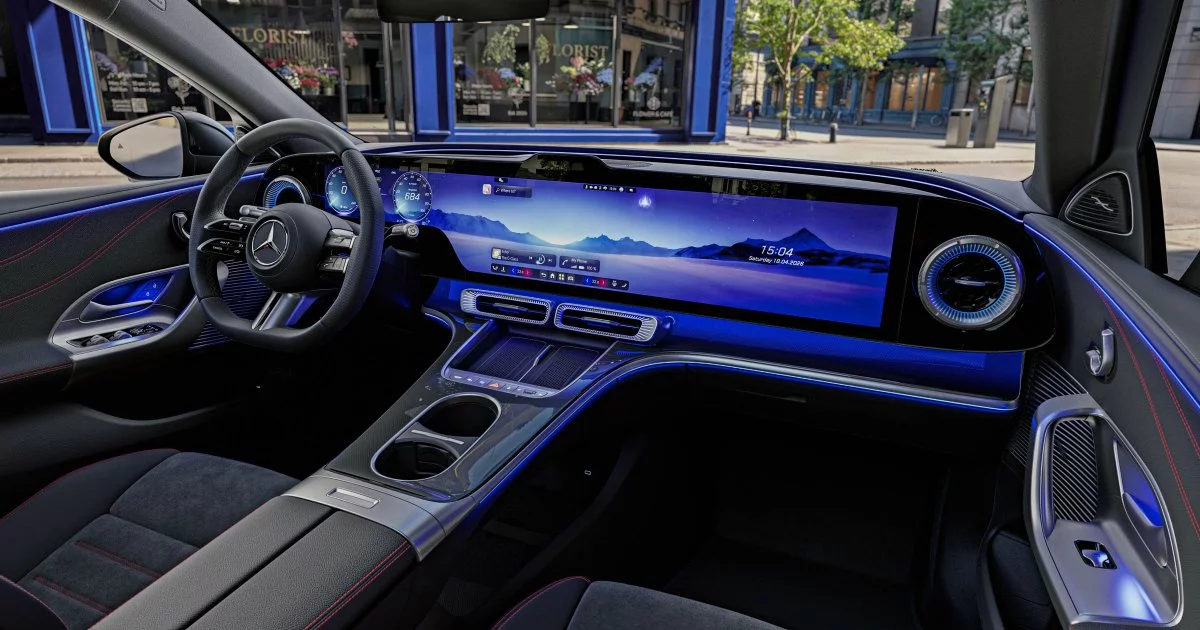

A widening gap between digital cockpit ambition and real-world driver behavior
The latest JD Power survey of 68,000 drivers of 2026 model-year vehicles lands as a pointed reality check for an industry that has treated ever-larger screens as a proxy for innovation. The data indicates a growing mismatch between what automakers are building—expansive, software-centric in-car experiences—and what many drivers actually want: simplicity, reliability, and reduced distraction.
One of the most striking signals is the underuse of passenger-facing touchscreens. More than one-third of respondents said they never used them, and only 6% used them regularly. That is not merely a feature adoption problem; it is a strategic warning about misallocated engineering effort and the risks of designing for showroom impact rather than daily utility.
At the same time, the survey links larger displays with higher rates of infotainment malfunctions, reinforcing an uncomfortable truth for software-defined vehicle strategies: complexity is not neutral. It carries operational costs—bugs, latency, update failures, and user frustration—that can erode brand trust faster than a new UI can win it.
For automakers, the implication is clear. The competitive frontier is shifting from “more digital” to more usable, where the winning interface is the one that disappears into the background and lets the driver focus on driving.
Reliability beats novelty: why “set-and-forget” tech is winning
The survey’s highest marks went to technologies that embody a simple promise: they work without demanding attention. Features such as smart ignition and smart HVAC performed strongly because they reduce friction rather than add decision-making steps. In a market where vehicle prices have climbed—driven by R&D, compute hardware, sensors, and software development—drivers appear increasingly focused on value perception: what improves the experience every day, not what looks futuristic once.
This is where the economics become inseparable from design. Large touchscreens and sophisticated graphical interfaces are expensive to develop and maintain across a vehicle’s lifecycle. They also introduce:
- More points of failure (hardware, firmware, UI layers, app integrations)
- Higher warranty exposure due to infotainment instability and component replacements
- Greater cybersecurity burden, as connected displays expand the attack surface
- Ongoing over-the-air update complexity, where fixes can create new regressions
In an inflation-pressured environment with constrained consumer financing, the return on investment for “feature bloat” becomes harder to justify—especially when many drivers don’t use the features and still bear the cost through higher sticker prices.
The survey also hints at a deeper behavioral reality: drivers are not rejecting technology. They are rejecting technology that competes for attention. The most appreciated innovations are those that deliver benefits quietly—reliability, comfort, and predictability—without turning the cabin into a cognitive workload.
Touchscreens, tactile controls, and the new premium: designing for attention scarcity
A notable industry response is already underway: several manufacturers are reintroducing tactile knobs and buttons. This is not nostalgia; it is a recognition that physical controls can be a safety feature. Tactile interfaces allow muscle memory and eyes-free operation—advantages that touch-only systems struggle to replicate, even with haptics and voice assistants.
The emerging design correction suggests a new kind of differentiation, particularly in the premium segment: well-engineered physical interfaces paired with restrained, purposeful software. In practice, that could mean:
- Physical controls for high-frequency tasks (temperature, volume, defrost, drive modes)
- Screens reserved for low-frequency or contextual tasks (navigation overview, settings, media browsing)
- Modular infotainment architectures that allow customers to opt into advanced features rather than bundling them by default
There is also a supply-chain and engineering logic behind simplification. Large displays add weight, wiring complexity, and component dependencies, with downstream implications for EV range, crash certification, and logistics. Reducing interior electronics complexity can streamline procurement and lower long-run warranty costs—an increasingly strategic advantage as automakers balance electrification investment with profitability targets.
In short, the cabin is becoming a battleground for attention management. The brands that treat attention as scarce—and design accordingly—may earn a reputation for safety and ease that becomes more valuable than another inch of screen.
ADAS expectations reset: when “more automation” feels like less confidence
The survey’s skepticism toward Level 2 Plus partial hands-free systems is a second, equally consequential signal. Drivers rated these more advanced systems below simpler Level 2 driver-assistance features, reflecting concerns that “more automation” can sometimes feel like more ambiguity—especially when combined with touchscreen-heavy controls and unclear operational boundaries.
This is as much a communications and trust issue as it is a technology issue. When driver-assistance systems are marketed or perceived as closer to autonomy than they truly are, the result can be misaligned expectations, overreliance, and reputational risk. The JD Power findings suggest a path forward centered on clarity:
- Position ADAS as bounded driver support, not a step-change toward self-driving
- Prioritize predictable behavior and transparent limitations over feature breadth
- Reduce interface friction so drivers can understand and control assistance modes quickly
For automakers pursuing “vehicles as platforms” and recurring software revenue, this matters. Subscription-based services depend on sustained trust and satisfaction. If the core interface is unreliable or the assistance systems feel confusing, customers will be less willing to pay for upgrades, packages, or ongoing digital services—undermining a key pillar of the software-defined vehicle business model.
The JD Power survey ultimately frames a pragmatic mandate for the next design cycle: human-centered innovation that treats usability, reliability, and safety as primary product features—not constraints. In the race to digitize the cabin, the brands that win may be those that remember the driver is not a user trapped in an interface, but a person navigating the real world at speed.

 By
By
 By
By

 By
By
 By
By


 By
By







