

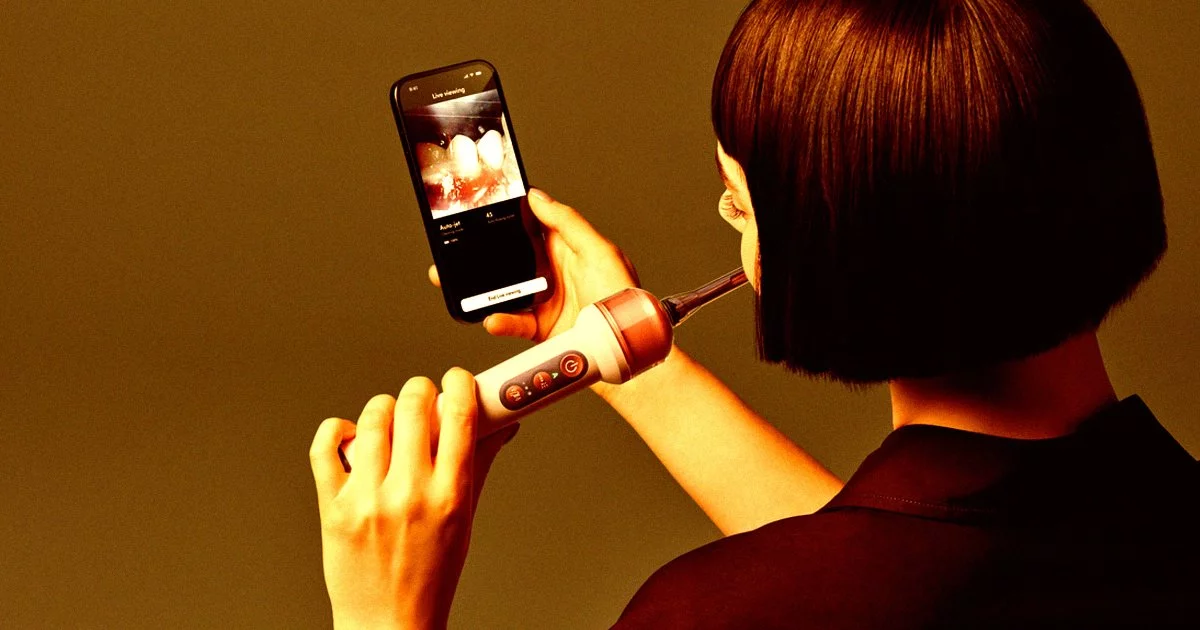

Dyson’s CameraJet and the new frontier of “diagnostics-by-default” personal care
Dyson’s debut of the CameraJet, a $499 AI-enhanced electric toothbrush equipped with a 100,000‑pixel macro-lens camera, stroboscopic illumination, and machine-learning analysis, is more than a premium gadget launch—it is a pointed statement about where consumer health hardware is headed. By capturing 28 frames per second and analyzing brushing in real time, the device reframes oral hygiene from a routine habit into a continuous, sensor-driven feedback loop.
This is part of a broader shift: clinical-grade sensing is moving into everyday products, and the boundary between “wellness device” and “health-adjacent diagnostic tool” is becoming increasingly porous. The CameraJet’s promise—identifying interdental gaps and potential oral health issues with dentist-grade precision—positions brushing as a moment of daily measurement, not merely maintenance.
Dyson’s inclusion of proprietary non-foaming toothpaste (SLS-free) is telling. It signals that the company is engineering not only the hardware but also the optical environment required for reliable imaging. In other words, this is a system, not a brush—an approach that mirrors how leading technology firms build ecosystems around sensors, software, and consumables to control performance end-to-end.
—
Engineering choices that hint at Dyson’s broader ambitions in health-tech hardware
The CameraJet’s most consequential innovation may be its miniaturized imaging stack: macro optics paired with stroboscopic lighting to stabilize capture in a wet, reflective, fast-moving environment. That is a nontrivial engineering challenge, and it plays to Dyson’s reputation for precision design—particularly in domains where fluid dynamics, airflow, and compact high-performance components matter.
Several implications stand out for business and technology watchers:
- Edge intelligence becomes a product differentiator: Real-time analysis while brushing suggests a push toward on-device (edge) computing, reducing dependence on cloud processing for responsiveness and potentially for privacy.
- Optics as a platform capability: If Dyson can reliably deliver high-speed, high-clarity imaging in the mouth—one of the most difficult consumer imaging environments—it may be able to extend similar techniques into adjacent categories where compact imaging is valuable.
- From appliance maker to health instrumentation brand: The CameraJet reads like an early move in a longer strategy: turning everyday appliances into measurement instruments that generate actionable health insights.
This is where the product becomes strategically interesting beyond oral care. The same miniaturized capture-and-illumination discipline could plausibly translate into future devices in dermatology imaging, ear and hearing diagnostics, or other home-use screening tools—markets where the ability to capture consistent, clinically useful images is often the limiting factor.
—
Connectivity, biometric sensitivity, and the cybersecurity burden of health-adjacent IoT
Dyson’s decision to integrate Wi‑Fi and Bluetooth is essential for modern “smart” positioning, but it also elevates the CameraJet into a higher-risk category of connected devices. Intraoral imagery and video streams are not just personal data; they can qualify as sensitive biometric and health-adjacent information, depending on jurisdiction and how the data is processed, stored, and shared.
This raises a set of questions that increasingly define the success or failure of connected health products:
- Data security and encryption: Consumers and regulators will expect strong protections—end-to-end encryption, secure key management, and hardened device authentication.
- Firmware and update integrity: Health-adjacent IoT devices live or die by their ability to patch vulnerabilities quickly and safely through secure update mechanisms.
- Privacy governance under GDPR and CCPA-style regimes: Even if Dyson positions the CameraJet as a consumer appliance rather than a medical device, privacy expectations will track closer to health-tech than to typical smart-home gadgets.
- Trust versus monetization: The temptation to leverage anonymized oral-health datasets for insights or marketing is real, but so is the reputational risk if consumers feel surveilled in an intensely personal context.
The market has learned—often the hard way—that connectivity is not a feature; it is a long-term obligation. For Dyson, the CameraJet’s credibility will depend not only on brushing performance but on whether the company can demonstrate security-by-design and transparent data handling that stands up to scrutiny.
—
Pricing, competitive pressure, and the emerging subscription logic of oral care
At $499, the CameraJet enters a premium tier where the purchase decision is less about incremental brushing improvement and more about perceived health value, status signaling, and the promise of measurable outcomes. Dyson’s packaging—two brush heads, a charging dock, and proprietary toothpaste—also hints at a familiar playbook: premium hardware paired with recurring consumables, with the potential to evolve into software and services.
From a market perspective, several dynamics are likely to follow:
- Premiumization with an ecosystem moat: Proprietary toothpaste designed to preserve image clarity is not just a formulation choice; it can become a lock-in mechanism if users believe it is required for best performance.
- SaaS and replenishment opportunities: Dyson could plausibly introduce paid layers such as advanced AI reporting, automated supply replenishment, or integrations with tele-dentistry platforms—turning a one-time sale into a recurring revenue relationship.
- Competitive escalation in smart oral care: Incumbents like Oral‑B (P&G) and Philips Sonicare already compete on sensors and coaching. Dyson’s camera-first approach raises the bar, potentially compressing margins in the mid-tier as feature expectations rise.
- Proof burden for mass adoption: The mass market will likely demand evidence that camera-guided brushing produces tangible benefits—fewer interventions, earlier detection, improved periodontal outcomes—rather than simply better “engagement metrics” in an app.
A pivotal strategic variable is whether Dyson pursues partnerships with dental professionals, insurers, or telehealth providers. Clinical validation and reimbursement pathways could transform the CameraJet from a luxury device into a preventive-care tool with broader reach. Without that external validation, the product risks being perceived as over-engineering applied to a task many consumers still view as fundamentally simple.
Dyson’s CameraJet lands at a moment when consumer technology is steadily absorbing responsibilities once reserved for clinics: measurement, monitoring, and early warning. If Dyson can pair its engineering advantage with credible privacy safeguards and clinically meaningful outcomes, the toothbrush may become a template for a new category of AI-enabled home diagnostics—where the real product is not the device, but the durable relationship between data, behavior change, and health.

 By
By
 By
By
 By
By
 By
By

 By
By
 By
By








