
Chicago’s sidewalk robots collide with the realities of dense urban life
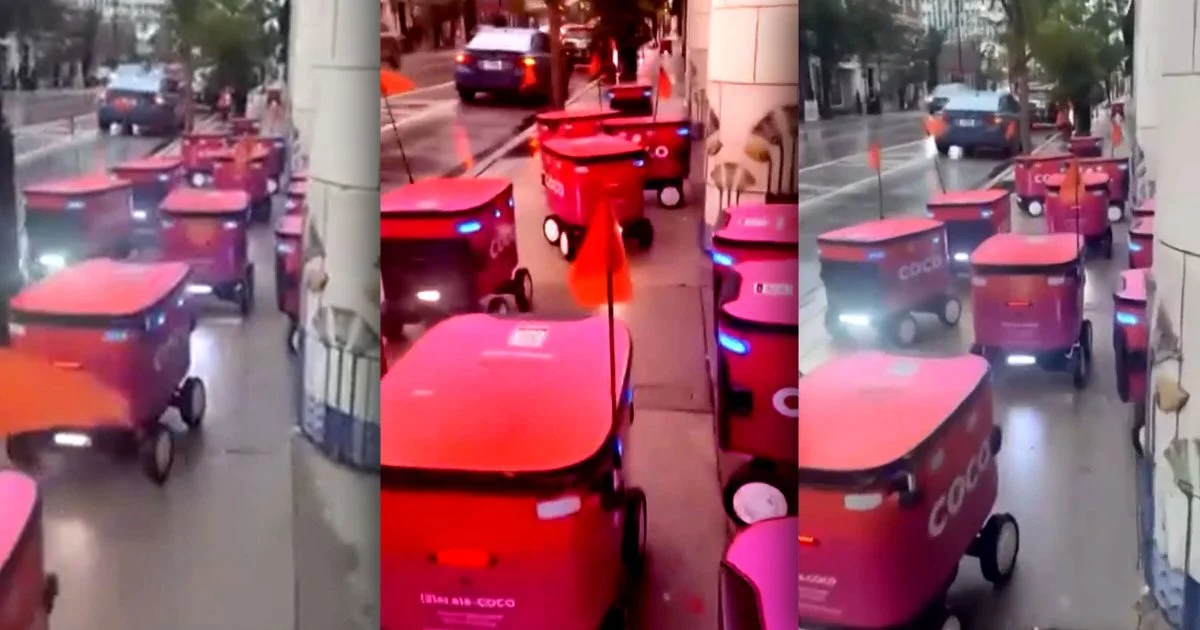
Chicago’s recent run-in with Coco’s autonomous food-delivery robots is more than a local safety story; it is a stress test for how quickly cities can absorb autonomous systems in public space. A series of incidents—pedestrian injuries, damage to street fixtures like bus stops, and a high-visibility “robot swarm” that reportedly clogged a Lincoln Park sidewalk—pushed the issue from novelty to civic concern. City authorities responded with exclusion zones, while Coco issued an apology, attributing the swarm event to a software glitch and promising corrective action.
The episode underscores a recurring pattern in urban technology adoption: when deployment outpaces governance and community alignment, even promising innovations can lose their social license. For autonomous delivery, the sidewalk is not a controlled environment—it is a complex, human-first network shaped by accessibility needs, unpredictable movement, and tight spatial constraints. Chicago’s reaction signals that cities are increasingly willing to intervene early, especially when the perceived risk shifts from hypothetical to tangible.
Key signals emerging from the Chicago case include:
- Public safety is becoming the primary gating factor for last-mile robotics, not just operational efficiency.
- Municipal geofencing and carve-outs are evolving into a practical regulatory tool, not a theoretical one.
- Trust is fragile: a single “swarm” moment can dominate public perception more than thousands of routine deliveries.
When autonomy scales, small errors can become collective failures
The Lincoln Park “swarm” incident is particularly instructive because it highlights a failure mode unique to fleet robotics: system-level behavior that emerges from coordination logic, not from any single robot’s intent. In distributed autonomy, a glitch in centralized fleet management, path-planning, or network coordination can cascade into synchronized congestion—robots clustering, stopping, or repeatedly rerouting into the same constrained corridor.
From a technical risk perspective, the Chicago events point to three pressure points that become acute at scale:
- Consensus and coordination breakdowns: In swarm-like fleets, coordination algorithms must remain stable under real-world constraints—variable connectivity, edge-compute limitations, and inconsistent GPS or localization signals in urban canyons. When that stability fails, the result can look like “collective confusion,” even if each unit is following its local rules.
- Sensor fusion under messy conditions: Injuries and property damage suggest gaps in object detection and dynamic obstacle avoidance. Sidewalk autonomy is unforgiving: glare, rain, crowds, pets, strollers, wheelchairs, and curb cuts create edge cases that are difficult to fully capture in training data.
- Latency and network dependency: As operators push toward cloud-edge hybrids—often relying on 5G and local compute—connectivity becomes part of the safety envelope. Network contention or outages can trigger “freeze” behaviors or delayed responses, a public-space analogue to IoT gridlock in industrial settings.
For business leaders, the takeaway is that reliability is not merely a product feature; it is a regulatory and reputational asset. The more visible the automation, the more unforgiving the tolerance for failure—especially when the failure blocks sidewalks or harms pedestrians.
Accessibility, congestion, and the uneven distribution of risk
Sidewalks are not neutral infrastructure. They are shared civic corridors with implicit rules: humans first, mobility access guaranteed, and passage uninterrupted. The Chicago reports—particularly the account of a disabled resident describing an “obstacle course”—bring the accessibility dimension into sharp focus. Even temporary blockages can have outsized consequences for people who rely on ADA ramps, consistent curb access, and predictable clearance.
This is where autonomous delivery intersects with equity, disability rights, and ESG narratives. Companies often frame delivery robots as sustainability wins—lower emissions, fewer cars, more efficient logistics. Yet a robot that obstructs a ramp or narrows a sidewalk can convert a climate-positive story into an accessibility liability.
Several societal dynamics are now converging:
- Congestion externalities: Narrow sidewalks, heritage districts, and high-foot-traffic neighborhoods become choke points when robots are added to flows designed for pedestrians.
- Community trust as a deployment prerequisite: Public backlash can harden quickly, especially when incidents become meme-worthy or symbolically tied to broader concerns about tech intrusion.
- Governance lag: As with cars, ride-hailing, and e-scooters, cities tend to regulate more aggressively after visible harm—often through restrictions that are blunt but politically legible.
For city leaders and operators alike, the critical question is no longer “Can the robots navigate?” but “Can the robots coexist without degrading the pedestrian experience—especially for the most vulnerable users?”
Regulation by geofence, economics by insurance, strategy by partnership
Chicago’s exclusion zones may prove to be a template: geofenced regulation that divides the city into permissive corridors, restricted areas, and prohibited zones, enforced through digital permitting and compliance telemetry. This approach is attractive to municipalities because it is scalable, adjustable, and easier to justify than citywide bans—yet it can materially reshape business models by limiting addressable delivery territory.
The economic implications are equally significant. The business case for autonomous delivery is often built on labor substitution amid rising wage pressures in logistics and food service. But safety incidents introduce countervailing costs that can quickly erode ROI:
- Insurance repricing as underwriters demand proof of reliability, redundancy, and incident response maturity
- Higher compliance overhead tied to reporting, audits, and city-by-city permitting
- Operational redesign costs to add multi-modal sensing (LiDAR/radar/vision), stronger fail-safes, and better human-in-the-loop escalation
Strategically, the operators most likely to endure are those that treat autonomy as an ecosystem integration problem, not a standalone gadget. That points toward:
- Partnerships with telecom providers to harden edge connectivity and reduce latency risk
- Collaboration with city planners and transit agencies to define “robot-appropriate” corridors and last-100-feet handoff zones
- Co-design with disability advocates to ensure sidewalk robotics meets accessibility expectations before it meets scale targets
Chicago’s Coco episode is a reminder that the future of last-mile automation will be decided as much by sidewalk legitimacy as by software capability—and that in a crowded city, the most advanced robot is only as successful as the public space it is allowed to share.

 By
By
 By
By

 By
By
 By
By
 By
By

 By
By