

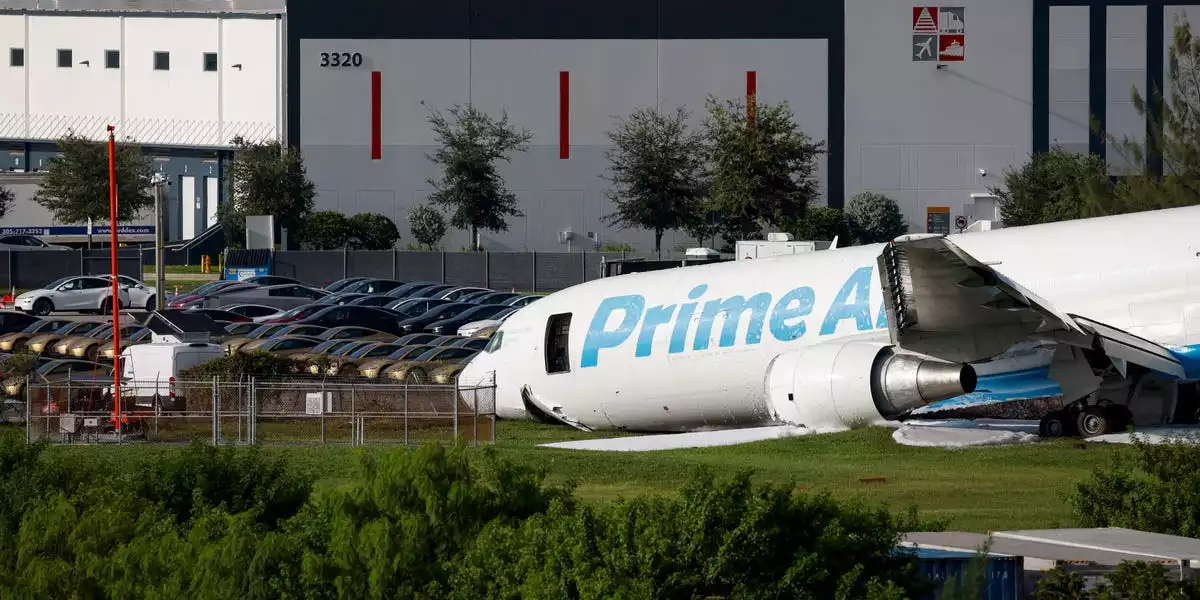

A runway overrun that exposes the new fault lines in automated transport ecosystems
The September 6, 2026 runway excursion at Miami International Airport (MIA)—involving an Amazon Prime Air–chartered Boeing 767 cargo jet that overshot the runway during adverse weather, struck ground vehicles, and came to rest near a staged fleet of gold-colored Tesla Cybercabs—is already being treated as more than an aviation accident. With five fatalities and five injuries, the human toll is immediate and tragic. Yet the broader significance lies in what the scene represented: a modern airport becoming a dense convergence point for automated logistics and software-defined urban mobility.
While early reporting indicates the Cybercabs were stationary and not involved, their proximity to the crash site has amplified scrutiny around two high-profile technology narratives at once:
- Amazon’s Prime Air cargo expansion, which increasingly relies on advanced avionics, automation-assisted operations, and predictive maintenance layered onto legacy airframes.
- Tesla’s Cybercab robotaxi rollout, positioned as Level 4 autonomy without traditional driver controls, with Miami reportedly serving as a storage and staging node following an initial commercial debut in Austin.
Federal and local investigations—spanning aviation and roadway safety authorities, including the National Highway Traffic Safety Administration (NHTSA) alongside first responders—will likely focus on a familiar triad: equipment performance, weather conditions, and procedural execution. But the Miami incident also introduces a newer question for regulators and operators: what happens when failures in one automated domain physically intersect with another, even incidentally?
Prime Air, legacy freighters, and the hard limits of “automation as a safety layer”
For Amazon, the optics are unavoidable. Prime Air’s promise is built on speed, reliability, and a technology-forward posture—yet a second fatal Boeing 767 incident within seven years (as referenced in the provided material) underscores a persistent industry challenge: integrating modern monitoring and decision-support systems into older aircraft platforms that were not originally designed for today’s sensor-rich, data-driven operational model.
Runway overruns are rarely monocausal. Investigators will likely examine:
- Braking and deceleration performance, including anti-skid behavior and runway condition reporting
- Crew decision-making under adverse meteorological conditions, including approach stability and go/no-go thresholds
- Maintenance records and predictive maintenance alerts, particularly where automated diagnostics may have flagged anomalies
- Airport ground operations, including vehicle placement, perimeter controls, and emergency response timing
The strategic tension for Amazon is that safety investments—enhanced runway excursion prevention, redundant braking systems, improved training regimes, third-party operational audits—compete directly with growth capital. In a tighter macro environment, where interest rates and credit conditions constrain experimental and high-capex transport ventures, the cost of resilience becomes a central variable in the unit economics of air cargo.
A key takeaway for the broader aviation automation market is that “more automation” does not automatically translate into “less risk.” When automation is layered onto complex operations, it can reduce certain error modes while introducing new ones—particularly around human-machine coordination, alert fatigue, and edge-case weather behavior.
Cybercabs at the perimeter: why an uninvolved robotaxi fleet still becomes part of the story
Tesla’s Cybercab program—described here as a Level 4 ride-hailing deployment without traditional controls—faces a different kind of scrutiny. Even though the vehicles were reportedly parked and uninvolved, the incident places a spotlight on infrastructure readiness and the resilience of autonomous fleets to external shocks.
The Miami setting matters. Airports are uniquely harsh environments for autonomy-adjacent operations:
- High-reflectivity surfaces and complex lighting conditions
- Heavy metal clutter and moving obstacles (tugs, fuel trucks, service vehicles)
- Sensor occlusion risks from spray, debris, and weather
- Unpredictable emergency dynamics during incidents
A robotaxi fleet staged near an airport perimeter raises practical questions that regulators and municipalities increasingly care about: Where are autonomous vehicles stored? How are they protected? What happens if they are damaged by external events? How is data secured and shared after an incident? Even if the Cybercabs were merely nearby, the public narrative can quickly shift from “uninvolved” to “exposed,” especially when autonomy remains a trust-sensitive technology category.
Economically, the risk is less about immediate physical damage and more about timeline disruption. Cybercabs represent substantial sunk cost in specialized compute, sensors, and software validation. Any delay to a Miami launch, or added local restrictions, can extend the breakeven horizon for mobility-as-a-service ambitions—particularly if regulators demand additional testing corridors, perimeter constraints, or reporting obligations.
The regulatory gap: when FAA airspace and NHTSA road safety collide on the same tarmac
The Miami crash is a case study in cross-modal risk interdependencies. Airports are no longer just aviation nodes; they are becoming logistics and mobility hubs where autonomous systems coexist—often under bifurcated oversight. Aviation safety is primarily FAA-led, while autonomous road vehicle safety and defect investigations sit in the NHTSA orbit, with state and municipal authorities shaping deployment permissions and operational rules.
That fragmentation can create gaps in:
- Incident response coordination across agencies with different mandates and data standards
- Data-sharing protocols, including black-box flight data, maintenance telemetry, and vehicle sensor logs
- Remediation requirements, where one domain’s corrective actions may not address adjacent-domain exposure
For Amazon and Tesla, crisis management now has a shared feature: radical transparency becomes a competitive necessity. Stakeholders—regulators, insurers, institutional investors, and the public—will expect timely disclosure of what can be disclosed: maintenance histories, operational procedures, sensor and telemetry integrity, and the concrete mitigation roadmap.
The market implications extend beyond these two brands. Reinsurance pricing for cargo operations may rise, while autonomy deployments may face more stringent municipal demands. The companies best positioned to navigate this moment will be those that treat safety not as a compliance checkbox, but as a system-of-systems engineering discipline—one that anticipates the unplanned interactions that occur when automated aviation and autonomous mobility begin sharing the same physical and regulatory terrain.

 By
By
 By
By
 By
By

 By
By

 By
By
 By
By







