
Cosmic Alchemy: JWST’s Wolf-Rayet Revelations and the New Materials Economy
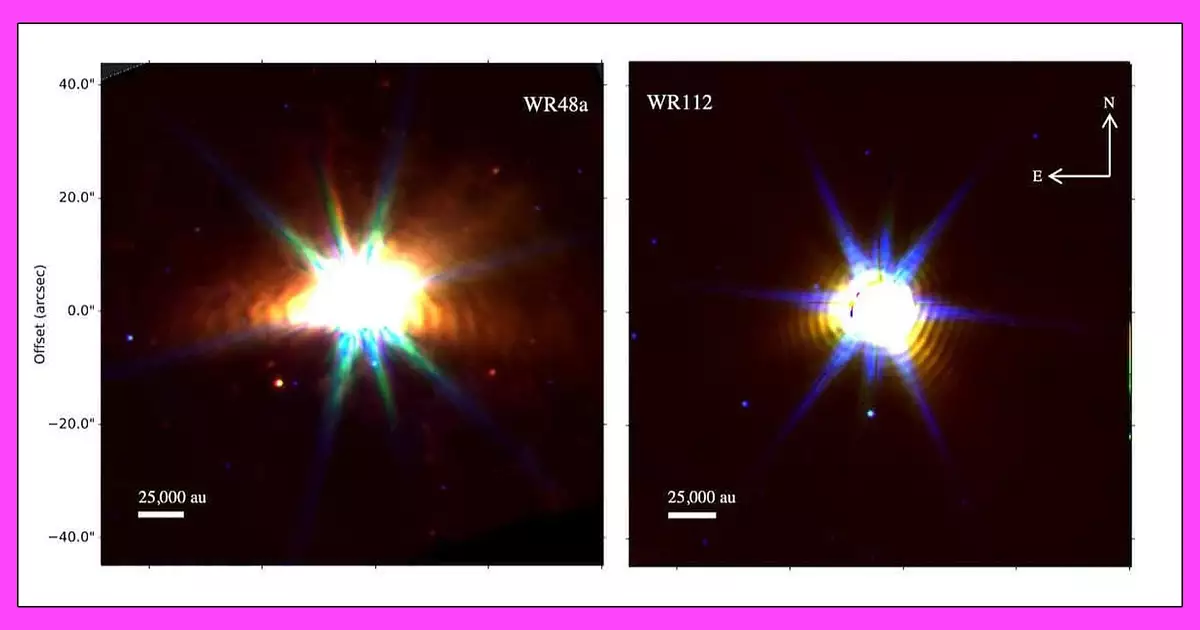
The James Webb Space Telescope (JWST) has once again upended our understanding of the cosmos, this time by illuminating the secret lives of Wolf-Rayet stars—massive, hydrogen-stripped titans on the brink of supernova. Where once only a single, dust-shrouded exemplar (WR-140) stood, JWST’s keen mid-infrared gaze has revealed a family of at least four more, each encased in long-lived, carbon-rich shells. These findings, enabled by the telescope’s unprecedented sensitivity and spatial resolution, are not merely a triumph of astronomical technique; they are rewriting the late chapters of stellar evolution and, in the process, reframing our relationship with cosmic carbon.
The Instrumental Edge: Unlocking Stellar Dust and Data Frontiers
At the heart of this breakthrough lies JWST’s Mid-Infrared Instrument (MIRI)—a symphony of cryogenic optics, ultra-sensitive HgCdTe detectors, and diffraction-limited imaging that renders the faintest dust shells in exquisite sub-arcsecond detail. This leap, a full order of magnitude sharper than Spitzer, has transformed features once lost in stellar glare into quantifiable, mappable structures. Each observation now yields data cubes surpassing 50 gigabytes, demanding a new paradigm in data reduction: cloud-native pipelines, AI-powered feature extraction, and scalable hyperspectral analytics are no longer luxuries but necessities.
This technical revolution is not confined to the observatory. The ripple effects are felt upstream, as JWST’s components—cryocoolers, micro-shutter arrays, beryllium mirrors—become reference architectures for commercial Earth-observation constellations and defense payloads. Suppliers report surging demand from primes building mid-infrared CubeSats and high-altitude pseudo-satellites, a testament to the telescope’s catalytic influence on the broader aerospace supply chain.
Data, Discovery, and the New Materials Playbook
JWST’s revelations have also transformed the economic and industrial landscape. NASA’s open-data mandate has seeded petabyte-scale astronomical archives, drawing hyperscale cloud providers into the orbit of astronomy. Specialized GPUs and object storage tiers are now the backbone of this new scientific infrastructure, setting a precedent for other data-intensive disciplines.
Perhaps most intriguing is the knowledge spillover into advanced materials. The characterization of carbon-rich stellar dust—its composition, formation, and dispersal—offers analogs for low-temperature chemical vapor deposition and nanoparticle self-assembly. Early patent filings already cite JWST’s spectral lines to guide process windows for next-generation battery anodes and infrared-transparent coatings. The telescope’s findings are thus blurring the boundaries between astrophysics and industrial R&D, opening unexpected avenues for collaboration and commercialization.
Venture capital has not missed the signal: investments in space-based telescopes and debris-monitoring startups have climbed 32% year-over-year, according to PitchBook. This is more than a speculative bubble; it is a recognition that space science, once the domain of pure research, now feeds a credible pipeline for dual-use technologies.
Strategic Positioning: Talent, Diplomacy, and the Stardust Narrative
The strategic reverberations extend far beyond the laboratory. The United States, leveraging JWST’s discoveries, reaffirms its leadership in big-science diplomacy even as Europe accelerates its Extremely Large Telescope and China prepares its own mid-infrared probe. The telescope’s success strengthens the case for public-private contracting models—fixed-price, milestone-based procurement with agencies like NASA as anchor tenants—a structure likely to shape the forthcoming Habitable Worlds Observatory.
Talent is the new currency. The demand for domain-aware data scientists—those fluent in Bayesian inference, pipeline automation, and cryogenic hardware—has never been more acute. Astrophysics, once a niche, now supplies a pool of PhD-level expertise directly portable to aerospace, defense, and semiconductor manufacturing.
The adjacency insights are equally compelling:
- Semiconductor Process Analogies: The concentric dust rings around Wolf-Rayet stars mirror pulsed-layer deposition in microelectronics, offering fresh models for in-situ process control and uniformity.
- ESG Storytelling: Understanding cosmic carbon cycles reframes the narrative from “carbon as liability” to “carbon as asset,” a powerful motif for green-tech firms seeking to anchor their portfolios in universal, cyclic principles.
- AI and Vision Models: The richly textured Wolf-Rayet images serve as benchmarks for generative vision models in anomaly detection, with techniques migrating from astronomy to industrial inspection and medical imaging.
The Next Horizon: Opportunity at the Intersection of Science and Industry
The implications are clear for decision-makers. As JWST’s spectroscopic campaigns ramp up, the detection of unexpected organics or silicates could pivot research funding toward astrochemistry-inspired catalysts and biomaterials. The coming data deluge—amplified by time-domain surveys—demands pre-positioned AI and storage capacity. Early movers in sensor calibration and interoperability standards will shape the next wave of space-borne mid-infrared imaging, while universities leading JWST research are actively courting corporate partners for algorithm development and materials validation.
The narrative is no longer just about stars and dust. It is about the emergence of a “stardust to startup” pipeline, where frontier science, robust data infrastructure, and cross-disciplinary collaboration converge to redefine markets, materials, and even the stories we tell about our place in the universe. Those who position themselves at this intersection—where cosmic alchemy meets commercial ingenuity—stand to extract extraordinary strategic value in the decade ahead.

 By
By


 By
By
 By
By

 By
By
 By
By