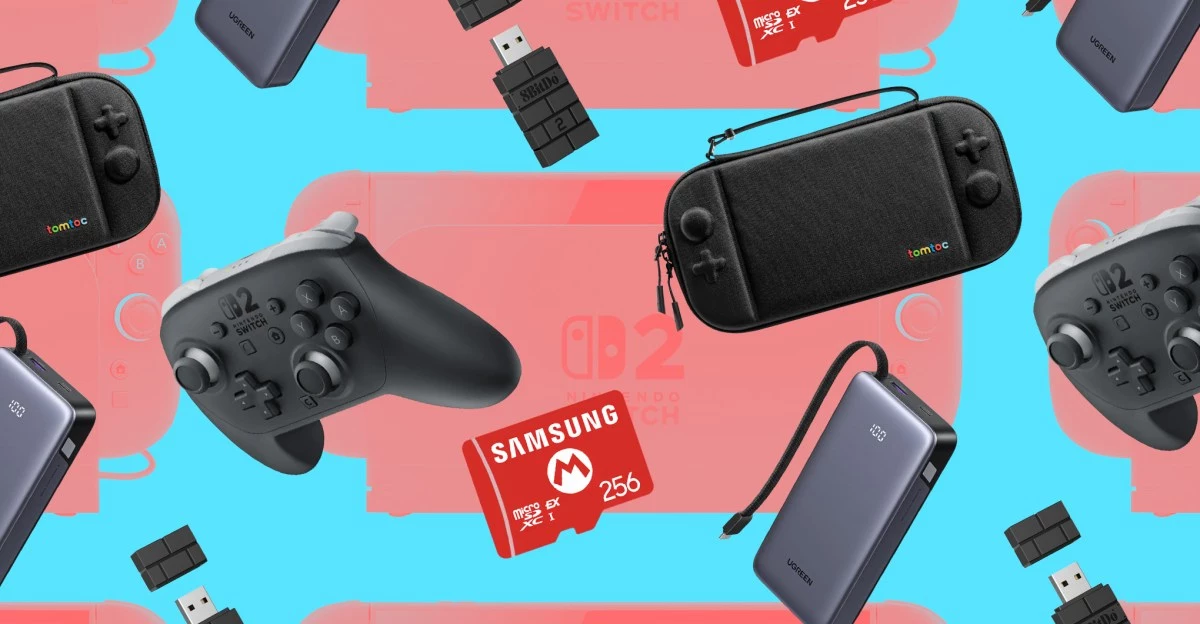

The Nintendo Switch 2: The Console as Ecosystem Nucleus
As anticipation swells around the Nintendo Switch 2, industry observers are discovering that the console’s true innovation may not reside in its silicon or industrial design, but in its orchestration of a high-margin, multi-layered accessory ecosystem. This emerging strategy positions the Switch 2 not as an isolated device, but as the gravitational center of a vibrant value web—one where physical protection, storage expansion, control versatility, and power delivery converge to extend the hardware lifecycle and deepen user engagement.
Nintendo’s approach is both pragmatic and visionary: by embedding the Switch 2 within an accessory-rich environment, the company seeks to elevate average revenue per user (ARPU) and insulate its platform from the volatility of hardware cycles. This is not merely an exercise in upselling, but a calculated play to transform every accessory purchase into a micro-investment in long-term brand loyalty.
Technological Shifts: From microSD Express to Protocol-Agnostic Peripherals
The Switch 2’s embrace of the microSD Express standard signals a tectonic shift in consumer electronics storage. Historically, microSD Express—with its PCIe/NVMe backbone—has been the preserve of enterprise and prosumer niches. Nintendo’s mass-market adoption is poised to catalyze demand, pushing theoretical read speeds beyond 800 MB/s and narrowing the performance gap between removable cards and internal SSDs. For developers, this unlocks new possibilities in asset streaming and game design, while for semiconductor manufacturers, it justifies a reallocation of 3D NAND production toward higher-speed, higher-margin bins.
Equally transformative is the trend toward controller interoperability. Devices like 8BitDo’s USB Adapter 2 leverage HID-class translation to bridge Nintendo’s proprietary protocols with those of Xbox and PlayStation, effectively creating a middleware layer that dissolves traditional barriers. This mirrors the broader industry’s “one-port rule” embodied by USB-C, where protocol-agnostic design reduces consumer friction and invites a flourishing aftermarket—albeit at the cost of diluting first-party accessory lock-in.
Power delivery, too, is converging on a universal standard. The recommendation of ≥20 W USB-PD (Power Delivery) power banks, especially those supporting Programmable Power Supply (PPS) profiles, cements USB-PD 3.0 as the lingua franca for charging not just consoles, but the entire spectrum of mobile devices. Accessory makers who certify to these standards are poised to command premium shelf space and consumer mindshare.
Economic Undercurrents: Margins, Attach Rates, and Channel Dynamics
The economics of the accessory ecosystem are as compelling as the technology. Nintendo’s first-party accessories routinely command gross margins exceeding 50%, dwarfing the ~30% margins typical of hardware. The $89 Pro Controller is emblematic of this strategy: a premium price point that captures wallet share without alienating the broader base through high console ASPs. Meanwhile, third-party innovators—names like Dbrand, Tomtoc, and 8BitDo—fill feature and price gaps, but their success paradoxically strengthens Nintendo’s ecosystem. Each accessory purchase becomes a sunk cost, subtly anchoring users and reducing churn.
In an era of inflationary headwinds and cautious discretionary spending, the economics of incremental attach are particularly potent. Consumers may balk at a $400 hardware refresh, but a $9 screen protector or a $29 carrying case feels justifiable—especially when bundled as part of a “starter kit.” Retailers, attuned to these margin dynamics, are shifting from optional upsells to standardized accessory bundles, echoing practices from the smartphone market. The logistics are favorable, too: small-parcel accessories offer supply-chain agility, especially during peak holiday quarters.
Strategic Horizons: Standardization, Lock-In, and the Edge Node Future
Nintendo’s accessory-centric playbook carries profound implications for the broader industry. By embracing open standards—USB-C for connectivity, microSD Express for storage—the company paradoxically strengthens its moat. R&D overhead is reduced, third-party innovation is subsidized, and the overall ecosystem becomes richer and stickier. For competitors, this resets user expectations: future handhelds from Sony or Microsoft will be judged not just on raw hardware, but on their ability to support high-speed removable storage and universal charging.
The long-term stakes are even greater. Each accessory purchased—be it a controller, dock, or memory card—raises the effective cost of switching platforms, lengthening the console lifecycle and boosting software attach rates. This incremental capital expenditure, often overlooked in traditional lifetime value models, is now a core variable for executives and investors alike.
Moreover, the technological foundations being laid—fast removable storage, power-dense batteries, protocol-agnostic IO—open doors to future optionality. Local caching of cloud-streamed games, mixed-reality overlays, and edge computing scenarios all become feasible, positioning the Switch 2 as more than a console: it becomes an edge node in Nintendo’s broader digital strategy.
For decision-makers across the value chain, the message is clear. Hardware architects must prioritize standards-compliant, accessory-ready designs. Retailers and e-commerce platforms should leverage historical attach data to craft tiered experience bundles. Investors would do well to track accessory attach rates as a leading indicator of platform health, often preceding software revenue growth by several quarters.
In the evolving landscape of hybrid consoles, the accessory ecosystem is not a peripheral concern—it is the strategic lever by which platforms will expand margins, propagate standards, and entrench themselves for the next generation. The companies that recognize and operationalize this reality will shape the future of interactive entertainment.

 By
By
 By
By

 By
By


 By
By


 By
By

 By
By