

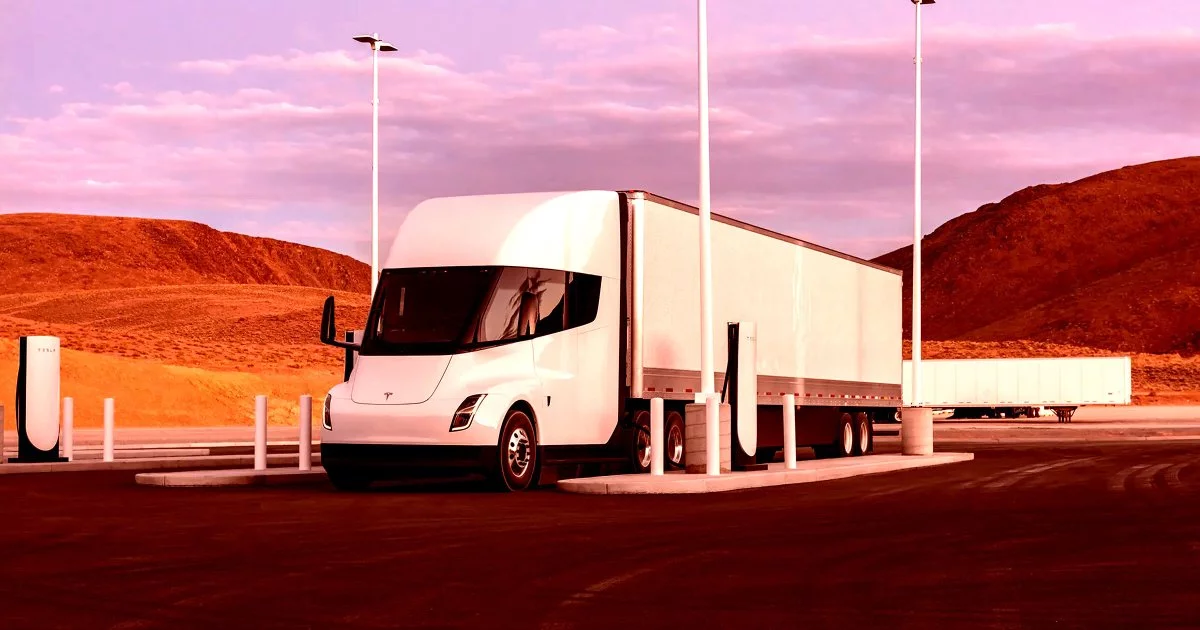

A courtroom test of California’s autonomous freight ambitions
California has become the focal point of a widening national debate over autonomous semi-trucks, after the state’s Teamsters union filed suit against lawmakers and agencies—including the California Department of Motor Vehicles (DMV)—to challenge newly adopted rules that enable pilot testing of driverless big rigs. At the heart of the complaint is not only the technology itself, but the process used to authorize it.
The union argues that the regulations were fast-tracked without a required economic impact study, effectively bypassing standard administrative review, public notice, and comment procedures. If the court agrees, the remedy sought is sweeping: void the rules as illegally adopted, forcing regulators back to the drawing board and potentially slowing the pace of autonomous freight trials in the nation’s largest transportation market.
The timing is politically and strategically charged. California recently signaled a nuanced posture toward autonomy—opening the door to limited autonomous trucking pilots even as it tightened oversight of robotaxi operations. That divergence underscores a central reality: the state is attempting to calibrate innovation and risk across different autonomous vehicle categories, but the Teamsters lawsuit challenges whether that calibration can proceed without deeper scrutiny of economic and safety externalities.
Why autonomous semi-trucks raise a different class of technical and safety questions
Autonomous trucking is often discussed in the same breath as robotaxis, yet the operational envelope is fundamentally different. Heavy-duty trucks introduce unique engineering and safety stakes: higher kinetic energy, longer stopping distances, more complex failure modes, and sustained operation across diverse road and weather conditions.
Key technical dynamics shaping the controversy include:
- Scale and consequence of failure: A malfunction in a passenger vehicle is serious; a malfunction in an 80,000-pound tractor-trailer can be catastrophic. Incidents involving advanced electric and automated heavy vehicles—such as the widely cited Tesla Semi-related safety concerns—reinforce how quickly public confidence can erode when edge cases become headlines.
- Sensor reliability and redundancy under load: Freight autonomy depends on robust perception (camera/radar/lidar configurations), fault-tolerant compute, and safe fallback behavior. The heavier the vehicle and the more variable the environment, the more demanding the redundancy requirements become.
- Decision-making complexity at highway speeds: Long-haul routes may appear simpler than dense urban driving, but highway autonomy must handle high-speed merges, construction zones, debris, unpredictable human drivers, and degraded visibility—often for hours at a time without intervention.
California’s regulatory shift is therefore being interpreted by many in the industry as a signal that public-sector institutions are increasingly willing to accelerate real-world pilots to keep pace with private-sector innovation. Yet the lawsuit highlights a countervailing view: that the state may be moving faster than its procedural safeguards were designed to allow, especially when the technology’s risk profile differs materially from smaller autonomous vehicles.
The economic stakes: logistics efficiency versus labor displacement and social cost
Autonomous freight sits at the intersection of two powerful economic forces: the drive to reduce logistics costs in a massive global market, and the vulnerability of a large, geographically dispersed workforce.
On the corporate side, the incentives are clear. Freight and logistics is forecast to reach $1.2 trillion globally by 2025, and autonomy is pitched as a lever to improve margins through:
- Lower labor costs and more consistent utilization
- Fuel efficiency gains via optimized driving and routing
- Telematics-driven predictive maintenance, reducing downtime and improving asset life
Some estimates suggest fleets could see operating expense reductions of roughly 20%, though real-world outcomes will vary widely depending on corridor design, regulatory constraints, insurance pricing, and capital costs.
On the labor side, the Teamsters’ warning of potential displacement—over 200,000 drivers—is consistent with broader research suggesting that a significant share of driving roles could be automated over time, with McKinsey projecting up to 45% of U.S. driving jobs at risk by 2030. The union’s argument is not solely that automation will arrive, but that California’s rulemaking allegedly failed to quantify and publicly vet the distributional impacts—including potential pressure on unemployment systems, regional labor markets, and retraining capacity.
This is where the absence of a mandated economic impact study becomes more than a procedural footnote. It becomes a proxy for a larger question: Who bears the transition cost of automation, and when does the public get to weigh in? For policymakers, the challenge is that the benefits of cheaper freight can be diffuse (lower prices, improved supply chain resilience), while job losses can be concentrated and immediate—creating a political asymmetry that often drives litigation and ballot-box backlash.
Strategic ripple effects: regulatory precedent, union leverage, and a patchwork national map
Beyond California, the lawsuit could influence how autonomous vehicle regulation is written, defended, and replicated. If courts require stricter adherence to administrative procedure—especially around economic impact analysis—states may need to slow down, document more, and invite broader stakeholder participation before authorizing novel pilots.
Several strategic implications stand out:
- Regulatory precedent risk: A ruling favoring the Teamsters could establish a higher bar for procedural rigor in emerging-tech rulemaking, with spillover effects beyond transportation into other regulated automation domains.
- Union strategy and bargaining leverage: By framing autonomy as an “existential threat,” organized labor is positioning itself to negotiate not just over wages, but over the architecture of deployment—job guarantees, wage insurance, retraining pipelines, and potentially profit-sharing or transition funds tied to autonomous fleet productivity gains.
- Investment and partnership recalibration: OEMs, autonomy-stack providers, and carriers may lean harder into shared-risk models—corridor-based pilots, revenue-sharing agreements, and consortium approaches to insurance and liability—particularly if regulatory uncertainty increases.
- Adoption pathways and operational models: A hub-and-spoke approach—driverless operation on rural interstates with human-driven first/last mile—may emerge as the politically and operationally feasible middle ground, while incremental automation features (platooning, advanced driver assistance) continue to monetize in the near term.
For national fleet operators, the likely outcome is a more fragmented compliance environment. Some states may accelerate autonomous freight to attract logistics hubs and investment, while others may prioritize labor protections and procedural safeguards, producing a patchwork regulatory landscape that complicates scaling.
California’s autonomous semi-truck dispute is therefore less a narrow fight over pilot rules than a broader referendum on how the U.S. governs high-impact automation: whether speed to deployment is treated as a competitive necessity, or whether legitimacy must be earned through deeper economic accounting, safety validation, and public consent—before the first driverless big rig becomes a routine sight on the interstate.

 By
By
 By
By
 By
By

 By
By
 By
By
 By
By








