

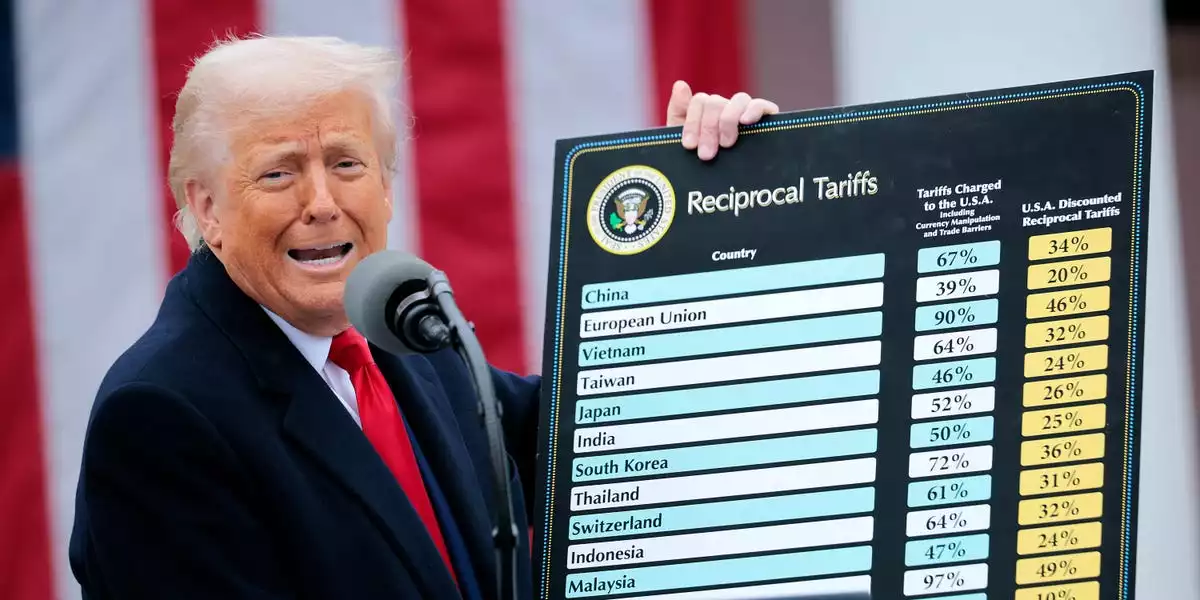

A Supreme Court rebuke that redraws the map of U.S. tariff authority
The Supreme Court’s decision to invalidate much of President Trump’s Section 232 national-security tariffs is more than a discrete legal setback for one administration’s trade agenda—it is a structural signal to markets that the judiciary is willing to police the boundaries of executive power in trade policy. For corporate America and global trading partners, the ruling injects a new variable into an already volatile equation: tariffs may still arrive quickly, but they may not endure without sturdier statutory footing.
That distinction matters. Section 232 has long been attractive to presidents precisely because it can be wielded with speed and broad discretion under the banner of national security. The Court’s pushback elevates the likelihood that future tariff programs will face faster, more confident legal challenges, and that companies will treat tariff exposure not only as a cost item, but as a litigable balance-sheet asset.
The administration’s reported pivot toward Section 122—a temporary, up to 150-day “worldwide” tariff mechanism—underscores the new reality: the executive branch still has tools, but many are time-limited and subject to congressional oversight. In practical terms, this shifts the trade-policy landscape from durable regimes to stopgap measures, complicating long-range planning for manufacturers, retailers, and logistics networks that depend on predictable landed costs.
Key legal and regulatory implications now coming into focus include:
- Shorter policy half-lives: Section 122’s sunset provisions make tariffs feel more like rolling shocks than stable frameworks.
- Higher litigation intensity: With roughly $133 billion in previously collected duties potentially subject to refunds, the incentive to sue is substantial.
- Greater congressional gravity: If courts narrow unilateral authority, lasting tariff policy increasingly requires legislative buy-in—difficult in a polarized Congress.
The $133 billion question: refunds, revenue gaps, and the bond market’s quiet veto
The most immediate financial aftershock is the looming contest over tariff refunds. More than 1,000 companies are positioned to pursue claims tied to the estimated $133 billion already collected. Even if repayment timelines stretch, the headline number alone reframes tariffs from “revenue stream” to “contingent liability,” with implications for both corporate cash flows and federal fiscal arithmetic.
For Washington, the potential evaporation of tariff inflows lands at an awkward moment: deficits are already elevated, and any meaningful revenue hole can translate into incremental borrowing. Markets tend to adjudicate fiscal slippage quickly, often through higher Treasury yields, which then ripple outward into corporate credit and equity valuations.
This is where the ruling becomes a two-sided market story:
- Positive for many corporates: Reduced risk of persistent tariffs can ease input-cost pressure and improve planning certainty, particularly for import-dependent sectors.
- Potential macro headwind: If tariff revenues disappear and borrowing rises, yields may drift higher, tightening financial conditions and weighing on rate-sensitive equities.
Equity implications are therefore likely to be non-linear. Industrials and exporters may welcome a lower probability of entrenched tariff barriers, while high-duration growth stocks could feel pressure if the market reprices the cost of capital. Financials, by contrast, can sometimes benefit from a steeper curve—though that advantage depends on broader credit conditions and loan demand.
Consumers, corporates, and the politics of who gets the “tariff dividend”
Politically, the ruling has already sparked competing narratives about who should benefit from tariff unwind. Some Democrats are floating direct consumer rebates—figures around $1,700 have been mentioned—framing the moment as an opportunity to return perceived over-collections to households. Yet Wall Street caution, including from Goldman Sachs, suggests consumers should not expect rapid, visible price declines.
That skepticism reflects how pricing actually works in modern supply chains. Tariffs are only one component of the final shelf price, and reductions do not always pass through cleanly because:
- Retail pricing is shaped by inventory cycles (goods imported under old tariff assumptions may still be on shelves).
- Firms may retain savings to rebuild margins after years of cost volatility.
- Shipping, labor, insurance, and financing costs can offset tariff relief.
The distributional backdrop also matters. The economy has continued to grow, but gains remain uneven, with wage growth lagging outside higher-income brackets. That means even if some prices soften at the margin, the broader demand response may be muted—particularly for discretionary categories where consumers remain sensitive to credit costs and job security.
Market strategists are already parsing likely winners. Jefferies’ consumer-oriented calls point to companies that could see margin relief if input costs fall, but the durability of that benefit depends on whether tariff policy stabilizes—or simply oscillates under new legal constraints.
The operational response: supply-chain tech, contract redesign, and “tariff agility” as a strategy
For executives running procurement, manufacturing, and distribution, the ruling does not end tariff risk—it changes its shape. The new operating environment favors companies that can treat trade policy as a dynamic variable and respond with speed. That is accelerating investment in digital supply-chain resilience, including:
- AI-driven predictive analytics to model tariff exposure and demand shifts in near real time
- Digital twins to simulate alternate sourcing, routing, and production footprints before disruptions hit
- Blockchain-enabled trade finance and documentation to reduce friction in cross-border compliance and improve auditability
At the same time, contracting is evolving from static pricing to risk-sharing structures designed for policy whiplash. More firms are exploring:
- Index-linked pricing tied to duties, freight, or commodity benchmarks
- Cost pass-through clauses that clarify who absorbs sudden tariff changes
- Dual-sourcing and nearshoring strategies that trade higher unit labor costs for lower geopolitical and tariff exposure
Notably, the tariff saga is also creating its own “shadow winners.” Trade lawyers and specialized law firms stand to benefit from the refund litigation wave and ongoing compliance complexity, while corporate operations leaders face a persistent mandate: engineer supply chains that can survive not just economic cycles, but legal and political ones.
The Supreme Court has effectively told the market that tariff power is not limitless—and that message will echo through boardrooms, courtrooms, and bond auctions alike. The companies best positioned now are those building tariff agility into their technology stacks, contracts, and capital allocation, treating trade policy not as a headline risk, but as a permanent feature of strategic planning in a geopolitically fragmented economy.

 By
By

 By
By
 By
By
 By
By
 By
By
 By
By








