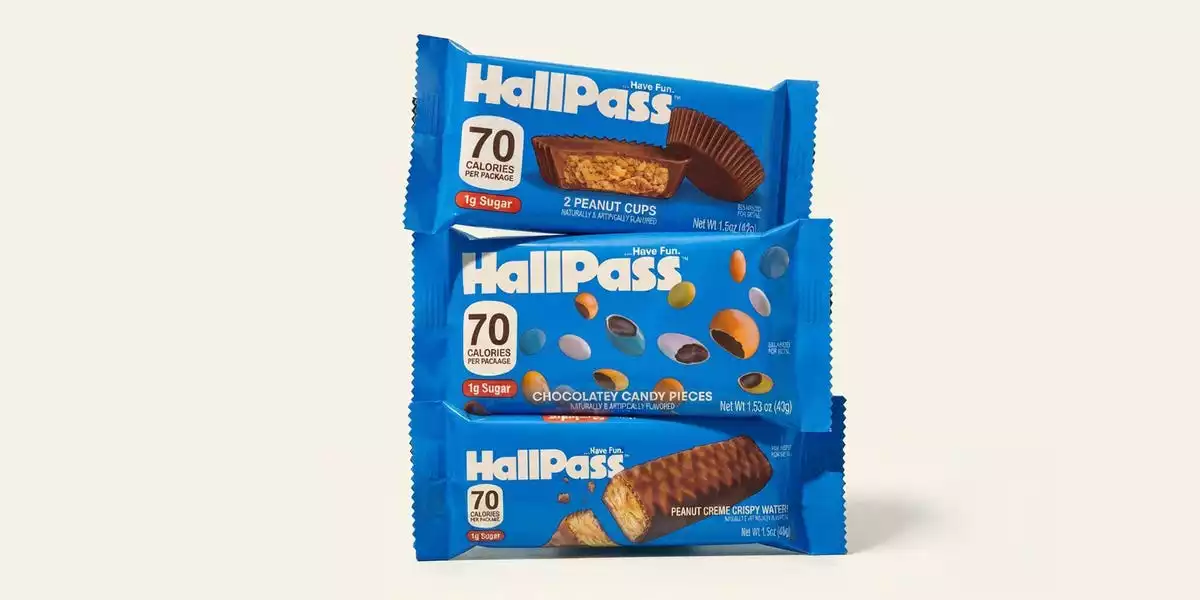

HallPass and the rise of “intentional imperfection” in consumer branding
HallPass, a new lower-calorie candy brand under Medici Brands, is entering the market with an unusual opening move: AI-generated packaging imagery that appears deliberately “wrong.” The visuals—circulating online ahead of the brand’s August 29 Walmart rollout—feature conspicuous typographic glitches such as “suger,” “pacaage,” and blurred or malformed product descriptors. Rather than quietly correcting the errors, HallPass’s leadership has treated the moment as a feature, not a bug—framing the missteps as internet “rage bait” designed to spark conversation and accelerate awareness.
The strategy is notable not only for its audacity, but for who is behind it. HallPass is co-founded by Peter Rahal (known for RxBar and David Protein) and Michael Tierney (Stuffed Puffs), entrepreneurs with deep experience in modern consumer packaged goods (CPG) playbooks—distribution-first scaling, brand storytelling, and product positioning that rides cultural currents. That pedigree makes the “flawed packaging” approach harder to dismiss as accidental. It reads instead like a calculated experiment in attention economics, where the first objective is not persuasion but *interruption*.
At stake is a broader question for business and technology leaders: in an era where generative AI is rapidly compressing the cost and time of creative production, does brand equity come from polish—or from provocation? HallPass is effectively betting that controlled controversy can outperform conventional refinement, at least long enough to earn a place in the consumer’s memory and the retailer’s velocity metrics.
What the packaging typos reveal about generative AI in real-world marketing
From a technology standpoint, the HallPass episode underscores a persistent limitation of many diffusion-based image models: reliable text rendering remains a known failure mode. Even as image generation becomes photorealistic, letters frequently warp, swap, or dissolve—an issue that is especially visible in packaging, where typography is not decoration but regulated, brand-defining information.
This is where the story becomes instructive for enterprise adoption. HallPass’s approach implicitly highlights that off-the-shelf AI creative tools still require human quality assurance, particularly for consumer-facing assets. The public reaction—much of it incredulous that a food brand would allow obvious spelling errors—reflects a growing expectation that companies deploying AI should also deploy strong governance.
Key implications for marketing operations and AI governance include:
- Hybrid review is still essential: Generative AI can accelerate ideation, but packaging, labeling, and claims require human editorial control and legal review.
- “Failure-driven branding” is emerging: HallPass is turning a technical weakness into a creative signature—suggesting a new genre where machine errors become intentional design language.
- Brand risk becomes a design variable: The same tactic that drives virality can also create a perception of carelessness, especially in categories tied to health, ingredients, and trust.
- Future QA frameworks will likely formalize: Expect broader adoption of automated anomaly detection (flagging garbled text, off-brand colors, missing required elements), paired with rapid human approval loops.
There is also a subtler psychological mechanism at play. Research in cognitive fluency suggests that small “processing difficulties”—like noticing a typo—can increase attention and memorability. In that light, HallPass’s packaging errors may function as a form of “desirable difficulty,” prompting consumers to pause, reread, and share. Whether that attention converts to purchase depends on what the product delivers once the joke lands.
Price parity, health positioning, and the economics of viral reach
HallPass is positioning itself as a health-conscious, lower-calorie alternative while keeping pricing in line with conventional candy bars—an approach reminiscent of Coca-Cola Zero Sugar’s long-standing strategy of reducing friction by avoiding a “health premium.” In today’s grocery environment, that matters. With inflation still shaping household budgets, many consumers will try “better-for-you” products only if the trade-offs—taste, portion size, and price—feel reasonable.
Economically, the brand’s viral packaging gambit also functions as a bid for marketing efficiency. Organic reach can reduce reliance on paid media, particularly during launch windows when awareness is the scarcest resource. But the trade is volatility: earned attention is powerful, yet unpredictable, and sentiment can swing from amused to distrustful quickly.
The competitive context is equally unforgiving. Better-for-you snacks and confectionery are crowded with:
- challenger brands built around macros and functional ingredients,
- legacy incumbents extending “zero” and “light” lines, and
- private-label alternatives competing aggressively on price.
In that landscape, calorie count alone is rarely a durable moat. HallPass will need differentiation across taste credibility, ingredient story, and repeat purchase behavior—the metrics that matter once the initial spike of attention fades. Walmart distribution can be a force multiplier, but it also compresses the timeline for proving velocity: shelf space is earned through performance, not novelty.
The strategic wager: narrative control in an AI-saturated attention economy
HallPass’s most sophisticated move may be its attempt to own the narrative before critics can define it. By publicly embracing the AI imperfections, the company reframes what could be interpreted as sloppy execution into a deliberate brand posture—playful, self-aware, and culturally fluent. This is the “authenticity paradox” of modern branding: imperfection can signal humanity and transparency, yet it can also read as manufactured relatability if overplayed.
The episode also foreshadows a regulatory and reputational frontier. As policymakers and industry bodies debate standards for AI-generated marketing and labeling clarity, early high-profile cases like this help shape expectations—both for disclosure norms and for what constitutes acceptable consumer-facing accuracy.
For executives watching from other sectors, the transferable lesson is not that typos sell candy. It’s that generative AI changes the economics of creative production, and that change invites new strategies—some rooted in craft and control, others in calibrated chaos. HallPass is testing whether a brand can convert AI’s most visible weakness into a durable identity asset, while still delivering the fundamentals consumers ultimately reward: taste, trust, and value.

 By
By
 By
By

 By
By

 By
By
 By
By
 By
By