

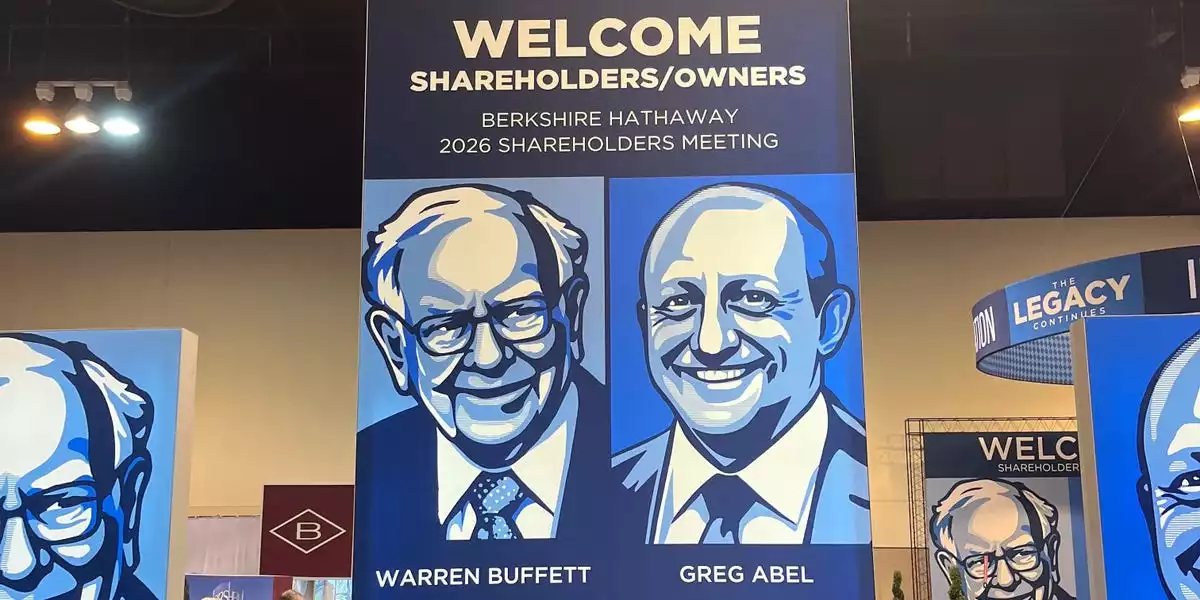

Greg Abel’s Berkshire: From Buffett’s “optionality” to a more active balance-sheet posture
Berkshire Hathaway’s leadership transition has moved from symbolic to operational. With Greg Abel now at the helm, the company’s famously patient capital-allocation machine is showing early signs of a different cadence—less about maximizing “dry powder” as a standing insurance policy, and more about selectively converting liquidity into ownership when pricing and strategic fit align.
The headline numbers are modest relative to Berkshire’s scale but meaningful in signal. Cash and equivalents declined from $380 billion to $365 billion in Q2, reflecting $23.5 billion in net stock purchases and $4.6 billion in share repurchases, the largest quarterly buyback since 2021 (followed by another $3.4 billion in July). For a conglomerate that has often been criticized—fairly or not—for letting cash accumulate faster than opportunities, the shift reads as a deliberate message: Berkshire is willing to act without waiting for a full-blown market dislocation.
This is not a repudiation of Warren Buffett’s framework so much as an adjustment in how it is applied. Under Buffett, record cash levels functioned as strategic optionality—a reserve designed to be most valuable when others are forced sellers. Abel’s early moves suggest a view that optionality can also be monetized in mid-cycle windows, when valuations are “good enough,” balance sheets remain resilient, and competition for assets has not yet turned frantic.
Buybacks and public equities: what the new tempo is signaling to markets
Berkshire’s buybacks are not merely a capital-return mechanism; they are a valuation statement. Repurchasing shares at scale implies management believes Berkshire’s intrinsic value is not fully reflected in the market price—an especially potent signal for a firm whose identity is built on disciplined appraisal.
Several implications follow:
- Buybacks as confidence architecture: The increased repurchase pace can stabilize investor expectations during a CEO transition, reinforcing continuity while Abel establishes his own operating rhythm.
- A tactical pivot back into equities: After 14 quarters of net selling, the move to net stock purchases suggests Berkshire sees improved relative value in public markets—either because prices have softened, or because expected long-term returns now clear Berkshire’s internal hurdle rates.
- Portfolio balance and concentration management: More active equity deployment can diversify exposure away from Berkshire’s core engines (notably insurance and industrial holdings) while preserving the conglomerate’s preference for durable cash flows.
Not everyone is reassured. Michael Burry’s concerns—that Abel might favor shorter-term confidence-building over Buffett’s hallmark patience—capture a broader market tension: leadership transitions often tempt companies to “do something” to prove momentum. Yet Berkshire’s governance context complicates that critique. Buffett remains involved in major allocation decisions, and recent examples—such as the $10 billion investment into Alphabet and the $9.4 billion OxyChem deal—underscore that capital deployment is still anchored to Berkshire’s long-standing emphasis on scale, durability, and downside protection.
The more precise question is not whether Abel will abandon Buffett’s discipline, but whether he will redefine what discipline looks like in a market where opportunity costs are more visible and shareholder scrutiny is more immediate.
Macro conditions shaping Berkshire’s calculus: rates, valuations, and real-asset appeal
Abel’s timing is inseparable from the current macro backdrop. Higher interest rates have made cash and short-duration instruments more attractive than in the prior decade, reducing the penalty for holding liquidity. At the same time, elevated rates have also compressed equity multiples, creating a landscape where long-term buyers can find better entry points without requiring a crisis.
Other tailwinds and crosscurrents matter:
- Inflation moderation and supply-chain normalization: As cost pressures ease and logistics stabilize, cyclical industrial and chemical assets can regain strategic appeal—particularly for investors comfortable underwriting multi-year recovery arcs.
- Corporate capital-allocation pressure: Across corporate America, boards are re-evaluating the trade-off between liquidity buffers and return on invested capital. Berkshire’s shift from hoarding to deploying may influence how other large firms justify cash-heavy balance sheets in a higher-rate world.
- Deal competition and financing dynamics: While Berkshire is not dependent on leveraged financing in the way private equity often is, the broader cost of capital still shapes asset pricing and seller expectations—creating windows where Berkshire’s speed and certainty can be decisive.
In this environment, Berkshire’s incremental cash drawdown is less a dramatic bet and more a recalibration of opportunity cost: if the market is offering acceptable long-duration returns today, waiting for a perfect storm may no longer be the dominant strategy.
Technology, energy transition, and the governance test of the post-Buffett era
Berkshire’s evolving posture also has technology and industry implications that extend beyond its quarterly filings. Buffett’s Alphabet allocation signaled comfort with platform-scale technology economics—an important marker for a conglomerate historically associated with consumer brands, insurance float, and industrial cash flows. Under Abel, market participants will watch whether Berkshire’s public-equity appetite broadens into areas adjacent to Alphabet’s ecosystem: AI infrastructure, cloud platforms, semiconductors, and data-centric business models—but only where valuation and durability meet Berkshire’s standards.
Meanwhile, industrial and chemicals exposure—highlighted by OxyChem—creates optionality around decarbonization and industrial digitization. Berkshire is positioned to be a long-duration backer of:
- Electrification and grid modernization
- Carbon capture and industrial efficiency technologies
- Lower-carbon process innovation in chemicals and manufacturing
There is also a quieter strategic angle: Berkshire’s insurance operations sit on deep reservoirs of underwriting data and risk expertise. A more active deployment stance could support insurtech and analytics investments that modernize pricing, claims, and catastrophe modeling—areas where AI is already reshaping competitive advantage.
Ultimately, Abel’s defining challenge is governance as much as investing: balancing stewardship with authorship. Continued consultation with Buffett may reassure shareholders, but the market will judge Abel on whether his decisions preserve Berkshire’s core identity—intrinsic value discipline, conservative leverage, and long-term compounding—while proving that Berkshire can still move decisively at scale. If Abel succeeds, Berkshire’s next chapter won’t be framed as “after Buffett,” but as a demonstration that a culture built on patience can also be engineered for timely action when the math—and the moment—align.

 By
By

 By
By
 By
By
 By
By


 By
By







