


Shattering the Canon: GRB 250702B and the New Era of Cosmic Discovery
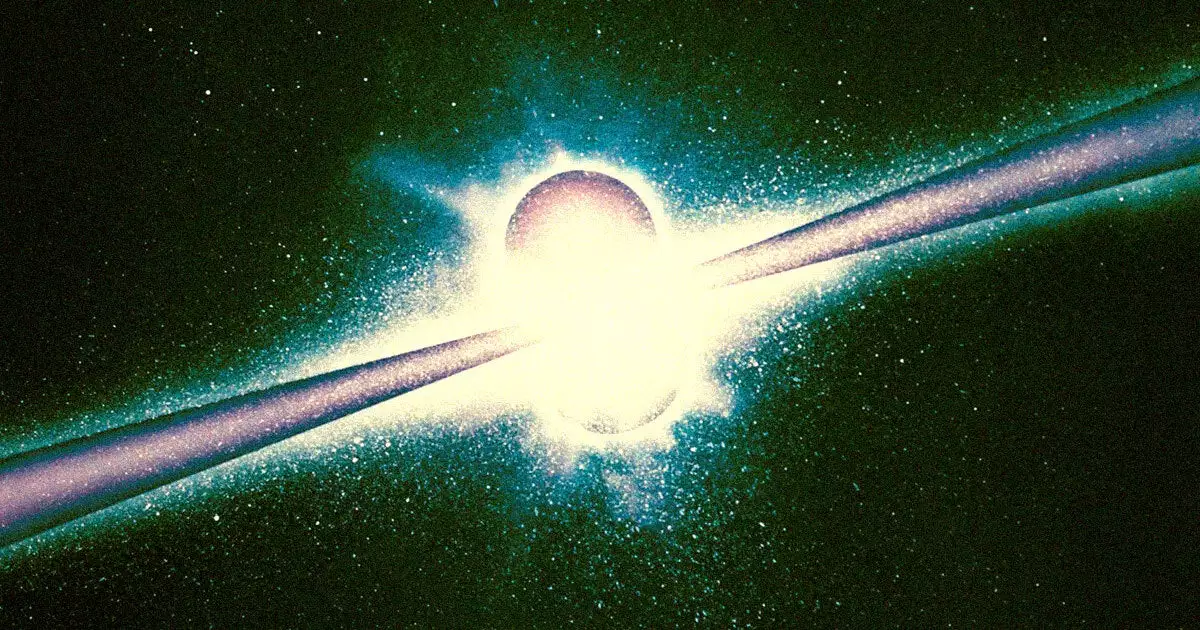
On July 2nd, the cosmos delivered a paradox: GRB 250702B, a gamma-ray burst whose behavior defies half a century of astrophysical dogma. Detected first by China’s Einstein Probe and then, hours later, by NASA’s Fermi telescope, this ultra–long-duration, repeating burst unfolded across billions of light-years. The Very Large Telescope’s subsequent localization only deepened the mystery, as theorists scrambled to explain a phenomenon that sits outside established models of stellar death. Was this a supernova’s prolonged swan song, or the signature of an intermediate-mass black hole—an object so elusive it’s become the stuff of astronomical folklore?
The implications ripple far beyond the realm of theoretical astrophysics. GRB 250702B is a Rosetta Stone for the future of sensor networks, data infrastructure, and the geopolitics of space.
—
Sensor Networks, Quantum Materials, and the Data Deluge
The choreography of detection—spanning continents and orbital altitudes—showcases the maturation of distributed sensor architectures. Fermi’s rapid flagging of the anomaly, corroborated by the Einstein Probe’s earlier signals, underscores the power of heterogeneous, real-time networks. These systems are more than just scientific instruments; they are the vanguard of autonomous, data-driven discovery, their algorithms sifting petabytes of telemetry for the rarest of cosmic events. The same anomaly-detection frameworks are now migrating into terrestrial domains:
- Earth-observation satellites: Identifying environmental anomalies with greater precision.
- Autonomous vehicles: Enhancing safety by recognizing rare but critical events.
- Cybersecurity: Detecting sophisticated, low-frequency threats.
The burst’s energy profile—orders of magnitude beyond prior records—forces a recalibration of radiation shielding for satellites. As commercial constellations balloon toward the 100,000-satellite mark, the need for robust, fault-tolerant hardware becomes existential. This is driving investment in wide-band-gap semiconductors and cryogenic sensor arrays, technologies that straddle the boundaries of quantum computing and advanced medical imaging. The race to capture higher-energy photons over longer intervals is not just a scientific pursuit; it is a commercial imperative.
Meanwhile, the sheer scale of data generated by GRB 250702B—multi-terabyte streams per event—has stress-tested the global exascale computing ecosystem. Cloud providers, sensing an inflection point reminiscent of the genomics revolution, are vying to become the backbone of astrophysical analytics. Public–private partnerships, often the unsung heroes of scientific progress, are now the scaffolding upon which this new era of discovery is being built.
—
Capital Flows, Geopolitics, and the New Space Economy
The reverberations of GRB 250702B are already being felt in boardrooms and ministries alike. The event strengthens the case for next-generation X-ray and gamma-ray observatories, likely redirecting capital from broadband megaconstellations to high-energy astrophysics. Insurance underwriters, ever attuned to the shifting sands of risk, are reevaluating exposure models for radiation-induced anomalies—particularly for polar low Earth orbits, the lifeblood of Earth-observation startups.
Yet, perhaps most striking is the event’s demonstration of international scientific collaboration. In an era marked by geopolitical tension, the seamless cooperation between Chinese and American instruments offers a template for future joint missions. Dual-use technology concerns may yet constrain this partnership, but they simultaneously open the field for European and Gulf-state investment, as nations vie for soft power through scientific leadership. Control over high-energy observatories is fast becoming as strategically valuable as dominance in quantum computing or artificial intelligence.
For enterprise strategists, the message is clear:
- R&D alignment: Companies in sensors, semiconductors, or advanced materials should monitor spin-in opportunities from astrophysical instrumentation—radiation-tolerant chips and ultra-fast converters are poised for cross-sector impact.
- AI and anomaly detection: Algorithms honed on GRB detection are primed for deployment in cybersecurity, industrial IoT, and critical infrastructure.
- Risk management: The extreme energy fluence of GRB 250702B is a clarion call for revisiting worst-case space-weather scenarios, with implications for aviation, telecom, and insurance.
—
Toward a New Taxonomy of Cosmic Phenomena
Perhaps the most tantalizing prospect is the potential confirmation of an intermediate-mass black hole, a discovery that would bridge the so-called “mass gap” in black-hole taxonomy. Such a breakthrough would catalyze upgrades to gravitational-wave detectors, fueling procurement cycles in precision optics, cryogenics, and high-throughput data links. The convergence of quantum sensing and exascale computing—once parallel pursuits—now finds common cause in modeling and detecting the universe’s most exotic events.
Policymakers, too, are taking note. Calls for open-data mandates, mirroring NOAA’s weather datasets, could democratize access and spur a new wave of analytics startups. International standards bodies are already contemplating the integration of ultra-high-energy transient events into satellite design guidelines, with cascading effects on certification timelines and insurance models.
GRB 250702B is not a mere cosmic curiosity. It is a fulcrum, shifting the balance of technological ambition, capital allocation, and geopolitical strategy. For those attuned to its reverberations, the event is a harbinger—heralding a decade where the boundaries between astrophysics, enterprise, and statecraft grow ever more porous, and where the rarest bursts of cosmic energy illuminate the next frontiers of human ingenuity.

 By
By
 By
By

 By
By
 By
By


 By
By







