

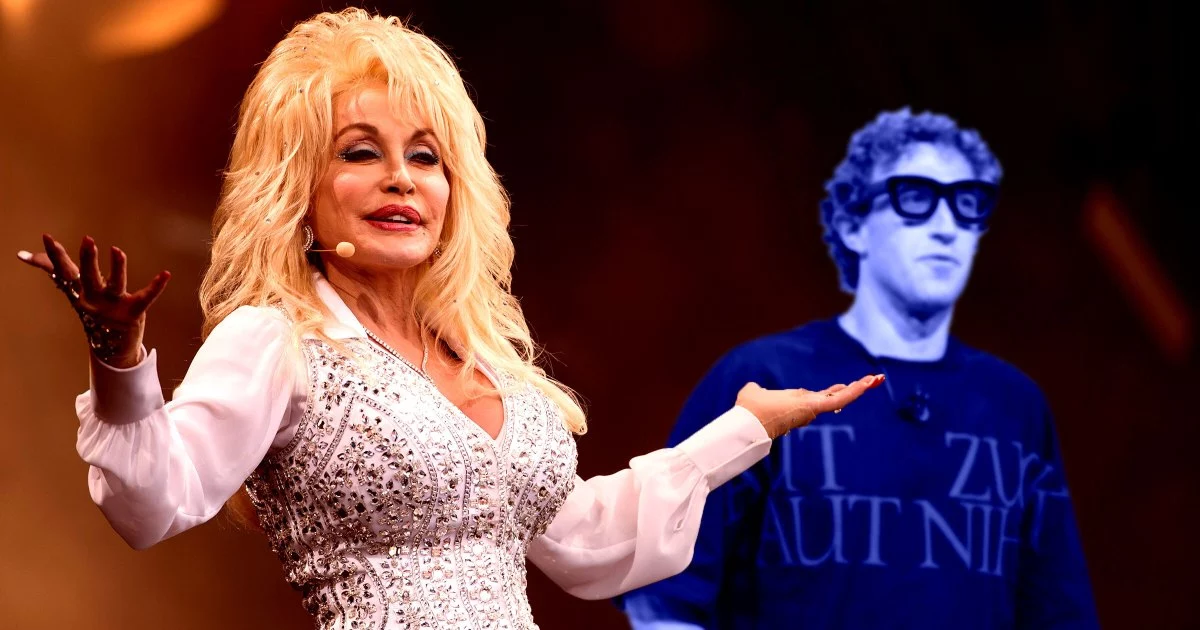

A tale of two reputations: cross-partisan admiration versus cross-partisan suspicion
The public response to Dolly Parton’s reported passing has been marked by an unusually broad, politically diverse outpouring—an emotional consensus that is increasingly rare in a polarized media environment. Favorability data cited from UMass Lowell captures that breadth: 78% among Democrats and 73% among Republicans. In brand terms, that is not merely popularity; it is durable, cross-segment trust that survives ideological sorting.
Set against that, the favorability numbers attributed to Meta CEO Mark Zuckerberg—8% with Democrats and 13% with Republicans—read less like ordinary controversy and more like a structural legitimacy problem. Even polarizing public figures typically retain a strong base within at least one partisan camp. Zuckerberg’s unusually low standing across both suggests a deeper dynamic: the public is not simply disagreeing with him; it is discounting the institution he represents, and the governance model that comes with it.
This juxtaposition matters beyond celebrity and personality. It illuminates a core tension in the modern economy: trust is now a competitive asset, and in technology—where products mediate speech, identity, and civic life—trust is also a form of permission to operate. When that permission erodes, reputational risk becomes financial risk, regulatory risk, and talent risk all at once.
The “trust dividend” and why authenticity scales better than innovation narratives
Parton’s reputation offers a case study in what might be called a trust dividend—the compounding returns earned when a public figure’s actions, tone, and values remain legible over time. Her brand has long been built on warmth, relatability, and consistency, reinforced by visible philanthropy and a persona that bridges multiple identity clusters: artist and entrepreneur, feminist and devout Christian, cultural icon and local-community benefactor. That multidimensionality functions as a set of cognitive bridges, allowing different audiences to see their own values reflected without feeling coerced into a political camp.
By contrast, the archetypal tech leadership narrative—innovation, disruption, scale—often struggles to translate into social affinity. The public may admire technical achievement while simultaneously distrusting the motives and methods behind it. In Meta’s case, skepticism has been amplified by a convergence of widely publicized issues:
- Data privacy and surveillance anxieties, crystallized by scandals such as Cambridge Analytica
- Perceived opacity in platform decision-making, especially around algorithms and content ranking
- Allegations of election interference or political manipulation, whether proven, exaggerated, or misunderstood
- Content moderation failures, where every enforcement decision can be framed as bias by one side and negligence by the other
- Workplace culture controversies and the broader critique of Silicon Valley elitism
- High-stakes AI and metaverse investments, seen by some as visionary and by others as evasive—an attempt to outrun unresolved governance questions
The key distinction is not that one figure is “good” and the other “bad,” but that one brand is experienced as human-scale and transparent, while the other is experienced as system-scale and inscrutable. In an attention economy shaped by distrust, the public increasingly rewards what it can interpret quickly: motives that feel comprehensible, accountability that feels personal, and values that appear stable.
The polarization penalty hits platforms harder than personalities
Parton’s long-standing avoidance of partisan battlegrounds has functioned as a unifying strategy—not apathy, but a deliberate refusal to convert cultural capital into political weaponry. In a fragmented media landscape, that neutrality can be a form of leadership: it preserves a shared cultural space where admiration is not contingent on ideological alignment.
For Zuckerberg and Meta, the challenge is structurally different. A social platform is not merely a product; it is a civic infrastructure layer. That means every design choice—ranking, recommendation, enforcement, verification, ad targeting—can be interpreted as governance. When the rules are complex and the logic is opaque, users and politicians often fill the gap with suspicion. The result is a polarization penalty: both sides can believe the platform is biased against them, even when their complaints contradict each other.
The comparison in the source material to other tech leaders—such as Elon Musk’s relatively higher ratings—highlights a further nuance: visibility can sometimes substitute for trust, or at least create the impression of authenticity. Direct engagement in cultural debate may be divisive, but it can also read as legible and “real.” Meta’s more institutional posture—policy statements, enforcement reports, and corporate messaging—can feel distant, even when it is operationally rigorous.
Market, regulatory, and AI-era consequences: when favorability becomes a balance-sheet variable
Low favorability is not a vanity metric when it attaches to a platform that depends on advertisers, creators, developers, and regulators. Reputational drag can translate into tangible business constraints:
- Advertiser sensitivity: brand safety concerns and association risk can shift budgets, especially during political flashpoints
- Regulatory acceleration: broad public disaffection can lower the political cost of tougher oversight—antitrust actions, data portability rules, privacy mandates, and algorithmic transparency requirements
- Competitive openings: user frustration creates space for rivals and upstarts positioning around privacy, decentralization, or community governance
- Capital allocation scrutiny: ambitious AI investments may be judged not only on ROI, but on whether the company has earned the credibility to deploy powerful systems responsibly
This is where the story becomes less about two individuals and more about the tech-public interface in the AI era. As AI systems become more embedded in feeds, ads, search, and content generation, the demand for explainability, consent, and accountability will intensify. Trust will not be rebuilt through slogans; it will be rebuilt through verifiable governance: clearer data practices, more transparent algorithmic choices, and leadership that demonstrates accountability in public, not just in earnings calls.
The enduring lesson in the Parton–Zuckerberg contrast is that scale amplifies everything—including doubt. In a marketplace where identity and commerce increasingly converge, the winners will not be those who merely build the most powerful platforms, but those who can convincingly answer the question the public is now asking first: *why should we trust you with our attention, our data, and our civic life?*

 By
By
 By
By

 By
By
 By
By
 By
By

 By
By







