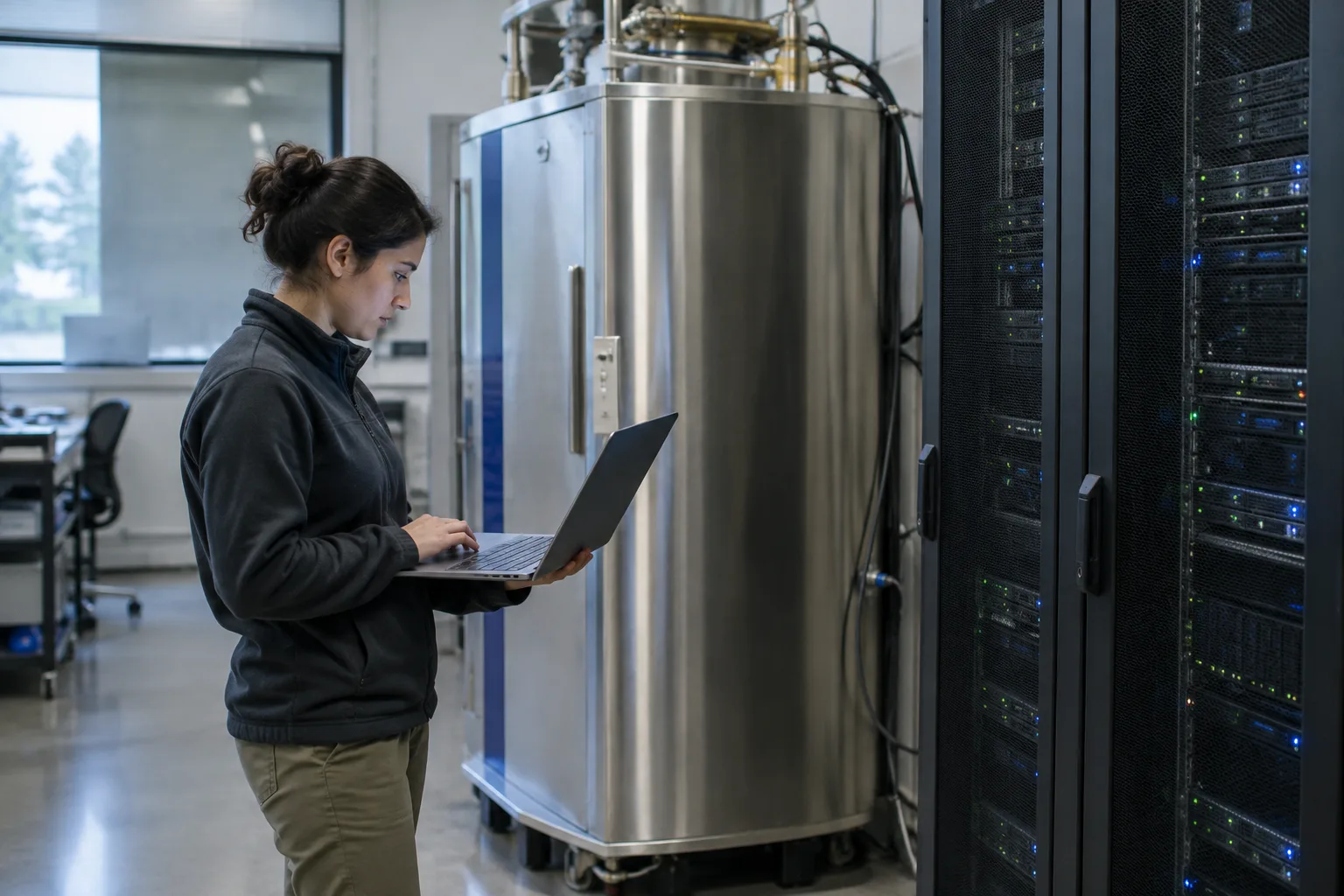

Cerebras Systems delivered record third-quarter revenue and lifted its full-year outlook, but the most important part of the report was not the headline sales number. It was the evidence that Cerebras is trying to turn a specialized AI chip into something closer to a cloud-capacity business: recurring inference services, hyperscaler channels, and contracted data-center power that can be sold as usable compute.
That matters because the real question around Cerebras is no longer whether its wafer-scale processor is unusual or even fast on selected workloads. It is whether customers that want an alternative to Nvidia can actually buy, deploy, and keep using Cerebras capacity at scale — and whether Cerebras can do that without giving away the economics in hosting costs, underused capacity, and customer concentration.
Cerebras reported Q3 GAAP revenue of $210.8 million, up 55% from a year earlier, and raised its 2026 adjusted-revenue outlook to $940 million to $960 million from $880 million to $890 million. GAAP cloud and other services revenue reached $141.9 million, up 265% year over year. In other words, more than half of reported revenue came from the services side of the business, not just box sales.
From hardware vendor to inference utility
That mix shift is the story. Cerebras still sells systems directly, but its model now also includes Cerebras Cloud and third-party cloud providers. The company said it won two new hyperscaler customers in the quarter and had 700 megawatts of data-center capacity under contract.
For an AI-infrastructure company, that is a different claim from saying its chip is better. It suggests Cerebras is trying to secure the ingredients of a capacity business: power, hosting, software integration, and more routes to market. Its wafer-scale design — built around a very large processor with extensive on-chip memory — can matter most when customers care about fast, low-latency inference rather than general-purpose training capacity. But that technical proposition only turns into a business if customers can reach it as a service, not just as a hardware installation.
The quarter gives some support to that transition. Cloud and other-services revenue grew far faster than the company overall, and management said Cerebras was the first to deliver what it calls a production-scale heterogeneous, disaggregated inference offering. Reuters reported that Cerebras also signed Microsoft as a cloud customer, with details expected next year. That does not tell readers the scale of the deployment, but it does signal that the company is starting to appear in larger buyers’ cloud plans.
The more realistic near-term bull case, then, is not that Cerebras suddenly displaces Nvidia across AI. It is that Cerebras becomes a credible second source for certain inference jobs: an extra supply lane for model providers, enterprise customers, or cloud operators that want lower latency, different economics, or another vendor in a market still constrained by cost and power.
The revenue jump is real; the economics are still unsettled
The company’s numbers show genuine demand, not just laboratory ambition. Core revenue, Cerebras’s non-GAAP measure, reached $230.9 million. Reuters said that beat a $214.70 million analyst consensus, and the company posted an adjusted Q3 profit of $29.82 million versus an adjusted loss a year earlier. The market reacted accordingly, sending the shares sharply higher after the report.
But the same filings show why this is still a proving-ground story rather than a completed turnaround. Cerebras’s GAAP gross margin was 20% in the quarter, and GAAP operating margin was negative 106%. Its Form 10-Q shows hardware gross margin at 11% and cloud-and-other-services gross margin at 24%. Research and development spending was $177.8 million, equal to 84% of GAAP revenue.
Those figures matter because a services-heavy AI business can look stronger on growth before it looks better on profit. Cloud revenue can be recurring and easier for customers to adopt, but it also pulls in rental, hosting, support, networking, and utilization risk. Even a 24% gross margin in cloud services is not yet the kind of margin that settles the long-term case on its own, especially when operating expenses remain so high. And hardware at 11% gross margin is still a weak base from which to finance rapid expansion.
There is also a comparability issue worth keeping straight. Cerebras’s Core revenue excludes items including customer-warrant amortization, stock-based compensation, and certain data-center pass-through revenue and costs. That can be useful for management’s view of operating progress, but it is not the same thing as GAAP revenue, and it does not erase the burden of building and servicing capacity.
Capacity, concentration, and timing are the real tests now
The strongest argument for Cerebras is that customers seem willing to commit ahead of broad proof. Reuters reported that an OpenAI deal underpinned $26.1 billion of remaining performance obligations as of Sept. 30, while Microsoft has now appeared as another cloud customer and Oracle is expected to launch an inference service using Cerebras hardware in its data centers in summer 2027.
That is a powerful setup if even part of it converts smoothly into delivered capacity and recurring use. Large anchor customers can help fill new infrastructure, validate the software stack, and make it easier to win follow-on business.
It also concentrates risk. Public materials do not show how much of that $26.1 billion will be recognized in which periods, how much revenue is tied to OpenAI versus other customers, or what protections exist around delivery or cancellation. Likewise, “700 megawatts under contract” sounds enormous, but it does not tell readers how much power is already supporting live workloads, how quickly sites can be brought online, or how much of that capacity is earmarked for Cerebras Cloud versus customer-owned deployments.
That is why the practical scorecard for the next few quarters is narrower than the headlines. Investors and enterprise buyers should watch for delivered capacity rather than contracted megawatts, utilization rather than reservations, cloud gross margin after hosting costs, and signs that revenue broadens beyond a small number of counterparties. An independent, workload-level view of total cost per useful token would also matter more than any single speed claim.
For now, Cerebras looks more credible as a second-source inference platform than it did a quarter ago. Record revenue, a higher 2026 outlook, fast cloud growth, and a reported Microsoft cloud deal are meaningful proof points. But the company has not yet answered the harder commercial question: whether those commitments can be turned into operational, diversified, and profitable inference capacity at scale. That is the threshold between an interesting chip company and a durable AI-infrastructure provider.

 By

 By


 By

 By


 By