
Samsung Electronics is reported to be in talks to acquire Modine Manufacturing, the U.S.-listed maker of data-center cooling equipment, a development that matters less as a stock-market jolt than as a sign of where the AI infrastructure race is moving next. According to a Reuters report citing Bloomberg News and people familiar with the matter, the companies have discussed a potential transaction that could come together within weeks. There is no announced agreement, and the talks could still fall apart.
The real question for customers, suppliers and investors is not whether the rumor briefly lifted Modine shares by about 29% in extended trading, or even that Reuters put the company’s market value at roughly $5.6 billion based on its Thursday close. It is whether AI infrastructure is forcing strategic control downward, from chips and servers into cooling systems, controls and plant capacity — the unglamorous layer that determines whether high-density racks can actually be deployed.
Why Modine matters now
Modine is not just another industrial target catching an AI halo. In its November 3 quarterly results for the period ended September 30, the company reported $994.4 million in net sales, up 35% from a year earlier, and $30.3 million in net earnings. The sharper signal came from data centers: that segment generated $439.7 million in sales, up 95% from $225.0 million a year earlier, driven primarily by stronger North American hyperscale demand.
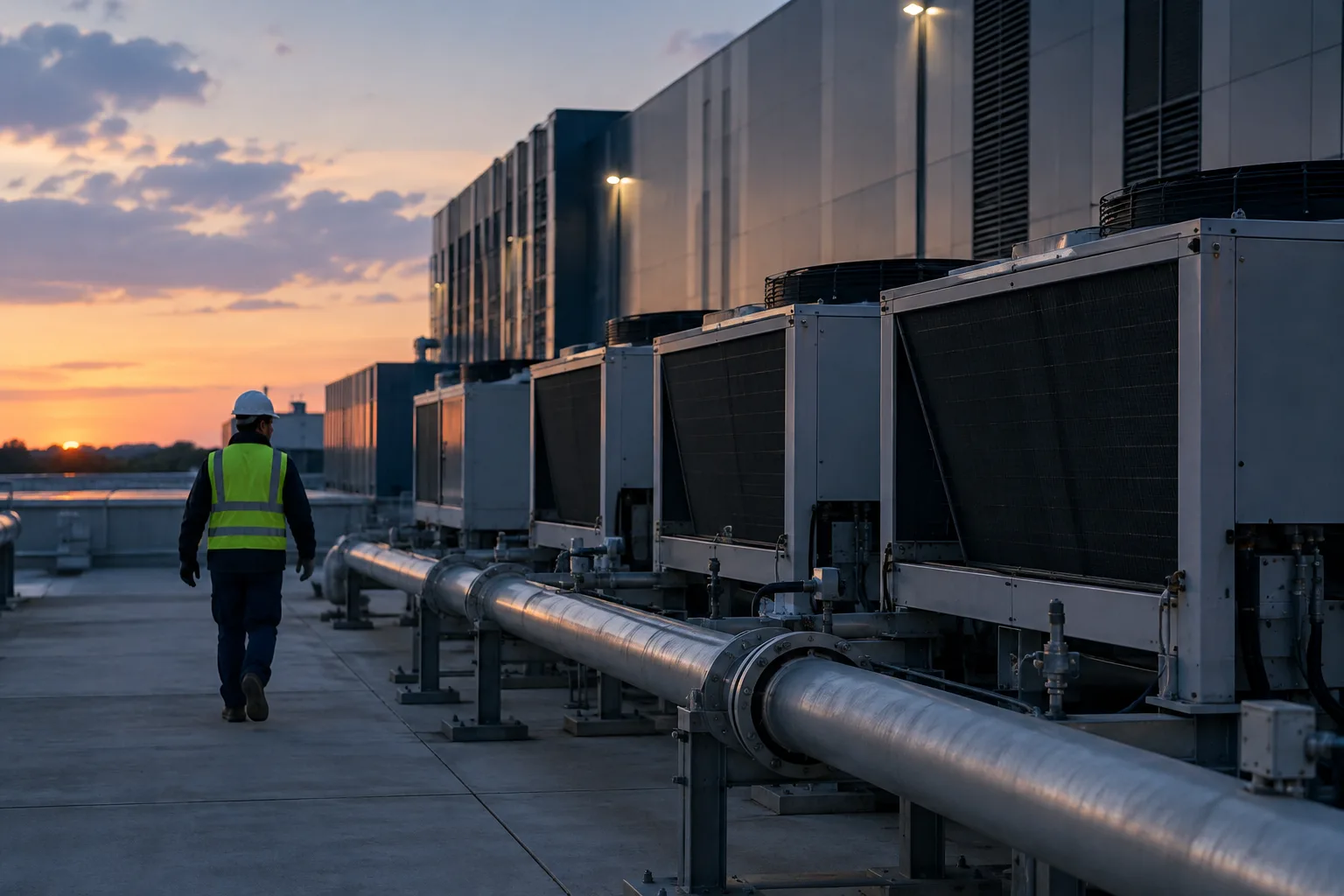
That growth helps explain why a buyer would care. Modine sits in the part of the stack where AI demand becomes physical constraint. Its product list spans chillers, dry coolers, precision air handlers, CRAC and CRAH systems, fan walls, rear-door heat exchangers, coolant distribution units, immersion solutions, modular data centers, controls, parts and maintenance. In other words, it supplies much of the thermal hardware and support needed once compute density rises and heat removal becomes a gating factor.
The company has also been reshaping itself around that opportunity. On April 1, it split Climate Solutions into separate Data Centers and Commercial HVAC segments. On October 1, it completed the spin-off and combination of its Performance Technologies business with Gentherm, pushing Modine toward a purer climate-solutions profile. That matters because Samsung, if it is exploring a deal, would be looking at a business increasingly defined by thermal management rather than a more diversified industrial portfolio.
Demand visibility is another attraction. In May, Modine announced a long-term capacity agreement with an unnamed strategic data-center customer covering more than $4 billion of Airedale cooling products from calendar 2027 through 2029. The customer paid $165 million upfront to support capacity investments. That does not identify Samsung as the customer or prove anything about these reported talks. It does show that hyperscale buyers are willing to prepay to secure cooling output.
What Samsung would actually be buying
If Samsung is pursuing Modine for strategic reasons rather than simply financial interest, the logic is vertical integration around a bottleneck. AI buildouts require more than accelerators and memory. They need thermal systems that can be qualified, manufactured, delivered and serviced at scale, often under tight power and water constraints. Ownership could, in principle, give Samsung access to scarce capacity, engineering know-how and customer relationships in a layer of the market that increasingly influences deployment schedules.
That would fit the broader industrial mood around AI. As rack densities rise, cooling stops being a commodity purchase made late in the process and becomes part of the core design problem. A company with major electronics and memory businesses could see value in coordinating thermal design more closely with servers, components and facility planning.
But the public numbers also show why such a deal would not be a simple “buy capacity, solve bottleneck” story. Modine’s Data Centers gross margin was 19.7% in the latest quarter, down 470 basis points from a year earlier because of higher material, component and tariff costs. The company said it had entered long-term supplier agreements to secure critical components for backlog and future business. That is a reminder that demand is outrunning parts of the supply chain. Buying Modine would not automatically create more chillers, liquid-cooling systems, skilled field technicians or constrained components. Integration itself could become a distraction while customers are pressing for delivery.
What customers and competitors should watch
For data-center operators and cloud planners, the best-case outcome from a buyer’s perspective is more investment and tighter execution: more factory capacity, stronger component commitments and faster coordination between compute design and heat removal. If Samsung brought capital, manufacturing discipline or customer reach, some buyers could benefit.
The risks run the other way. Once a neutral supplier is owned by a large technology company, customers will want to know whether output remains broadly available, whether lead times shift toward favored accounts, and whether pricing power increases. Rivals would watch for bundling risk: not only whether Samsung could pair thermal systems with other infrastructure offerings, but whether customers would feel pressure to take a larger package to secure scarce cooling capacity.
That is why the unanswered questions matter more than the rumor premium. There is no disclosed offer price, financing plan, exclusivity agreement or regulatory path. There is no public indication of whether Samsung would preserve Modine’s management structure and customer relationships, or whether it would try to integrate the business more tightly into existing operations. There is also no public breakdown of Modine’s backlog economics, customer concentration or the specific capacity additions required to fulfill its multiyear commitments.
Those unknowns are especially important because Modine looks valuable partly for reasons that also make it hard to absorb: fast growth, customer-specific engineering, manufacturing expansion and supply tightness. The strategic case is credible because the operating data are real. The execution risk is just as real for the same reason.
Modine’s November 18 Analyst and Investor Day may help investors judge the standalone alternative. If management lays out a convincing multiyear expansion plan after the spin-off, the question becomes whether a buyer adds enough capital, capacity confidence or commercial advantage to justify surrendering independence. If the plan instead highlights how demanding the next phase of growth will be, the appeal of a deep-pocketed owner becomes easier to understand.
Until there is a confirmed offer, the most useful way to read the report is not as a completed deal but as evidence of where pressure is building in the AI supply chain. Chips may capture the headlines, but cooling is where many deployments are won, delayed or repriced. If Samsung is circling Modine, the significance is not merely who owns one supplier. It is whether thermal management is becoming a controlled strategic layer of the AI stack.
 By

 By

 By

 By

 By