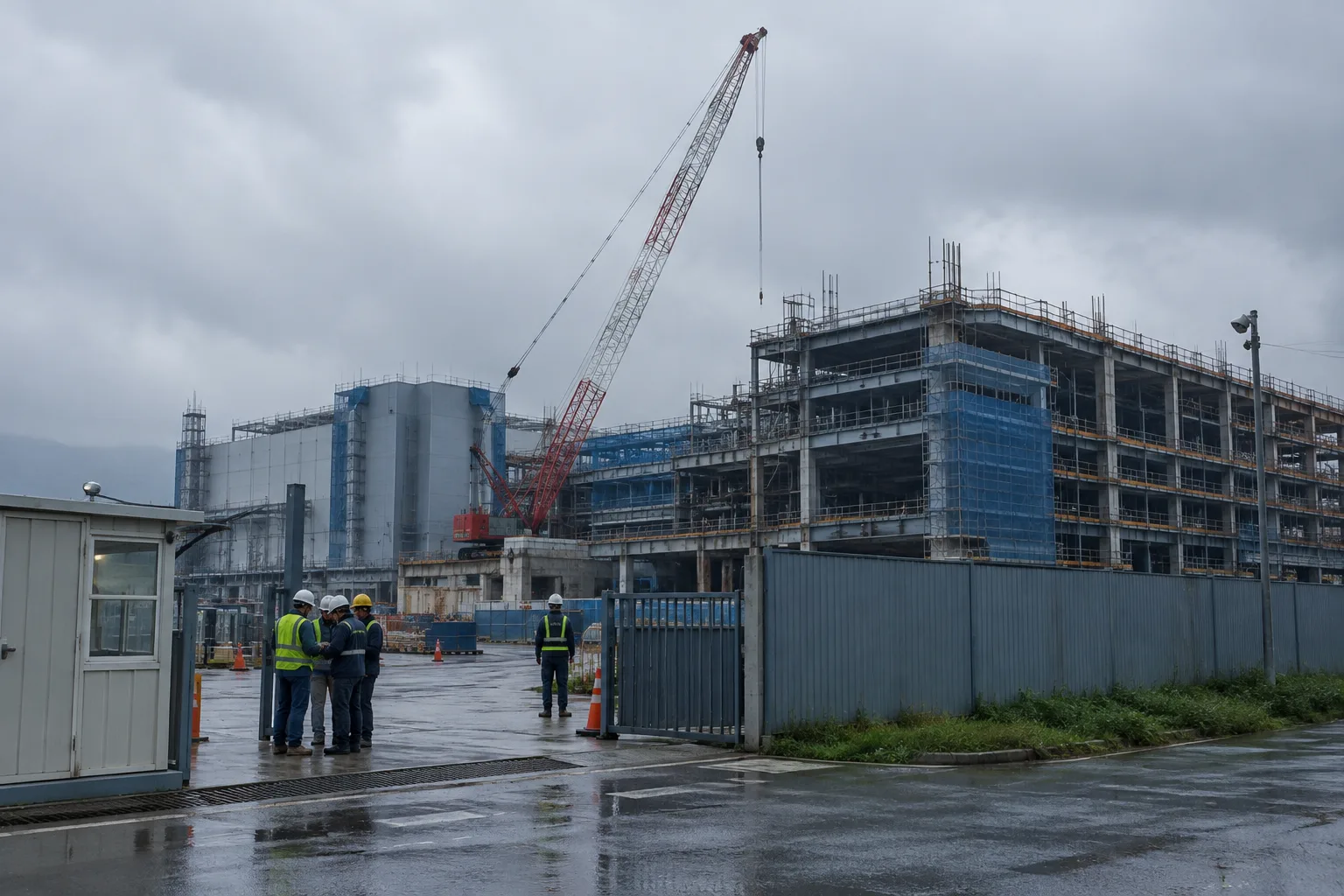

Bloomberg reported on Nov. 5 that Micron Technology has all but halted construction activity at a planned memory-chip facility in Taoyuan, Taiwan, after a prolonged dispute with the local labor union over profit-sharing. Micron has not directly confirmed a project suspension. Instead, in a Nov. 6 statement reported in Taiwan, the company said its Taiwan operations were continuing as normal, that it could maintain stable operations in Taoyuan without disrupting customers, and that it would continue negotiations with the Taoyuan workers’ union.
That difference matters. The story is not that Micron has shut down Taiwan, missed customer shipments, or canceled a fab. The real question is narrower and more consequential: can an unresolved labor dispute at a planned memory site push future AI-memory capacity far enough to the right that it starts to matter for customers, equipment suppliers, and Micron’s own expansion plans?
The most useful answer, on the public record so far, is: not yet for current customers, but potentially yes for the next wave of capacity.
Three clocks are running at once
The first clock is labor. Focus Taiwan reported that Micron employs about 3,000 people in Taoyuan, with roughly 2,400 union members, and about 12,300 in Taichung, with roughly 11,000 union members there. Those numbers make the Taoyuan dispute more than a symbolic skirmish. The local union wants a specific, durable profit-sharing program rather than relying only on discretionary bonuses. Workers staged a one-day symbolic strike in Taoyuan on Oct. 22, and while Micron later reached an agreement with the larger Taichung union, that deal did not settle the Taoyuan talks.
The second clock is construction and equipment. The reported pause affects Fab 11E, a project described in public reporting as roughly a $3 billion to $4.5 billion investment and associated with planned high-end tool purchases, including ASML equipment. No public source in the research packet confirms whether major orders were canceled, delayed, or left intact. But in semiconductors, hesitation itself can be costly. A fab is not just a building; it is a sequence: cleanroom work, utilities, tool installation, process qualification, technician hiring, yield learning, packaging coordination, and customer qualification. Lose time early, and the delay can compound long before any buyer sees a missed shipment.
The third clock is demand. The products expected from the Taoyuan expansion are HBM and DRAM, the memory categories most exposed to AI-server growth. In Micron’s fiscal Q3 2026 prepared remarks, the company said it expects supply-demand conditions for DRAM and NAND to remain tight beyond calendar 2027. It also said strategic customer agreements represent about $100 billion of remaining commitments, alongside roughly $22 billion of expected cash deposits and related financial commitments, while noting those figures are based on minimum volumes and pricing rather than total future revenue. In other words, Micron is already planning against a tight market. Any slip in planned capacity matters more in that context than it would in a loose one.
A reported pause does not equal a supply shock — but it can become one
Micron’s statement that current Taiwan operations remain normal is important counterweight to the Bloomberg report. Most of the company’s Taiwan production base is in Taichung, not Taoyuan, and the Taichung union has reached an agreement. Taiwan’s Ministry of Economic Affairs has also said it will help facilitate negotiations. Those facts lower the odds of an immediate customer outage.
But they do not answer the more strategic question: whether the Taoyuan project was supposed to add capacity on a timetable that customers, suppliers, and Micron’s own internal plans were already counting on.
That is where the mechanics matter. HBM supply is constrained by much more than announced fab spending. Wafer starts, process technology, testing, packaging, and yield ramp all have to line up. If Taoyuan slips, the first visible effect may be a later ramp rather than a near-term shortage. Yet later ramps are exactly how future shortages begin. Cloud operators, AI-chip designers, server makers, and device manufacturers plan around expected memory availability well before the first wafer ships. Uncertainty alone can affect pricing, purchasing, and inventory behavior.
There is also a governance lesson here. In a strong AI cycle, the value created by memory companies is rising sharply, and workers are asking for a transparent share of that upside. A one-time bonus can help retention in the short term, but it does not create a repeatable formula. For management, that raises a harder calculation than a simple wage-cost debate: is a durable profit-sharing framework cheaper than the risk of construction pauses, tougher staffing, and strained local relationships at a site meant to support multiyear output?
Can Micron route around Taoyuan?
Micron is not standing still elsewhere. Its own remarks say the Idaho ID1 fab remains on track for first wafer output in mid-2027, ID2 in late 2028, the Tongluo site in Taiwan is expected to support meaningful shipments in mid-2027, and construction timelines in Japan and Singapore are on track. Singapore is also expected to contribute meaningfully to HBM packaging capacity in the first half of 2027.
Those projects give Micron options, but not perfect substitutes. They do not automatically replace Taoyuan on the same node, with the same supplier timing, the same workforce, or the same packaging and qualification path. Equipment lead times are long. Skilled labor is local. Packaging ramps are their own bottleneck. Taiwan is already a critical node in Micron’s memory footprint, and shifting a delayed project to another geography is not something a chipmaker does on short notice.
So what should readers watch next? First, whether Micron says anything more specific about Fab 11E in a filing, investor event, or updated capital-spending discussion. Second, whether city- or ministry-facilitated talks produce a Taoyuan labor agreement with a defined profit-sharing structure. Third, whether there is any confirmed decision on long-lead equipment orders. And fourth, whether Micron begins talking about revised timing instead of just stable current operations.
Until then, the best way to read the situation is as a labor-risk signal at the center of the AI-memory buildout. It is not proof that Micron has lost output or that a global HBM crunch has already worsened. It is proof that future semiconductor capacity depends on more than capex headlines and technology roadmaps. In AI memory, the workforce is part of the supply chain.

 By

 By

 By

 By