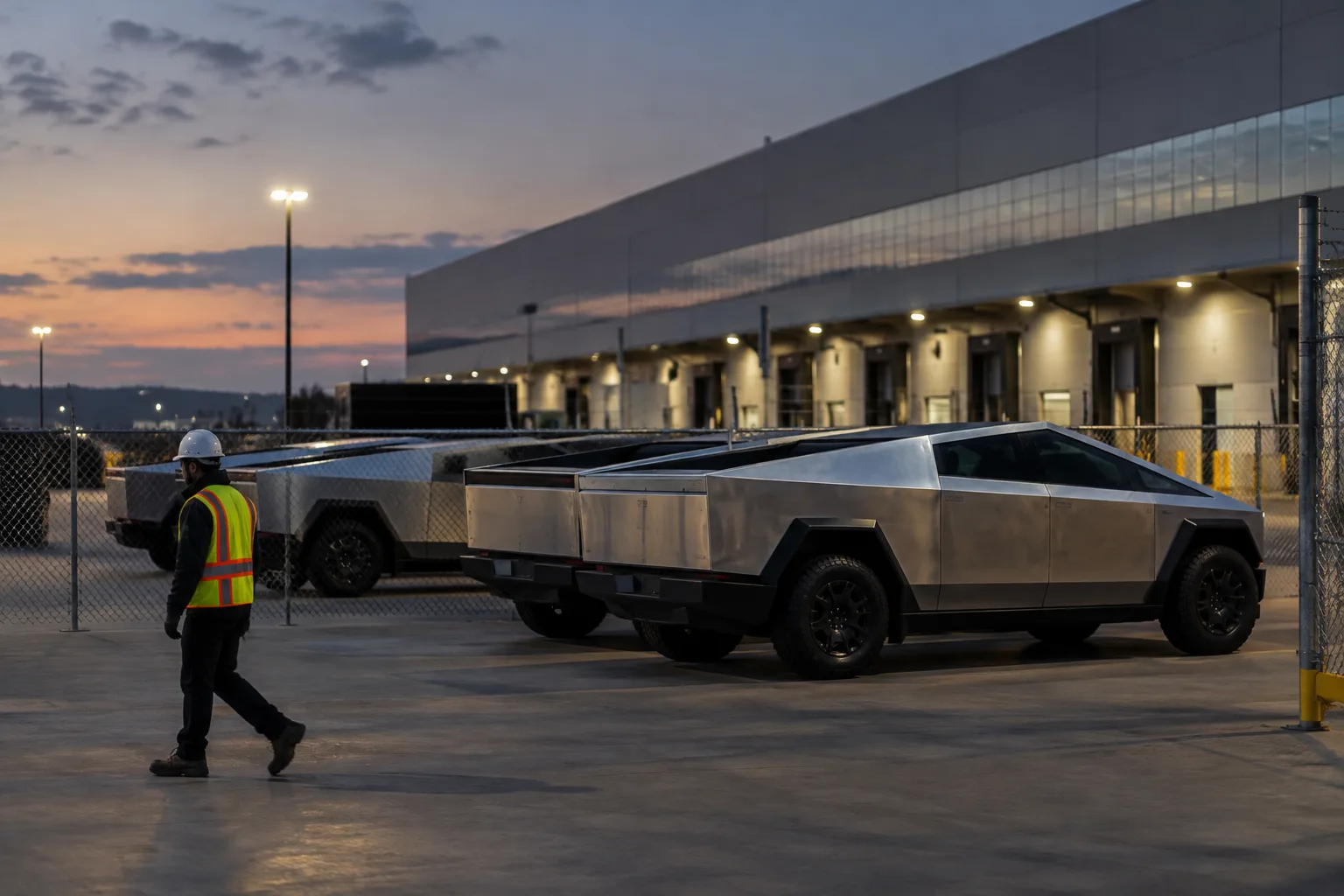

Tesla plans to wind down Cybertruck production at Gigafactory Texas around the middle of 2027 so it can increase Cybercab production there, CEO Elon Musk wrote on X on Nov. 6. Reuters and the Associated Press separately reported the same timing and rationale. The immediate headline is about a pickup truck. The more important business story is about factory capacity: Tesla is choosing to take space, labor and manufacturing attention away from one of its most distinctive consumer vehicles and redirect them toward its robotaxi strategy.
That makes the real question fairly straightforward. Is this a rational reallocation from a weakly scaled vehicle line into a higher-potential business, or is Tesla swapping a difficult but familiar auto market for a much less proven autonomy-led one?
This is a factory decision before it is a product verdict
Musk’s wording matters. He said Cybertruck production at Gigafactory Texas will be winding down around mid-2027. That is not the same as a formal global cancellation, and Tesla has not published a separate end-of-production date, a customer notice, or a statement saying the vehicle will not be built anywhere else. In the reporting cited here, however, the Austin-area plant is the only factory identified as making the Cybertruck, and Tesla’s stated plan is to use the freed capacity for Cybercab rather than to add another Cybertruck line.
That distinction matters because a vehicle program is bigger than the badge on the tailgate. Shrinking or ending a line affects tooling, supplier contracts, body structures, battery packs, software validation, service parts, warranty support and the workforce that knows how to build and repair the vehicle. A retooling decision is also an opportunity-cost decision. Floor space committed to Cybertruck cannot simultaneously be used for Cybercab, Semi or another passenger vehicle at the same scale.
Seen that way, Tesla is not just making a statement about demand. It is making a capital-allocation choice about what deserves room inside one of its most important factories.
What Tesla is giving up
The Cybertruck was unveiled in November 2019 and began customer deliveries in November 2023 after delays. Tesla marketed it as a futuristic electric pickup aimed at a category long dominated by established truck makers. It also became a symbolically important product for the company: unusual design, difficult manufacturing, high visibility.
What Tesla has never provided publicly is a clean model-by-model read on how that symbolism translated into sustained volume. Tesla does not break out Cybertruck deliveries in its quarterly delivery table. In Tesla’s Q3 2026 operational update, the company reported 486,532 total vehicle deliveries, including 478,237 Model 3/Y deliveries and 8,295 deliveries for “Other Models,” a category down 48% from a year earlier. That number is a real warning sign for Tesla’s lower-volume products, but it is not a verified Cybertruck total. “Other Models” can include Cybertruck, Semi and remaining Model S/X inventory.
So the available evidence supports a narrower conclusion. Cybertruck appears to have fallen well short of the scale implied by its launch ambition, but the public data still do not prove exactly how much of the weakness sits with the truck itself.
Even without a clean sales line, the industrial logic is understandable. Low-volume products can consume a disproportionate share of factory complexity. Unique body panels, specialized parts, engineering support and dedicated service knowledge are all expensive if volumes stay modest. A pickup that does not become a major profit and scale contributor can tie up suppliers and skilled labor that management may prefer to redirect.
That does not make the Cybertruck irrelevant. It can still matter as a brand and technology platform. But Tesla’s Texas move suggests the company no longer sees the truck as the best use of that plant’s next increment of capacity.
What Tesla hopes Cybercab can do instead
Tesla’s Q3 filing says the company rolled out Cybercab in September 2026 and has been expanding a service-driven robotaxi model. That is the positive case for the pivot. If Tesla can turn the same factory footprint into vehicles that support a recurring mobility service rather than one-time retail sales, the economics could improve materially. More utilization per vehicle, more revenue opportunities over time and a tighter link between manufacturing and service operations are the strategic attractions.
But the missing pieces are substantial. Tesla’s public materials do not establish Cybercab’s production rate, profitability or regulatory status after the rollout. They do not show whether the robotaxi service can scale safely and repeatably, what the maintenance burden looks like, how insurance and liability will work at meaningful volume, or whether demand will support the kind of fleet utilization that would justify giving up Cybertruck capacity.
That is why the announcement should be read as a test, not a proof. Reallocating a line can be rational before the replacement business is mature. Companies do that all the time. But the burden shifts quickly from product vision to operating evidence. Cybercab must eventually earn more per square foot and per skilled worker than the truck line it displaces.
The unresolved costs for owners, workers and suppliers
Tesla has not yet addressed several practical questions that matter more than the cultural debate around the Cybertruck. For current and prospective owners, the big issues are parts availability, software updates, warranty support, continued engineering attention and resale values if the model becomes a low-volume vehicle. A wind-down does not automatically mean support disappears, but Tesla has not published a parts-and-service commitment tied to this plan.
For Austin-area workers and suppliers, the key issue is the shape of the transition. Retooling can preserve jobs if the incoming product scales quickly; it can also create turbulence if production schedules, parts orders or training needs change faster than Cybercab demand develops.
For investors, the practical scoreboard is also clear. They need more than a factory announcement. The most useful next disclosures would be Cybertruck backlog and unit economics, the scope and cost of the Texas retooling, Cybercab production targets, regulatory milestones and evidence that the robotaxi model can produce repeatable demand rather than a promising pilot.
For now, Tesla has made one thing plain: it believes the next best use of Gigafactory Texas is not more Cybertruck. Whether that looks prescient or premature will depend on what Cybercab becomes after the floor space is freed.
 By

 By

 By

 By