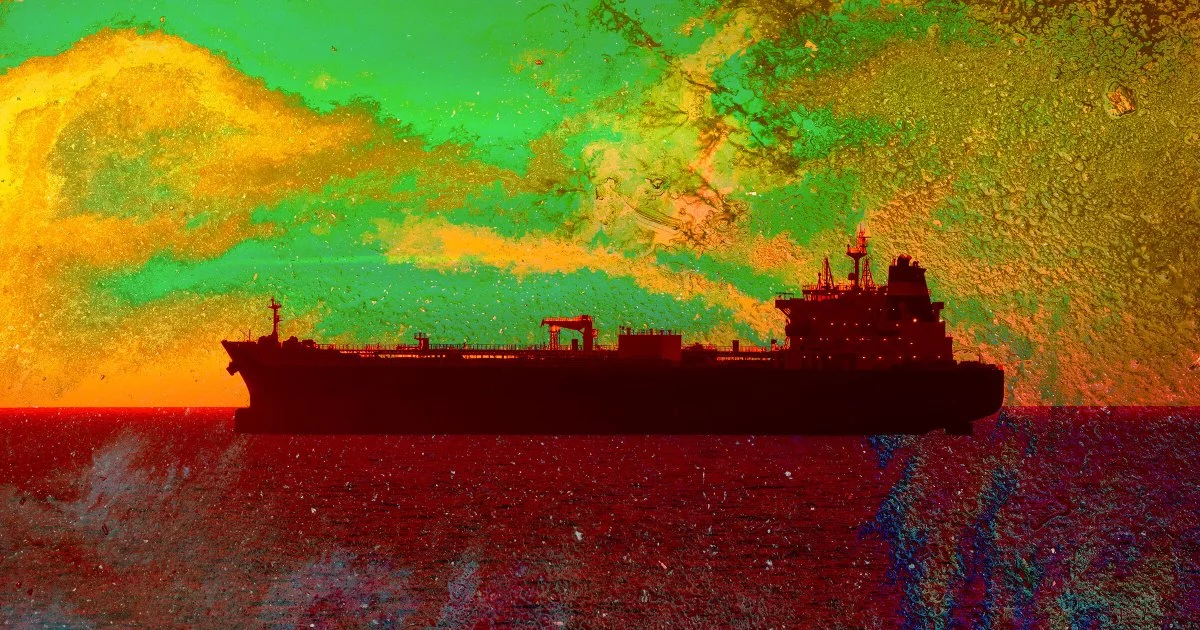

A drifting crisis at the crossroads of energy security and marine stewardship
The unfolding spill from the oil tanker Caroline Bezengi has become a case study in how modern energy logistics can collide with fragile environmental zones—and how quickly accountability can evaporate in contested waters. After an onboard blast on June 8, the vessel—carrying roughly 800,000 barrels of Russian crude—ultimately ran aground on June 30 near Oman’s Al Hallaniyat Islands, a marine nature reserve with potential UNESCO designation. Over the ensuing weeks, the wreck has discharged an expanding oil slick now reported to exceed 2,000 km², with experts warning that further hull fragmentation could trigger a far larger release—up to 50 million gallons in a worst-case scenario.
What makes this incident especially consequential is not only the scale of the spill risk, but the governance vacuum surrounding it. The ship’s Cameroonian flag, the operational complexity of a war-zone corridor, and the absence of a clearly empowered lead agency have combined into a familiar but still alarming pattern: a major maritime casualty where jurisdictional ambiguity becomes operational paralysis. For coastal states, insurers, energy traders, and technology providers, the Caroline Bezengi spill is less an isolated accident than a stress test of the global system that moves oil across geopolitically fraught sea lanes.
Remote sensing proves its value—while response coordination lags behind
One of the clearest takeaways is the growing centrality of real-time geospatial intelligence in environmental crisis management. Satellite imagery and synthetic-aperture radar (SAR) have been indispensable for tracking the slick’s growth and direction, especially when on-scene access is constrained by weather, distance, or security conditions. In practical terms, this is what modern spill response increasingly looks like: space-enabled situational awareness feeding decision-making on containment, fisheries closures, and shoreline protection.
Yet the same episode also exposes a structural weakness: detection is outpacing coordination. Monitoring may be technically sophisticated, but alerting and mobilization remain fragmented across NGOs, flag states, coastal governments, and commercial stakeholders. The result is a critical delay window—precisely when containment is most effective.
From a technology and operations perspective, the incident highlights several pressure points:
- Open-sea containment limits: Traditional booms and skimmers are often ill-suited to rougher offshore conditions, and their deployment becomes even harder when authority to act is unclear.
- Scaling gap for emerging tools: Autonomous surface vessels, hydrocyclone separators, and advanced sorbent materials are promising, but they are not yet integrated into standing international rapid-response fleets at meaningful scale.
- Next-generation risk monitoring: In high-risk corridors, ship operators and charterers are being pushed toward continuous hull-integrity monitoring, blast-detection sensors, and AI-driven anomaly detection—capabilities that are common in other critical infrastructure sectors but unevenly adopted in shipping.
The strategic implication is straightforward: maritime safety is no longer just a shipboard engineering discipline. It is becoming a data-and-response ecosystem problem, where the weakest link may be governance, not hardware.
Sanctions-era trade routes, insurance exposure, and the cost of uncertainty
The cargo itself—Russian crude—anchors the spill in the broader reconfiguration of global energy flows under sanctions dynamics. As Russian exports are rerouted away from traditional European buyers, longer and more complex maritime routes gain prominence, often passing through chokepoints where security risks, enforcement ambiguity, and political sensitivities are elevated. The Gulf of Aden corridor and adjacent waters have become emblematic of this new reality: essential to energy trade, yet persistently exposed to disruption.
For markets, the spill’s significance extends beyond environmental damage. Any prolonged disruption or heightened perceived risk in the region can feed into:
- Freight rate volatility, particularly for tankers transiting contested corridors
- War-risk and pollution-liability premium increases, as insurers price in both physical risk and the legal uncertainty of delayed responsibility
- Knock-on effects for charter rates and commodity mark-ups, with intermediaries facing tighter credit conditions when liabilities are unclear
This is where the incident becomes a board-level issue. The cost of capital and the cost of coverage are increasingly tied to whether firms can demonstrate robust risk governance—especially under ESG-driven scrutiny. Institutional investors are watching not just the spill, but the quality of disclosure, preparedness, and accountability across the shipping and energy value chain.
The accountability gap: flags of convenience meet fragile international enforcement
The Caroline Bezengi spill underscores a recurring weakness in maritime governance: when a vessel operates under a flag of convenience and suffers a casualty in politically complex waters, the path to decisive action can become tangled in overlapping mandates and diluted responsibility. While frameworks such as UNCLOS and MARPOL set out principles for environmental protection and pollution prevention, the practical enforcement and rapid-response financing mechanisms can falter when no single actor has both the authority and the incentive to lead.
Several governance deficits stand out:
- No pre-positioned pooled response capacity among neighboring littoral states, despite the region’s strategic importance
- Slow-moving liability chains, where compensation and cleanup funding may depend on protracted claims and contested jurisdiction
- Limited transparency on ownership and maintenance history, complicating due diligence and delaying accountability
This is precisely where business and technology intersect with policy. Digital tools—such as blockchain-based registries for cargo provenance and vessel ownership, and digital twins for structural integrity and maintenance logs—offer a pathway to reduce ambiguity. But technology alone cannot substitute for standing agreements, shared resources, and enforceable rules that function under stress.
The spill near Al Hallaniyat is also a reminder that environmental harm is not abstract. Hydrocarbon exposure can destabilize food webs for decades, while coastal communities dependent on artisanal fishing face immediate income shocks and public-health concerns from contaminated seafood. In a region where tourism and conservation value are rising, reputational damage will likely attach not only to the ship and its operators, but to the broader ecosystem of charterers, insurers, and regulators seen as slow to act.
The Caroline Bezengi incident is shaping up as a defining signal of the sanctions-era maritime economy: energy continues to move, but the governance and response architecture has not kept pace with the risk.

 By
By

 By
By
 By
By
 By
By

 By
By